

Not long ago, sleeping in your car meant a reclined seat, a cracked window, and a fog of engine exhaust cutting through an otherwise peaceful night outdoors. For millions of Americans who own a Tesla today, that picture has been retired entirely. Car camping has quietly undergone one of the most dramatic reinventions in the history of outdoor recreation, and the vehicle responsible is not a truck kitted out with aftermarket gear. It is a mainstream electric vehicle that most owners bought for the daily commute.
Tesla’s Camp Mode, Powershare technology, and the growing ecosystem of purpose-built camping accessories have collectively transformed the brand’s lineup into something the outdoor industry had not anticipated: a legitimate, climate-controlled, zero-emission camping platform that does not require a campfire to stay warm or a gas generator to stay charged.
What Camp Mode Actually Does
Camp Mode is the foundation of the Tesla camping experience, and it is simpler than most new owners expect. With the car in Park, you open the Climate menu on the touchscreen and tap the Camp option in the mode row. The system takes over from there.
What Camp Mode keeps running throughout the night is substantial. Climate control, including the heat pump on newer models, maintains whatever cabin temperature you set. Interior lighting stays on at whatever brightness you choose. USB ports remain powered, so phones, tablets, and small devices charge through the night. The 15-inch touchscreen stays on, dimmed, displaying a gently animated campfire that has become something of a signature for Tesla overnight stays. Sentry Mode is automatically suspended, meaning the car’s motion-detection cameras will not trigger alerts every time you roll over inside the cabin. Auto-lock is disabled so you can move freely in and out without fighting the car’s security system.
More Read

Crucially, none of this requires a running engine. There is no exhaust. There is no carbon monoxide risk. In national parks, wilderness areas, or any space where idling is prohibited or simply disrespectful, a Tesla in Camp Mode produces no emissions and, apart from the near-silent hum of the climate system, virtually no noise.
Battery consumption is one of the most common questions from first-time Tesla campers, and the honest answer is that it is remarkably modest under typical conditions. In mild weather, around 60 to 70 degrees Fahrenheit, an eight to ten hour overnight in Camp Mode typically draws between five and fifteen percent of the battery, depending on the model and the temperature differential between the cabin target and the outside air. The heat pump in newer Model Y Juniper units is particularly efficient. Real-world owner data consistently shows that a Model Y starting the night at sixty percent charge and running Camp Mode at a comfortable temperature will have plenty of range left to drive to the nearest Supercharger in the morning.
Cold weather is where the math shifts. Below freezing, the battery works harder to maintain a comfortable cabin temperature, and owners routinely report overnight draws of twenty to thirty percent in sub-freezing conditions. The practical rule of thumb that has emerged from the Tesla camping community is straightforward: do not start the night below twenty-five percent state of charge unless you are plugged in.
The Model Lineup and How Each One Camps
Not every Tesla camps the same way, and the differences matter enough to shape which model a dedicated car camper might choose.
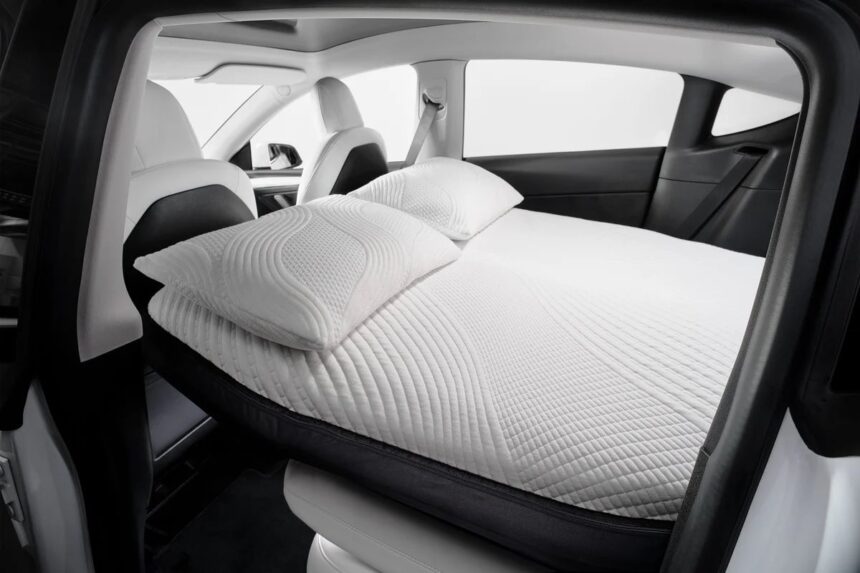
The Model Y has emerged as the undisputed favorite among the Tesla camping community. With the rear seats folded flat, it provides a sleeping platform approximately seventy-five inches long and forty-one inches wide, enough for two adults if at least one is under six-foot-two. The cargo floor does have a slight step and a gentle slope at the rear seatback junction, which is why a purpose-fit contour mattress has become nearly essential gear for comfortable overnight use. Aftermarket mattress makers have built a small industry around this specific geometry. The panoramic glass roof provides a genuinely extraordinary view of a star-filled sky and has become one of the most talked-about aspects of the Tesla camping experience, though it requires window shades for privacy and heat management.
The Model X provides the most generous interior space of any Tesla for sleeping, particularly in the five-seat configuration with both rear rows folded. The headroom is exceptional, and the falcon-wing doors make loading gear in and out of tight campsite spaces dramatically easier than any conventional SUV. The tradeoff is price and a slightly higher per-night battery draw given the larger cabin volume.
The Cybertruck occupies a different category altogether. Its cabin does not fold into a flat sleeping surface the way the crossovers do, which makes it the most awkward of the Tesla lineup for sleeping inside the vehicle itself. What it offers instead is the pickup truck bed, marketed as the Vault, and a camping power capability that no other Tesla can match.
Cybertruck’s Powershare: A Generator You Never Have to Refuel
More Read

If Camp Mode is the feature that makes sleeping in a Tesla comfortable, Powershare is the feature that makes camping in a Cybertruck a fundamentally different experience from any other vehicle on the market. The Cybertruck delivers up to 9.6 kilowatts of continuous power through a combination of 240-volt and 120-volt outlets in the cargo bed and 120-volt outlets in the rear cabin, all drawing from the truck’s main battery pack.
To put 9.6 kilowatts in practical context: it is enough to simultaneously run an induction cooktop, a string of LED lighting, a portable refrigerator, a Starlink satellite internet terminal, and a full climate setup for an attached tent, all without a gas generator, all in silence. Real-world testing by owners running the full Powershare load has recorded running a complete campsite for 48 hours while drawing only eight percent of the battery pack, an extraordinary result that speaks to how large the Cybertruck’s usable energy reserve actually is.
The system requires setup before leaving home. Under Controls on the touchscreen, owners navigate to Powershare and activate the feature, then set a minimum battery reserve, typically twenty percent, to ensure the truck always retains enough charge to drive away. Tesla OS 2026 introduced an Energy Reserve feature that automatically cuts off Powershare output when the battery reaches the configured floor, removing the risk of draining the truck past a driveable state.
The 240-volt outlet in the driver-side bed wall is the one most campers underuse. It supports appliances that would normally require a dedicated home circuit, including full-size induction ranges, power tools, and higher-draw devices that the 120-volt outlets cannot handle.
The Accessories Ecosystem
Tesla camping has spawned a meaningful aftermarket industry in 2026. The gear categories that have seen the most development are bed tents for the Cybertruck, contour mattresses for the Model Y and Model 3 that address the uneven cargo floor geometry, privacy curtain systems for the panoramic roofs, window shade sets, and compact power management setups for owners who want to extend their off-grid stays beyond what the in-car battery allows alone.
Tesla’s own air mattress for the Model Y remains one of the most recommended first purchases for owners exploring car camping, precisely because it is designed around the actual dimensions and contours of the vehicle interior rather than adapted from a generic product. Third-party options have proliferated, with several companies now producing mattresses with built-in geometry to compensate for the rear seat angle and cargo floor step.
Roof glass sunshades have become close to mandatory for summer camping in warmer climates. The panoramic glass that makes nighttime stargazing extraordinary also admits significant solar heat during the day and reduces privacy in populated campsites. A well-fitted shade set addresses both issues and meaningfully reduces the battery draw required to maintain cabin temperature during hot afternoons.
The Supercharger Network as Campsite Infrastructure
One dimension of Tesla camping that rarely gets enough credit is the role of the Supercharger network as de facto campsite infrastructure. Tesla’s navigation system routes camping trips through Supercharger stops automatically, and the company has continued expanding its coverage into rural and outdoor recreation areas that were previously underserved. Many Supercharger locations now sit at or near trailheads, state park entrances, and outdoor recreation hubs, meaning that a night plugged in at a Supercharger campsite effectively eliminates overnight battery anxiety while adding a modest charge credit to the morning departure.
The Supercharger network has also opened to other manufacturers in recent years, which has driven a broader conversation about EV-capable campground infrastructure. But for Tesla owners, the seamless integration between the in-car navigation, Camp Mode energy management, and the charging network creates a trip-planning workflow that competitors have not yet replicated end to end.
Why This Matters Beyond the Camping Community
Tesla camping is not a niche hobby anymore. It is a genuine use case that is reshaping how a meaningful segment of EV buyers think about their vehicles. The conversation has moved from whether a Tesla can camp to which Tesla camps best, what gear optimizes the experience, and how far the Powershare platform can extend the definition of off-grid living.
For Tesla, the camping narrative also serves a larger purpose. It reframes the electric vehicle not as an environmental concession or a compromise on lifestyle but as an upgrade to it. You can drive further, sleep more comfortably, power more of your camp, and leave the campsite exactly as you found it, without the smell of exhaust or the drone of a generator echoing through the trees.
That is not a small thing. For anyone who has spent a night at a crowded campground listening to a neighbor’s generator run until midnight, it is, in fact, exactly the kind of thing that converts skeptics into buyers.