

In a significant development for electric vehicle comfort and efficiency, Tesla has been granted a U.S. patent for an “Automotive Perforated Insulated Glass Structure.” This technology introduces a dual-layer panoramic glass roof that actively integrates with the vehicle’s HVAC system while providing advanced acoustic dampening. The patent, which builds on earlier filings from around 2019-2020, promises to transform how future Tesla vehicles manage cabin temperature, noise, and overall occupant experience.
Tesla’s glass roofs have long been a signature feature, offering passengers an open, airy feel and expansive views of the sky. However, they have also presented challenges: excessive solar heat gain in hot weather, increased road and wind noise in the silent cabins of EVs, and reliance on traditional dashboard vents for climate control. This new patent addresses these issues head-on with a clever engineering solution that turns the roof itself into an active participant in thermal management and sound isolation.
The Perforated Architecture: A Multi-Layered Sandwich
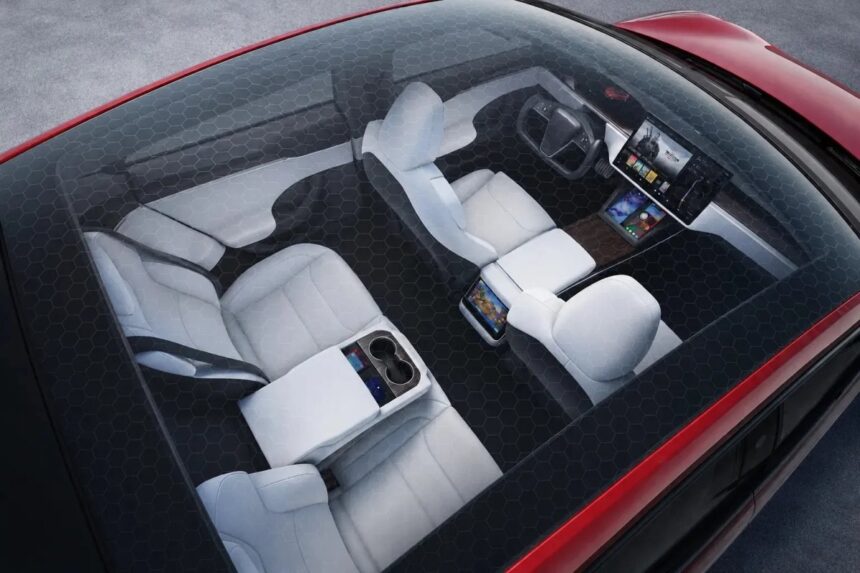
At the heart of the invention is a departure from the conventional single-pane or simple laminated glass roof. The design features a solid outer glass layer that provides weather protection, UV blocking, and structural integrity against external elements. The inner layer, facing the cabin, is perforated with thousands of precisely engineered micro-holes. These holes, ranging from 0.05 to 2 millimeters in diameter, allow for controlled airflow and acoustic properties.
Between these two layers lies a narrow gap or void, typically between 0.5 and 6 millimeters thick. This interstitial space is not empty; it serves as a plenum for conditioned air and a buffer zone for insulation. The patent describes how this configuration creates a highly tunable system. By adjusting hole size, gap thickness, and inner pane properties, engineers can optimize for specific performance metrics like heat rejection or frequency-specific noise absorption.
A standout element is the incorporation of a honeycomb matrix within the gap. Hexagonal or honeycomb-shaped walls connect the outer and inner glass layers. These cells provide multiple benefits:
More Read

- Structural rigidity: They reinforce the dual-pane assembly, making it more resistant to flexing or shattering while maintaining a lightweight profile.
- Even airflow distribution: The matrix channels HVAC air uniformly across the entire roof surface, preventing hot or cold spots.
- Acoustic trapping: Each small chamber acts as a Helmholtz resonator or physical trap, dissipating sound waves before they enter the cabin.
This honeycomb structure is reminiscent of aerospace composites used in aircraft wings and fuselages for strength-to-weight efficiency, adapted here for automotive use.
Active HVAC Integration: Cooling (and Heating) from Above
One of the most groundbreaking aspects is the direct integration with the vehicle’s climate control system. Instead of pushing air through traditional dashboard vents, the HVAC system pumps conditioned air (hot or cold) into the gap between the glass panes. The pressurized air then diffuses evenly through the thousands of perforations, creating a gentle, blanket-like flow across the cabin ceiling.
This approach offers several advantages:
More Read
- Superior thermal management: Solar heat often enters through the roof first. By ventilating directly at the source, the system creates a thermal barrier, reducing the greenhouse effect inside the vehicle. This could lower the overall HVAC load, improving energy efficiency and extending range—critical for EVs.
- Quiet and diffuse delivery: Airflow feels more natural and less drafty than forceful vent blasts. It aligns with Tesla’s minimalist interior philosophy, potentially eliminating or reducing visible dashboard vents in future models.
- Versatility: The system works for both cooling in summer and gentle heating or defogging in colder conditions. It could also help mitigate cabin overheat when parked in direct sunlight, a common complaint among Tesla owners.
Tesla has long emphasized efficiency. Traditional panoramic roofs often require heavy tinting or ceramic coatings to combat heat. This active system might allow for clearer, more transparent glass without compromising comfort, enhancing the premium feel of vehicles like the Model Y, Cybertruck, or upcoming models such as the Robotaxi or next-generation compact EV.
Acoustic Benefits: Engineering Silence in EVs
Electric vehicles are inherently quiet, which amplifies other noises like wind rush at highway speeds, tire roar, and road imperfections. The perforated roof is designed to combat this. The gap, perforations, and honeycomb cells can be tuned to target specific frequencies. For instance, engineers could adjust parameters to absorb prominent wind noise around 200-500 Hz or tire hum.
This builds on Tesla’s ongoing efforts in NVH (noise, vibration, and harshness) reduction. Earlier patents and production tweaks, such as improved door seals and double-pane windows, have already made modern Teslas among the quietest vehicles on the road. This roof technology could push that further, creating a near-library-quiet cabin even at high speeds.
Context and Historical Development
This patent is not entirely new in concept. A related application titled “Automotive Perforated Insulated Glass Structure” was filed in 2019 and published in early 2020, focusing on noise absorption and thermal insulation. Inventors included Tesla engineers specializing in glass and acoustics. The recent grant (or continuation) adds the active HVAC functionality and honeycomb details, reflecting iterative development over years.
Tesla frequently files patents to protect intellectual property without necessarily implementing every idea immediately. However, glass technology is core to the company’s vehicles. Panoramic roofs debuted prominently on the Model X and became standard on many models. Future applications could appear in refreshed Model 3/Y, the Cybercab, Robovan, or a high-end Model S/X successor.
Potential Impact on Tesla’s Future Vehicles and Industry
If implemented, this technology could deliver:
More Read

- Enhanced comfort: More consistent temperatures, reduced reliance on seat heaters/ventilated seats, and a calmer acoustic environment.
- Design freedom: Larger glass areas without heat or noise penalties, supporting the “exoskeleton” aesthetic Tesla favors.
- Efficiency gains: Lower HVAC energy use translates to better range, especially in extreme climates.
- Minimalism: Cleaner interiors with hidden climate delivery, reinforcing Tesla’s futuristic appeal.
For the broader EV industry, it sets a benchmark. Competitors like Lucid (with its expansive glass) or traditional automakers exploring panoramic roofs may need to innovate similarly. It also highlights Tesla’s vertical integration advantage, controlling everything from batteries to body structures.
Challenges remain: Manufacturing perforated glass at scale with precision holes and honeycomb integration could be costly and complex. Durability against debris, condensation in the gap, or cleaning would need addressing. Integration with existing production lines is another hurdle, though Tesla’s Gigafactories are adept at rapid iteration.
Broader Implications for EV Innovation
This patent exemplifies Tesla’s approach under Elon Musk: relentless iteration on fundamentals like comfort, efficiency, and user experience. It complements other recent innovations, such as vacuum-assisted heat management or RF-transparent roofs for better connectivity (e.g., Starlink integration).
Owners have already reacted positively on platforms like X, with many expressing excitement about cooler cabins and quieter rides. Some speculate applications in the Robovan or next-gen vehicles, while others note it could finally tame the notorious glass roof heat in models like the Model Y.
As Tesla pushes toward full self-driving, affordable EVs, and robotaxis, technologies like this ensure the passenger experience remains premium. A quiet, perfectly tempered cabin is essential for long autonomous trips or shared mobility.
In summary, Tesla’s perforated dual-layer glass roof patent represents a holistic leap in automotive design. By merging structure, climate control, and acoustics into one elegant component, it could redefine what a modern EV cabin feels like. While timelines for production remain unclear, this filing signals Tesla’s commitment to turning even the roof into a smart, active system. Expect to see elements of this in vehicles rolling out in the coming years, further solidifying Tesla’s reputation for innovation.