

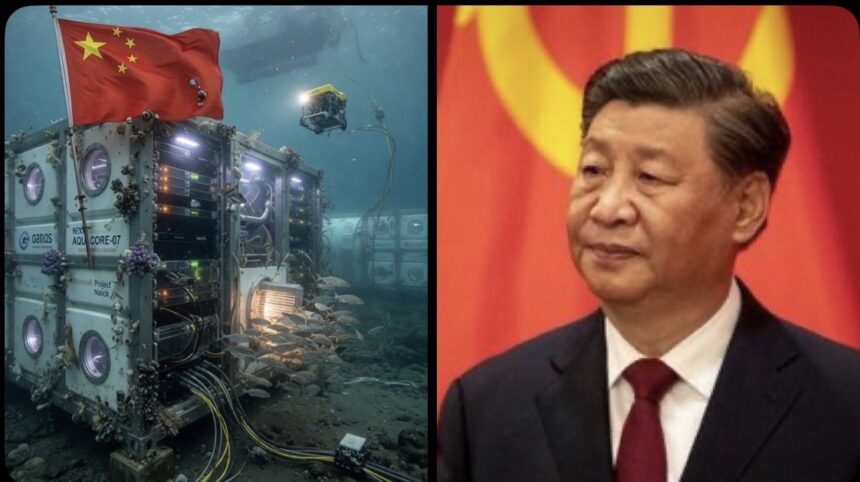
Shanghai, China (May 21, 2026) — In a pioneering move that blends marine engineering, renewable energy, and advanced computing, China has activated what it claims is the world’s first fully commercial underwater data center directly powered by offshore wind. Located in the Lingang Special Area southeast of Shanghai, the facility began full commercial operations in mid-May 2026, marking a rapid progression from concept to deployment in under a year.
The project, developed at a cost of approximately 1.6 billion yuan ($226–235 million), integrates sealed server modules submerged about 10 meters underwater, roughly 10 kilometers offshore. It sits strategically between phases of Lingang’s offshore wind farm, harnessing direct submarine cable connections for power and the surrounding seawater for natural cooling. With a pilot phase at 2.3 MW and full capacity targeting 24 MW, the facility houses nearly 2,000 servers, including GPU clusters, optimized for AI training, big data processing, 5G infrastructure, autonomous driving technologies, and smart robotics.
Addressing the AI Infrastructure Crisis
The global surge in artificial intelligence has created unprecedented demands on data center infrastructure. According to the International Energy Agency, data center power consumption worldwide is projected to more than double by 2030, largely driven by AI workloads that require dense GPU clusters generating enormous amounts of heat. Traditional land-based facilities often allocate up to 40% of their energy to cooling systems and consume vast quantities of freshwater, exacerbating electricity shortages and water stress in many regions.
China, home to one of the world’s most aggressive AI development programs, faces these pressures acutely. The country is racing to expand computing power to support domestic large language models, industrial automation, and digital economy goals. Lingang’s underwater data center (UDC) offers a compelling solution by colocating compute resources with renewable generation and leveraging the ocean as a free, stable heat sink.
Project developers report a Power Usage Effectiveness (PUE) of approximately 1.15 significantly better than the industry average of 1.5–2.0 for conventional data centers. This efficiency stems from passive seawater cooling through heat exchangers, which maintains stable temperatures around 15°C in the area, eliminating energy-intensive chillers and evaporative cooling towers. The design also achieves zero freshwater consumption and slashes land use by over 90% compared to equivalent onshore facilities.
More Read

Electricity is supplied directly from the adjacent offshore wind farm comprising over 50 turbines with 200 MW capacity via photoelectric composite submarine cables. More than 95% of the facility’s power comes from renewable sources, minimizing transmission losses and grid congestion. Full-scale operations are projected to save 61 million kWh of electricity annually and substantially reduce carbon emissions.
Rapid Development and Technical Achievements
The timeline underscores China’s execution speed in complex infrastructure projects. A cooperation agreement was signed in June 2025 between the Lingang Special Area administrative committee, Shanghai Lingang Special Area Investment Holding Group, and HiCloud Technology (also known as Shanghai Hailanyun Technology or a subsidiary of Highlander Group). Construction wrapped up by October 2025, trials began in February 2026, and commercial service launched last week.
Engineers overcame challenges such as strong waves, heavy sediment, and precise underwater installation by developing new integrated offshore construction techniques. The modules feature robust pressure-resistant, corrosion-protected designs with 192 server racks arranged across four levels. GPU servers from partners including China Telecom and local provider LinkWise are already operational, supporting real-world AI and data annotation tasks while enabling hybrid onshore-offshore resource allocation.
HiCloud Technology, with prior experience in underwater systems, led the technical deployment. Earlier efforts by the company and partners included a commercial underwater facility in Hainan Province, which uses similar seawater cooling but lacks the direct offshore wind integration of the Lingang project.
Global Context and Comparisons
Underwater data centers are not entirely new. Microsoft’s Project Natick, launched in the mid-2010s, tested sealed capsules off Scotland and later California, demonstrating lower failure rates due to the inert nitrogen atmosphere and consistent temperatures. However, Microsoft shelved commercial plans, citing logistical complexities. Other concepts, such as floating data centers or wave-powered systems backed by investors like Peter Thiel’s Panthalassa, remain in development.
China’s approach stands out for its scale, speed, and integration with existing renewable assets. While Western projects often emphasize experimental or small-scale pilots, the Lingang UDC is purpose-built for commercial AI workloads and tied directly into national “dual carbon” (carbon peaking and neutrality) goals alongside the “Eastern Data, Western Computing” strategy, which seeks to balance computing resources across regions.
Internationally, data center operators grapple with similar issues. Hyperscalers like Google, Amazon, and Microsoft have invested heavily in liquid cooling, renewable power purchase agreements, and efficiency improvements. Yet, permitting delays, grid constraints, and community opposition to large onshore facilities persist. Underwater or offshore solutions could alleviate these by utilizing ocean real estate and colocating with offshore wind farms, which are expanding rapidly in Europe, the U.S., and Asia.
Environmental and Sustainability Benefits
Proponents highlight multiple green advantages. Beyond high renewable penetration and low PUE, the project eliminates freshwater use—a critical factor as AI data centers in arid regions strain local water supplies. Reduced land footprint preserves coastal and urban areas for other uses. Developers claim overall electricity consumption drops by about 22.8% versus traditional setups.
Marine ecosystem considerations were reportedly addressed through environmental assessments, with designs minimizing heat discharge impacts and avoiding sensitive habitats. Long-term monitoring will be essential to evaluate effects on local biodiversity, water temperatures, and sediment dynamics.
More Read

Challenges and Risks
Despite the optimism, underwater data centers face unique hurdles. Saltwater corrosion, biofouling, and high-pressure environments demand advanced materials and sealing technologies. Maintenance is logistically complex: failed components require specialized vessels and remotely operated vehicles rather than on-site technicians. Redundancy and remote monitoring are therefore critical.
Submarine cables must withstand marine traffic, seismic activity, and fishing operations. Cybersecurity for offshore infrastructure also merits attention amid rising geopolitical tensions. Initial costs are high, though proponents argue lifecycle savings from efficiency and renewables offset them.
Skeptics question scalability and true environmental net benefits, noting that waste heat still enters the ocean and construction involves significant embodied carbon. Critics also point to broader concerns about China’s data governance, though the project’s technical merits stand independently.
Future Outlook and Expansion Plans
Lingang officials envision the project as a blueprint for a “blue computing” economy. Success here has already prompted plans for larger deployments, including ambitions toward 500 MW-scale integrated wind-compute facilities. Lingang aims to become a major computing hub, already hosting multiple intelligent computing centers that represent a significant share of Shanghai’s capacity.
Nationally, this aligns with China’s push for technological self-reliance and sustainable digital growth. As AI models grow more demanding training a single frontier model can require energy equivalent to thousands of households the need for innovative infrastructure will intensify.
For the global industry, the Lingang UDC provides valuable data on real-world performance of subsea systems. If proven reliable at scale, it could inspire similar hybrid renewable-marine projects elsewhere, particularly in regions with strong offshore wind resources like the North Sea, U.S. East Coast, or East Asia.
Conclusion
China’s underwater data center near Shanghai represents more than an engineering novelty; it is a pragmatic response to the converging crises of energy, water, land, and compute demand in the AI era. By merging offshore wind, seawater cooling, and advanced modular design, the project achieves impressive efficiency while advancing national green development objectives.
As operations ramp up, performance metrics, maintenance records, and environmental data will determine whether this model can be widely replicated. For now, it stands as a bold demonstration that innovative thinking quite literally diving beneath the surfacemay help power the next wave of digital transformation sustainably. With AI’s appetite showing no signs of slowing, such unconventional solutions could become mainstream features of tomorrow’s infrastructure landscape.