

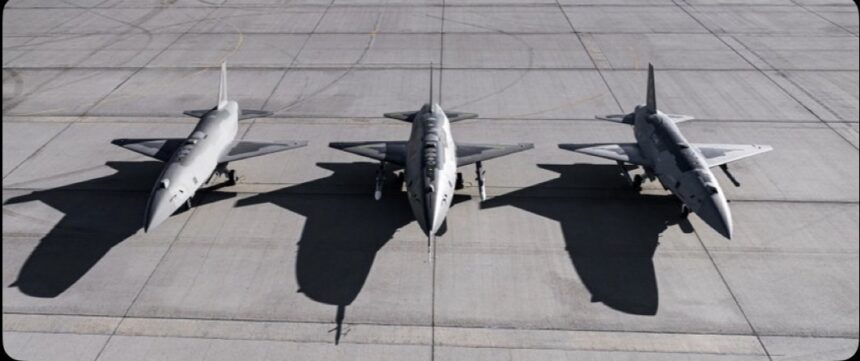
In a move that highlights rapid innovation in American defense technology, the U.S. Air Force has selected Anduril Industries for the production phase of its Collaborative Combat Aircraft program. The company will now build and deliver production-ready FQ-44 semi-autonomous fighter aircraft to support testing, validation, and eventual operational deployment.
The announcement, shared directly by Anduril on social media, underscores a shift toward faster development cycles and software-driven systems in military aviation. Anduril described the milestone as moving “from prototype to production in two years” — the first time a new company has won a fighter aircraft program in more than five decades.
What the Contract Means
The Air Force awarded engineering and manufacturing development plus production contracts to both Anduril for the FQ-44 and General Atomics for its FQ-42. This dual-source approach gives the service options for competition, supply chain resilience, and a mixed fleet from the start. Contracts cover initial production lots and set up options for additional aircraft over the coming years.8
Anduril will deliver an initial batch of production FQ-44 aircraft. These will undergo continued testing before scaling toward full operational fielding. The service aims to field at least 100 to 150 Collaborative Combat Aircraft by the end of the decade, with longer-term plans calling for hundreds more to create affordable mass in the air.
The Collaborative Combat Aircraft Vision
Collaborative Combat Aircraft, often called “loyal wingmen,” are uncrewed platforms designed to fly alongside manned fighters such as the F-35 Lightning II, F-22 Raptor, and upcoming next-generation crewed aircraft. They extend sensor range, carry weapons or electronic warfare payloads, perform reconnaissance, and absorb risk in high-threat environments where sending a human pilot would be too dangerous.
More Read

The concept addresses a core challenge for the U.S. military: peer adversaries like China field large numbers of advanced fighters and missiles. Affordable, attritable aircraft that can operate in swarms or teams multiply the effectiveness of expensive crewed platforms without requiring one pilot per aircraft.
Increment 1 of the CCA program focuses on getting these systems into production quickly. The Air Force selected Anduril and General Atomics after a competitive prototype phase that began in 2024. Production decisions arrived four months ahead of the original schedule, signaling strong confidence in both designs.11
Anduril’s Rapid Progress
Anduril’s FQ-44, internally known as Fury, traces its roots to the Fury design from Blue Force Technologies, which Anduril acquired in 2023. The company adapted and matured the platform specifically for the CCA mission.
Key timeline highlights show impressive speed:
- Prototype contract awarded around April 2024
- Ground testing began April 2025
- First flight achieved October 31, 2025
- Production contract awarded June 17, 2026
That path from clean-sheet prototype to production contract in roughly two years stands out sharply against traditional fighter programs that often stretch 15 to 20 years or more.
Anduril is manufacturing the aircraft at its growing facilities, including the massive Arsenal-1 hyperscale plant under construction in Columbus, Ohio. The company has already started producing early units and optimized processes to increase manufacturing speed.
Technical Capabilities of the FQ-44
The FQ-44 is a compact, high-performance uncrewed aircraft. It measures roughly 20 feet long with a 17-foot wingspan and has a maximum takeoff weight around 5,000 pounds. A single Williams FJ44-4M turbofan engine provides about 4,000 pounds of thrust.
Performance targets include speeds up to Mach 0.95, a service ceiling of 50,000 feet, and the ability to pull up to 9 g. The design supports short-field operations, making it deployable from austere locations. It is built for multi-mission roles: air-to-air combat, ground strikes, electronic warfare, and intelligence collection.
While not fully “attritable” in the disposable sense, its lower cost relative to crewed fighters allows commanders to accept greater risk when the mission demands it.
More Read

The Software Edge: Lattice for Mission Autonomy
Hardware is only part of the story. Anduril’s Lattice platform for mission autonomy will power the next phase of the CCA effort. Lattice is an open software system that enables human-machine teaming, allowing one operator to oversee multiple aircraft while the drones handle routine tasks autonomously.
The company emphasized that “one software stack” can work across different aircraft types. This approach supports the Air Force’s goal of affordable mass through autonomy. Separate contracts went to Anduril, Shield AI, and RTX Collins Aerospace to accelerate production-ready autonomy software.
Why This Matters for National Security and Industry
This contract represents more than just new hardware. It validates a new model for defense acquisition: agile technology companies partnering directly with the military to deliver capability on accelerated timelines. Traditional large primes still play major roles, but Anduril’s success shows that software-first, vertically integrated firms can compete and win on complex programs.
For the Air Force, the CCA program helps close capability gaps faster and at lower unit cost than adding more crewed fighters alone. Dual sourcing between Anduril and General Atomics creates healthy competition and reduces single-point-of-failure risks.
Economically, production at facilities like Arsenal-1 in Ohio will create high-tech manufacturing jobs and strengthen domestic supply chains for advanced aerospace components.
Looking Ahead
Initial production aircraft will support expanded testing and operational evaluation. The Air Force expects to begin fielding operational CCA capability before 2030. Future increments will likely incorporate more advanced autonomy, new payloads, and potentially different airframe designs.
Anduril’s win also fuels ongoing discussion about when or if the company might pursue a public offering, though leadership has stayed focused on execution.
The selection of both Anduril’s FQ-44 and General Atomics’ FQ-42 for production marks a concrete step toward a future where manned and uncrewed aircraft routinely fight as integrated teams. It is a future built on speed, software, and the willingness to rethink how America builds and fields airpower.