

CARACAS, Venezuela — Venezuela’s acting president, Delcy Rodríguez, declared a national state of emergency late Wednesday after a powerful doublet of earthquakes struck the northern coast, killing an unspecified number of people, collapsing buildings in Caracas, and causing widespread chaos including disruptions to the metro system, power outages, loss of cellphone signals, and the closure of the main airport.36
The back-to-back quakes — a 7.2 magnitude foreshock followed roughly 40–60 seconds later by a 7.5 magnitude mainshock on June 24, 2026 — hit near San Felipe and Yumare in Yaracuy state, about 160–170 km (100+ miles) west of the capital. The shallow events triggered strong shaking felt by millions, sent residents fleeing into the streets, and prompted urgent international assistance, with El Salvador becoming the first country to offer substantial on-the-ground support.
The Earthquakes and Immediate Impact
According to the U.S. Geological Survey (USGS), the first quake struck just after 6:04 p.m. ET with its epicenter west of Morón along the Caribbean coast. The larger mainshock followed almost immediately, centered near Yumare. Both were shallow (depths of roughly 8–13 km), intensifying the ground motion. Approximately 8 million people experienced strong shaking, and the tremors were felt as far as neighboring Colombia.
In Caracas, the shaking was violent and prolonged. Footage shared widely shows panic inside the city’s metro system as trains and stations lurched violently. Passengers and staff scrambled as lights flickered and the ground heaved. Parts of the capital lost electricity and cellphone service, complicating rescue coordination. Gas supplies were shut off in affected areas as a safety measure.
The main international airport serving Caracas, Simón Bolívar (Maiquetía), suffered heavy damage — including a roof collapse — and has been closed to all flights. Acting President Rodríguez confirmed the closure during her address and noted at least 20 aftershocks recorded so far.
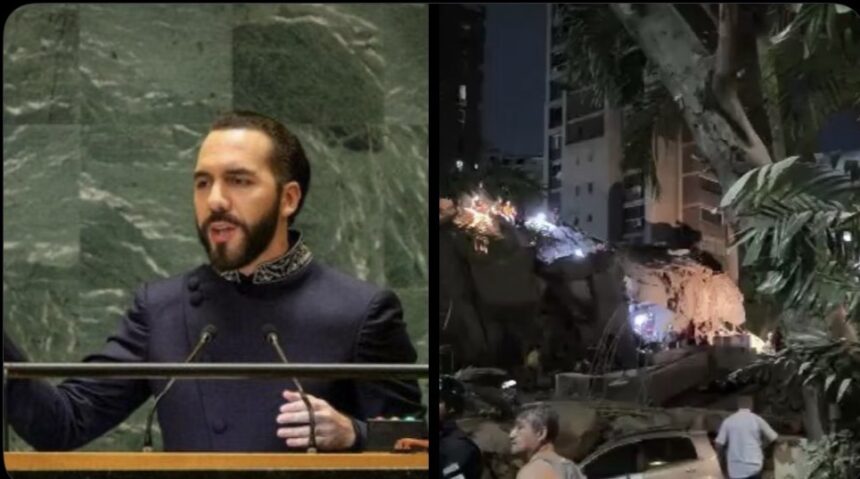
Buildings collapsed or were severely damaged in several Caracas neighborhoods, most notably Altamira and Palos Grandes. Walls gave way, exposing interiors, and dust clouds rose over affected districts. Similar scenes were reported in coastal and western areas closer to the epicenter. The USGS issued its highest-level “red alert,” warning of probable high casualties and extensive damage requiring a major response. Initial modeling suggested a significant chance of thousands of fatalities.
Acting President Rodríguez expressed condolences to families who lost loved ones and confirmed fatalities had occurred, though official tallies have not yet been released as rescue operations continue amid rubble and aftershocks.
Government Response and State of Emergency
Rodríguez declared a national state of emergency and urged calm and national unity. She called on all healthcare professionals to report to hospitals immediately to treat the injured. Interior Minister Diosdado Cabello appeared on state television describing “alarming situations” in parts of Caracas and directing emergency vehicles priority on roads. Security forces were mobilized nationwide.
Over 500 personnel were reportedly deployed to key rescue sites in the capital. The government has activated protocols for structural assessments, aid distribution, and aftershock preparedness. Residents were repeatedly warned to stay outdoors where possible due to the risk of further collapses.
International Aid Begins: El Salvador Steps Up
In a rapid show of solidarity, El Salvador’s government, under President Nayib Bukele, has offered immediate assistance. The country is preparing to send 300 rescuers and paramedics along with 50 tons of equipment, medicine, and essential supplies directly to Caracas. The aid is ready to depart via the Foreign Ministry.
This marks one of the first concrete international responses to the disaster. Bukele’s administration has positioned the offer as a gesture of regional support during Venezuela’s time of need.
Broader Context and Challenges
The earthquakes struck Venezuela at a particularly difficult moment. The country is under acting leadership following the U.S. capture of former President Nicolás Maduro earlier in 2026. Acting President Delcy Rodríguez has emphasized cooperation with the international community, including on economic matters.
Infrastructure vulnerabilities were starkly exposed. Many buildings in Caracas and along the coast were not designed or retrofitted to withstand major seismic events of this scale. Power and communications failures have hindered real-time damage assessment and rescue coordination.
The USGS and other experts warn that aftershocks will continue for days or weeks, potentially causing additional damage to already compromised structures. Search-and-rescue efforts remain the immediate priority as teams work through rubble in affected neighborhoods.
Human Stories and Ongoing Developments
Eyewitnesses described terrifying moments: furniture toppling, walls cracking, and people rushing into the streets clutching children and pets. In the metro, chaos unfolded in real time as the ground shook violently beneath trains and platforms.
As dawn approached on Thursday, June 25, rescue operations continued under difficult conditions. Hospitals were treating injuries, though exact casualty figures remain preliminary. The government has pledged transparent updates as assessments progress.
This is a rapidly developing story. Further details on the death toll, extent of damage, and additional international aid offers are expected in the coming hours and days.
Sources: USGS earthquake reports and PAGER alerts, statements from Acting President Delcy Rodríguez and Interior Minister Diosdado Cabello via state media, Reuters, AP, NBC News, and contemporaneous reporting including social media documentation of impacts and aid offers. All casualty numbers and damage assessments are preliminary as of early Thursday morning.