

UPDATED: May 8, 2026 | Originally published May 7, 2026
NEW YORK | As the world watches the unfolding hantavirus crisis aboard the expedition cruise ship MV Hondius, which is now heading toward Spain’s Canary Islands with nearly 150 passengers from 23 countries still on board, a Pfizer post-authorization safety document has resurfaced online, drawing millions of views and sharp debate across social media.
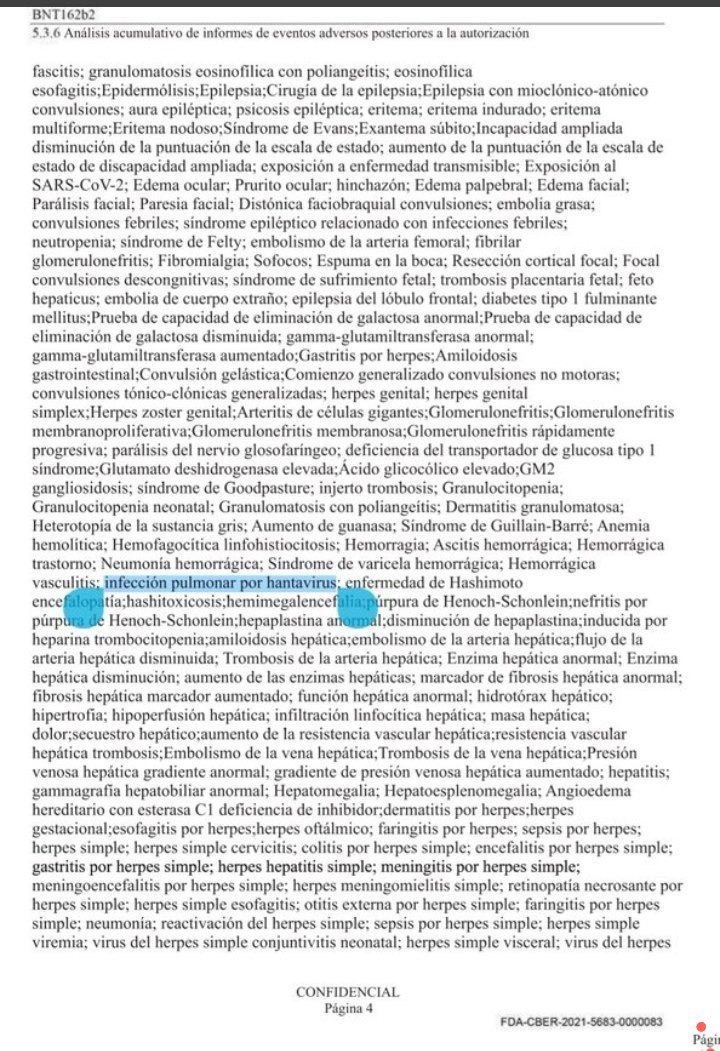
The document, formally titled “5.3.6 Cumulative Analysis of Post-Authorization Adverse Event Reports of BNT162b2,” was released in 2022 following a court-ordered Freedom of Information Act (FOIA) request by the group Public Health and Medical Professionals for Transparency. On page 33, among a list of 1,233 conditions, sits a single entry: “Hantavirus Pulmonary Infection.”
That entry is now at the center of a viral storm, and it deserves a clear, honest explanation.
What the Document Actually Is and What It Is Not
Let’s be direct: this document is not a confirmed list of vaccine side effects.
More Read

The 38-page report is a post-authorization safety monitoring document. The conditions listed in Appendix 1 are formally called Adverse Events of Special Interest (AESIs), a standard pharmacovigilance tool used across the pharmaceutical industry.
According to the U.S. Food and Drug Administration (FDA), AESIs are health conditions that regulators and drug companies agree to watch closely after a product launches. Inclusion on an AESI list means: “If this condition is reported, investigate it.” It does not mean the vaccine caused it.
The Brighton Collaboration, an independent international vaccine safety organization, compiled the core AESI framework used in the Pfizer document. Similar lists were contributed by the European Medicines Agency (EMA), the CDC, and the UK’s Medicines and Healthcare products Regulatory Agency (MHRA).
More Read

In short: Pfizer didn’t invent this list in isolation. Regulators shaped it. And the purpose was safety surveillance, not a confession.
Responding to the Fact-Checkers
Since this article was first published on May 7, 2026, fact-checking outlets including Lead Stories and Yahoo News have published rebuttals targeting social media posts framing hantavirus as a “COVID vaccine side effect.”
Their core argument is correct on one point: the AESI list is not a side effects list. We said that in our original article, and we stand by it.
However, the fact-checkers’ framing misses what is genuinely worth examining. The debate is not whether the vaccine causes hantavirus it clearly does not, and no serious person is arguing that an mRNA vaccine can transform into a rodent-borne virus. The more legitimate questions being raised in public health circles are:
- Why does a standard vaccine monitoring list include over 1,200 conditions, including rare zoonotic diseases like hantavirus?
- How transparent was the early post-authorization safety communication to the public?
- Does the timing of this document’s viral resurgence, coinciding with a real, deadly hantavirus outbreak, reflect genuine public anxiety about health institutions that still hasn’t been addressed?
Those are fair questions that deserve honest answers, not dismissal.
Dr. Nick Bennett, a physician who writes pharmacovigilance protocols professionally, noted on his blog that the appendix “is an instruction guide… results do not go in the appendices,” and confirmed there is no documented case of hantavirus occurring after COVID vaccination in the trials. That context matters, and we include it here in full.
More Read

The MV Hondius Outbreak: Full Update (May 8, 2026)
The hantavirus outbreak at the center of this public conversation is very real and very serious.
The MV Hondius, a Dutch-flagged expedition cruise ship operated by Oceanwide Expeditions, departed Ushuaia, Argentina on April 1, 2026, carrying passengers and crew from 23 countries on a voyage through Antarctica and remote South Atlantic islands.
By April 11, the first passenger, a 70-year-old Dutch man, had died on board after presenting with fever, headache, abdominal pain, and diarrhea. His body was removed in Saint Helena. His wife also disembarked there, and later died in South Africa, where she tested positive for hantavirus. A German woman died on board on May 2. Three deaths in total have now been recorded.
As of May 7, the World Health Organization (WHO) confirmed eight cases linked to the ship, five confirmed and three suspected, spanning multiple countries. The CDC issued a formal statement confirming it is monitoring the situation closely, noting 17 Americans are among those still aboard.
Three people were evacuated from the ship on May 6 while it was anchored off Praia, Cape Verde. Two landed in Amsterdam, where specialist medical teams received them. A third patient’s plane made an unscheduled stop at Gran Canaria Airport after Morocco refused a refueling request.
Switzerland separately confirmed a passenger who had already disembarked tested positive at University Hospital Zurich after developing symptoms, bringing the international case count to eight. Singapore is monitoring two residents who were aboard the same Johannesburg-bound KLM flight as a confirmed case, though both are currently asymptomatic.
The Canary Islands initially refused to allow the ship to dock, with regional president Fernando Clavijo citing safety concerns shaped by the region’s COVID-19 experience. Spain’s central government overruled that position. Health Minister Monica Garcia confirmed the MV Hondius is expected to arrive in Tenerife around May 11, after which non-Spanish nationals will be repatriated to their home countries.
The strain involved is the Andes virus, the only known hantavirus with documented limited human-to-human transmission capability, though WHO stresses this requires prolonged, very close contact. WHO Director-General Tedros Adhanom Ghebreyesus confirmed the overall public health risk remains low, and officials have explicitly ruled out any pandemic-level threat.
Investigators now believe the index case, the Dutch couple, likely contracted the virus during a birdwatching trip in Ushuaia before departure. Argentine authorities tracked the couple’s four-month road trip through Chile, Uruguay, and Argentina and are investigating rodent exposure near a landfill in Ushuaia as the probable source.
For our full outbreak coverage, read:
- Hantavirus Outbreak on MV Hondius Cruise Ship Sparks Global Concern
- WHO Confirms 5 Hantavirus Cases on MV Hondius with 40% Mortality Rate
- Hantavirus in 2026: Understanding the Rare but Deadly Rodent-Borne Threat
Why the Pfizer Document Keeps Coming Back
This is not the first time the 5.3.6 document has gone viral. It surfaced during monkeypox concerns, during debates over long COVID, and now during this hantavirus outbreak. The pattern is consistent: whenever a new health story breaks, people search for patterns in old data.
That impulse is not irrational. Public trust in health institutions took severe damage during COVID-19, and millions of people feel they were not given complete information in real time. Documents like this one, raw and thousands of entries long, feel like evidence of hidden knowledge, even when the explanation is more straightforward.
The straightforward explanation here is this: pharmaceutical companies are required by regulators to cast a wide net. A monitoring list that includes hantavirus is not a smoking gun. It is a sign the surveillance system was designed to track almost anything, including rare events with no plausible biological link to the vaccine.
That does not mean every question about COVID vaccine safety has been answered satisfactorily. It does not mean public skepticism is baseless. It means this particular document, for this particular claim, does not say what many social media posts claim it says.
What the Science Says, Clearly
- Hantavirus is a zoonotic disease spread through contact with infected rodents, primarily through urine, droppings, and saliva.
- The CDC confirms there is no evidence connecting COVID-19 vaccines to hantavirus infection.
- mRNA vaccines do not contain live virus and cannot mutate into a different pathogen.
- The Andes strain involved in the MV Hondius outbreak has circulated in South America for decades, long before any COVID vaccine existed.
- Argentine health authorities reported 101 hantavirus infections since June 2025, roughly double the prior year’s rate, suggesting increased regional transmission driven by environmental and ecological factors, not vaccination.
The Bigger Picture
The intersection of the MV Hondius outbreak and the Pfizer document going viral in the same news cycle is a coincidence of timing, not evidence of causation. Two things can be true simultaneously: the hantavirus outbreak is a genuine public health emergency demanding urgent response, and the Pfizer document does not implicate COVID-19 vaccines in causing it.
What this moment reveals is a real and unresolved gap in science communication. When people turn to viral documents instead of official channels for answers, it signals that official channels have not adequately earned or maintained trust. That is worth taking seriously, regardless of where you stand on vaccine policy.
As the MV Hondius makes its way to Tenerife and nearly 150 passengers await repatriation, health authorities worldwide remain focused on containment and care. There is currently no licensed hantavirus vaccine for humans, making early detection and rodent exposure prevention the primary tools at our disposal.
For ongoing coverage of the MV Hondius outbreak and global health developments, follow Briefly USA’s Trending section.
Sources:
- Pfizer 5.3.6 Post-Authorization Safety Document (PHMPT)
- CDC Statement on MV Hondius Cruise Ship
- CDC Hantavirus Overview
- WHO Hantavirus Information
- Brighton Collaboration AESI Framework
- FDA Vaccine Adverse Event Reporting System
- Lead Stories Fact Check on the Pfizer Document
- Dr. Nick Bennett MD: Is Hantavirus a Side Effect of the Covid Vaccine?