

China banned Nvidia’s RTX 5090D V2 gaming chip while CEO Jensen Huang was in Beijing with Donald Trump. Here is why it matters and what chips China is using instead. For more on the US-China tech and geopolitical standoff, see our breakdown of what the Thucydides Trap means for the US-China rivalry.
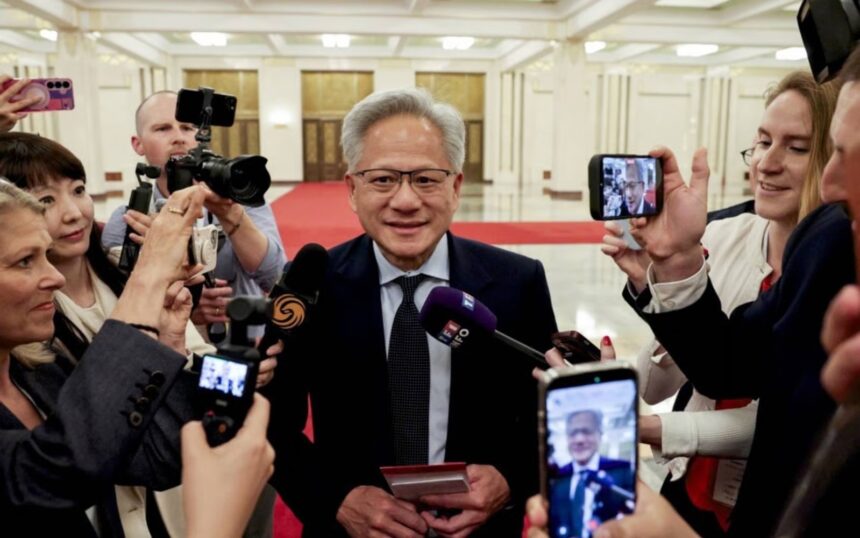
China banned Nvidia’s RTX 5090D V2 gaming chip last Friday, according to the Financial Times. The timing was not a coincidence. The ban was added to China’s list of prohibited goods while Nvidia CEO Jensen Huang was physically in Beijing alongside US President Donald Trump for a high-stakes summit with Chinese President Xi Jinping.
The China Nvidia RTX 5090D V2 ban is the latest move in a semiconductor war that has been escalating for years between Washington and Beijing, and it sends a message that is impossible to misread: China is not interested in letting Nvidia back into its market, no matter who is in the room.
Here are 5 things you need to know.
1. China Nvidia RTX 5090D V2 Ban Happened at the Worst Possible Moment for Jensen Huang
The RTX 5090D V2 was originally designed for Chinese gamers. It is a downgraded version of Nvidia’s flagship RTX 5090 card, modified to comply with US export restrictions that limit the performance specifications of chips sold to China. But it was also being widely used by Chinese AI developers to access Nvidia’s Blackwell-based GPU architecture at a time when more powerful Nvidia chips remained restricted.
Beijing added it to a list of banned goods on Friday, May 16, while President Donald Trump and Nvidia CEO Jensen Huang were visiting China. The ban was first reported by the Financial Times, which cited a document listing prohibited goods and two people with direct knowledge of the situation.
More Read

The symbolism was deliberate. Banning an Nvidia chip while the CEO of Nvidia sits across the table from Chinese officials is not an accident of timing. It is a statement about Beijing’s priorities regardless of who shows up.
2. Jensen Huang Almost Did Not Make the Trip at All
The story of how Jensen Huang ended up in Beijing is as revealing as the ban itself.
Nvidia CEO Jensen Huang was not among the business leaders originally invited to join President Donald Trump for his China state visit from May 13 to 15, 2026. The original delegation included Apple’s Tim Cook, Tesla’s Elon Musk, and representatives from Qualcomm, Micron, and Cisco. Huang was conspicuously absent.
After seeing the media coverage of Huang’s absence from the delegation, Trump called the Nvidia executive and asked him to join. Huang flew to Alaska to board Air Force One during a refueling stop.
Trump denied on social media that Huang had not been invited, and said that opening up China for US businesses would be his “first request” to Xi. He added: “I will be asking President Xi, a Leader of extraordinary distinction, to open up China so that these brilliant people can work their magic.”
Analysts suggested Huang’s initial exclusion may have been intentional, with the Trump administration viewing access to computing power as too strategically important to compromise and preferring to leave the substance of chip policy negotiations to the governments rather than exposing Nvidia to direct pressure from Beijing.
3. China Has Not Bought a Single Nvidia H200 Chip Despite US Approval
The RTX 5090D V2 gaming chip ban sits on top of a much larger and more damaging pattern of Chinese resistance to Nvidia products.
Trump approved Nvidia H200 exports to China in late 2025, but Beijing stepped in and told its customs officers to stop the chips at the border. It has been almost six months since the White House gave Nvidia the go-signal to sell the H200, and Commerce Secretary Howard Lutnick confirmed the company has yet to sell a single H200 AI GPU to China.
Chinese companies that had placed purchase orders with Nvidia earlier this year later informed the company they could not follow through.
More Read

During the Beijing summit, Trump said the topic of H200 purchases came up during his meetings with Xi and that “something could happen,” but offered no specifics. US Trade Representative Jamieson Greer said the same day that any movement on H200 purchases is now up to China.
In other words, the US has unlocked the door. China is choosing not to walk through it.
4. What Chips Is China Using Instead of Nvidia?
This is the question that makes the China Nvidia ban story so significant beyond the immediate headlines.
Beijing is not simply going without chips. It is actively redirecting its companies toward domestic alternatives and using every Nvidia ban and restriction as an incentive to accelerate that shift.
The three main beneficiaries of China’s Nvidia exclusion policy are:
Huawei: The Chinese tech giant has been developing its own AI chip line, the Ascend series, specifically to fill the gap left by Nvidia. DeepSeek, the Chinese AI company that shocked the world in January 2025 by releasing a competitive AI model at a fraction of the cost of American rivals, was trained on Huawei Ascend chips. Huawei is widely expected to seize China’s AI chip crown in 2026 as Nvidia’s H200 shipments remain stalled in regulatory limbo.
Cambricon: A Beijing-based AI chip designer backed by Chinese state investment. Cambricon has been gaining ground in the data center market as Chinese companies pivot away from American hardware.
Alibaba and Baidu: Both Chinese tech giants have been developing their own custom AI chips, reducing their dependence on any single foreign or domestic supplier.
Nvidia’s China market share plummeted from a high of 95% to essentially zero following export bans, allowing Huawei, Cambricon, Alibaba, and Baidu to gain ground filling the vacuum left by the American chipmaker.
5. Jensen Huang Has Been Warning About This for Years
The irony of the China Nvidia RTX 5090D V2 ban landing while Huang sat in Beijing is that he has been arguing against exactly this outcome for years.
Huang has historically been very pro-trade on AI tech and China, arguing that “it’s important to be mindful that what harms China could oftentimes also harm America.” Just last month, Huang argued the US should export AI “like crazy” to China.
Huang has been an outspoken critic of Trump’s approach to chip export restrictions, arguing that cutting off Chinese access to Nvidia chips will only accelerate China’s efforts to develop a competing hardware stack, potentially backfiring on the United States. Huang even borrowed Trumpian language, calling restrictive export policy a “loser mentality” that jeopardized US competitiveness.
The RTX 5090D V2 ban, announced while he was in the country trying to negotiate market access, is the exact scenario he has been warning about. Beijing does not want Nvidia chips. It wants its own chips to be the standard. Every ban makes that goal more achievable.
Analysts suggest Huang’s last-minute inclusion in the delegation could signal that Nvidia’s access to China has become part of a broader geopolitical negotiation, with Trump potentially using chip access as leverage on other issues including Chinese help on Iran.
Whether that leverage works is the question the next few weeks will answer. For now, the RTX 5090D V2 is banned, the H200 is blocked, and Huawei is building.
For more on the broader US-China tech and geopolitical standoff, see our breakdown of what the Thucydides Trap means for the US-China rivalry.
Key Takeaways
- China banned Nvidia’s RTX 5090D V2 gaming chip on Friday, May 16, while Jensen Huang was in Beijing with Trump for the US-China summit.
- The chip was being used by Chinese AI developers to access Nvidia’s Blackwell architecture despite being marketed as a consumer gaming product.
- Huang was not originally invited to the delegation. Trump personally called him and asked him to board Air Force One at a refueling stop in Alaska.
- China has not purchased a single Nvidia H200 AI chip despite US approval of their export in late 2025, blocking imports to push investment toward domestic chipmakers.
- Huawei, Cambricon, Alibaba, and Baidu are the main beneficiaries of China’s Nvidia exclusion policy, with Huawei positioned to take the AI chip lead in China in 2026.
- Huang has argued for years that US chip export restrictions are counterproductive, calling the approach a “loser mentality” that accelerates China’s domestic chip development.