


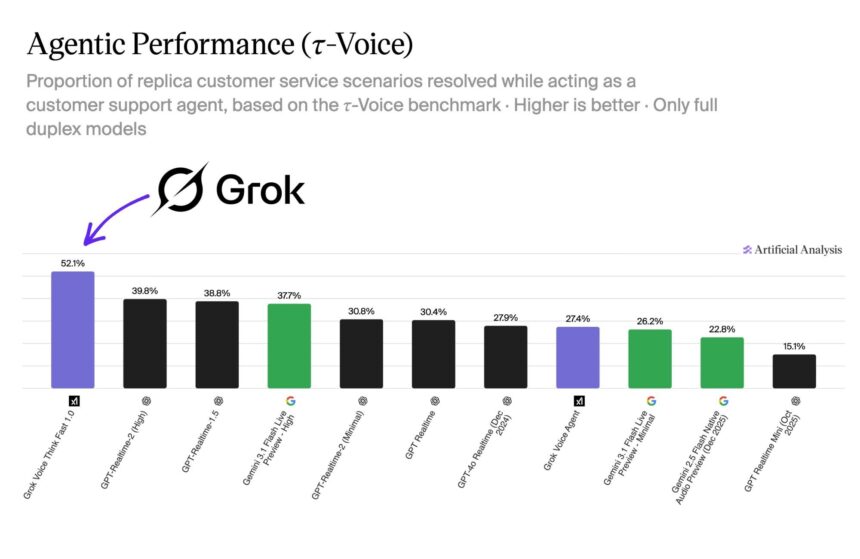
xAI has made a significant stride in conversational artificial intelligence with the release and deployment of Grok Voice Think Fast 1.0. This new model has claimed the top spot on the Artificial Analysis τ-Voice benchmark, achieving a 52.1 percent resolution rate in agentic customer service tasks. The accomplishment stands out not only for the score itself but also because the system is already handling live interactions for Starlink customer support and various enterprise operations.
In the fast-moving world of voice AI, benchmarks often feel detached from reality. Many models sound impressive in controlled demos yet falter when faced with real accents, interruptions, background noise, or shifting customer demands. The τ-Voice benchmark attempts to bridge that gap by testing full-duplex voice agents on grounded, multi-step customer service scenarios drawn from retail, airline, and telecom domains. It evaluates how well systems can resolve issues end to end while managing natural conversation flow.
Understanding the τ-Voice Benchmark
τ-Voice builds on earlier work in agentic evaluation, extending text-based testing into spoken interactions. It presents agents with 278 realistic tasks that require tool use, information gathering, policy adherence, and clear communication. Success depends on more than just understanding words. The model must maintain context across turns, handle interruptions gracefully, confirm details accurately, and actually solve the customer’s problem rather than simply sounding polite.
Grok Voice Think Fast 1.0 reached 52.1 percent resolution. For context, that puts it well ahead of GPT-Realtime-2 (High) at 39.8 percent and Gemini 3.1 Flash by a double-digit margin. The gap between first and second place exceeds the distance from second place to the bottom of the leaderboard. That spread highlights a meaningful capability difference rather than marginal gains.
More Read

What makes this result particularly noteworthy is the model’s architecture. Grok Voice Think Fast performs reasoning in the background while maintaining low-latency speech output. Traditional voice systems often trade off speed for intelligence or vice versa. This version aims to do both by thinking deeply without forcing awkward pauses in conversation.
Real-World Deployment at Scale
Benchmarks matter, but production use reveals the true test. xAI and SpaceX have already integrated Grok Voice into Starlink’s customer support operations. Callers to the Starlink hotline can now speak with an AI agent powered by this model for troubleshooting, account questions, hardware issues, and even sales inquiries.
Early indications suggest strong performance in the wild. The system handles natural speech patterns, manages noisy environments common in rural internet setups, and resolves a substantial portion of inquiries without human escalation. This deployment goes beyond proof-of-concept. It represents one of the largest real-time voice agent rollouts to date, serving thousands of users across different time zones and connectivity conditions.
Enterprise customers outside of Starlink are also adopting the technology for internal support desks and customer-facing lines. The ability to integrate with existing tools, pull account data securely, and execute multi-step workflows has made it attractive for operations teams looking to reduce wait times and agent workload.
How It Compares to the Competition
OpenAI’s GPT-Realtime models have set high bars for natural prosody and responsiveness. Google’s Gemini series excels in multimodal understanding and speed. Yet in sustained agentic tasks that require planning, tool calling, and consistent resolution, Grok Voice Think Fast 1.0 appears to hold an edge according to independent testing.
The difference likely stems from several design choices. First, native audio processing reduces the error-prone text-to-speech and speech-to-text hops that older pipelines relied upon. Second, background reasoning allows the model to simulate chain-of-thought processes without verbalizing every step to the user. Third, heavy optimization for full-duplex interaction means the agent can listen and think simultaneously, much like a skilled human support representative.
Users have noted that conversations feel more fluid. The AI can acknowledge partial statements, ask clarifying questions at natural moments, and adapt when a customer changes direction mid-sentence. These qualities matter enormously in customer service, where frustration often builds from feeling unheard.
More Read

Technical Innovations Behind the Performance
While xAI has not released exhaustive architectural details, public statements point to an audio-native foundation combined with advanced reasoning capabilities. The “Think Fast” designation emphasizes the balance between quick responses and deliberate problem-solving.
Latency remains competitive, with initial audio output arriving fast enough to maintain conversational rhythm. The model also demonstrates strong performance across languages and accents, important for global services like Starlink that serve users in remote and diverse regions.
Safety and reliability features include careful handling of sensitive account information, clear disclaimers when appropriate, and escalation paths to human agents when confidence drops or complexity spikes. These guardrails help build trust in production environments.
Broader Implications for Voice AI
The success of Grok Voice Think Fast 1.0 signals a maturing phase for spoken AI agents. For years, voice technology focused primarily on transcription accuracy and basic command execution. We are now seeing systems that can reason, act, and converse with meaningful autonomy.
This shift carries consequences for industries beyond telecom. Call centers could see dramatic efficiency gains, with AI handling tier-one support while humans focus on complex or emotional cases. Automotive voice assistants might evolve from simple navigation to genuine copilots capable of troubleshooting vehicle issues on the road. Accessibility tools could become far more capable for users who prefer or require spoken interaction.
There are challenges ahead. Voice AI must continue improving reliability in truly adversarial conditions. Regulatory questions around transparency, consent, and data handling will grow as adoption spreads. Customer acceptance varies. Some people still prefer speaking with humans, especially for high-stakes matters, while others appreciate the speed and availability of capable AI.
The Road Ahead
xAI’s rapid iteration suggests more updates are coming. Future versions may expand context windows, deepen tool integration, or add richer emotional intelligence for handling frustrated callers. The company has positioned itself as focused on building systems that maximize truth-seeking and usefulness, values that could differentiate its voice offerings in a crowded market.
For developers and businesses, the availability of these models via API opens new possibilities. Building custom voice agents that inherit Grok’s reasoning strengths while tailoring domain knowledge becomes more feasible.
The 52.1 percent score on τ-Voice represents more than a leaderboard victory. It demonstrates that voice AI has crossed an important threshold where spoken interfaces can reliably perform knowledge work rather than just route requests. As these systems continue to improve, the way we interact with technology, companies, and even each other may change in subtle but profound ways.
Grok Voice Think Fast 1.0 shows that the future of customer service, and perhaps personal computing, may well be spoken, intelligent, and already arriving. The gap between science fiction assistants and real deployments has narrowed considerably, and the pace shows no signs of slowing.