


Veteran Astronaut Chris Hadfield Hails Major SpaceX Starship Heat Shield Advancements Following Successful Flight 12 Test
In a testament to the rapid pace of innovation in commercial spaceflight, retired Canadian astronaut Colonel Chris Hadfield has publicly praised SpaceX’s ongoing refinements to its Starship vehicle’s thermal protection system. Hadfield, drawing from his own extensive experience with atmospheric reentry, spotlighted the visible progress in heat shield performance across recent test flights, particularly the latest suborbital mission.
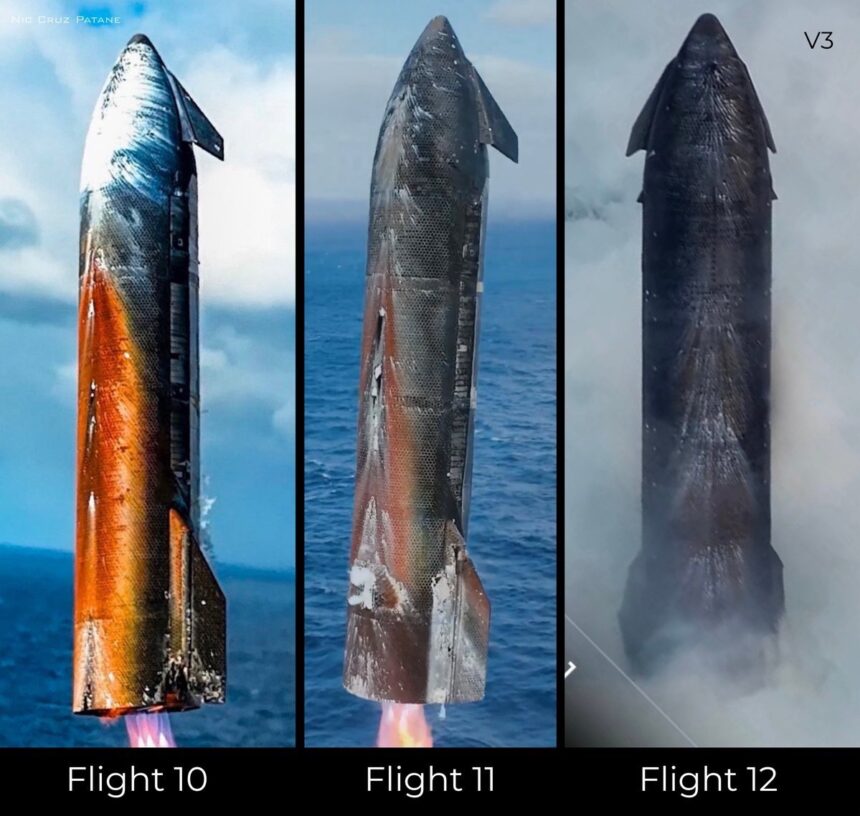
Hadfield shared his analysis on X, noting the physics of reentry: spacecraft rely on atmospheric drag to decelerate, generating extreme heat. Orbital returns typically reach around 1650 degrees Celsius (3000 degrees Fahrenheit), while high energy lunar returns can soar to 2750 degrees Celsius (5000 degrees Fahrenheit). For Starship’s Flight 12, the peak temperature was a comparatively moderate 1450 degrees Celsius (2600 degrees Fahrenheit). Accompanying his post was a compelling side by side image compilation by space enthusiast @niccruzpatane, juxtaposing the vehicle’s condition after Flights 10, 11, and 12 and showing clear reductions in charring, tile stress, and overall damage.
“The visible progress across flights 10 to 12 is not just lower damage. It is lower damage with reduced refurbishment,” Hadfield emphasized in follow up commentary. “Making them truly reusable is complex and necessary for permanent, cheap space access.”
Early Starship Flights: Building the Foundation for Heat Shield Success
SpaceX’s Starship development program began with a series of increasingly ambitious test flights that gradually addressed the immense challenges of full reusability. The earliest integrated flights, such as Flights 1 through 4 in 2023 and 2024, focused primarily on proving basic ascent, stage separation, and survival through reentry. Heat shield performance in those missions was rudimentary at best. Many tiles were lost, flaps suffered burn through, and vehicles often disintegrated during descent. These tests provided critical data but highlighted that the thermal protection system required major iterations in tile materials, attachment methods, and gap sealing to withstand repeated plasma exposure.
More Read

By Flights 5 through 9, SpaceX introduced Version 2 hardware with improved tile layouts, secondary ablative layers on high stress areas like flaps, and more aggressive testing of missing tile scenarios. Success rates climbed. Boosters achieved catches in some cases, and upper stages completed controlled splashdowns. Yet heat shield durability remained the primary technical hurdle. Tiles still detached in clusters during peak heating, and refurbishment times between flights stayed longer than the airline like turnaround goals set by Elon Musk and the engineering team.
Flight 10: Aggressive Testing Reveals Strengths and Weaknesses
Starship Flight 10, launched on August 26, 2025, marked a significant step forward in heat shield experimentation. Using Booster 16 and Ship 37, the mission followed a suborbital trajectory. Engineers intentionally stressed the vehicle by removing dozens of tiles in strategic locations: 26 on the leading edge of the hull, another 26 on single layer ablative zones, and 17 in areas without ablative backing. They also installed experimental metallic tiles, including some with active cooling features, to explore alternatives to traditional ceramic designs.
During reentry, the ship encountered temperatures near 2600 degrees Fahrenheit. Post flight imagery revealed rust colored orange patches from oxidized metallic tiles and white insulation in deliberately exposed areas. While some flaps experienced partial burn through and an aft skirt anomaly occurred, the vehicle survived overall and achieved a precise splashdown. SpaceX viewed the flight as a roaring success because it gathered extensive data without catastrophic failure. The “crunch wrap” felt material placed between certain tile gaps in test sections performed well, preventing plasma intrusion and protecting the stainless steel structure underneath.
This flight demonstrated that targeted tile loss did not doom the vehicle when supported by improved underlying layers. However, the metallic tile experiment underperformed, leading to their removal in subsequent tests. Flight 10 set the stage for rapid iteration.
Flight 11: Refinements Build on Lessons Learned
Flight 11, conducted in mid October 2025, incorporated direct lessons from its predecessor. SpaceX expanded the successful “crunch wrap” sealing approach across more tile interfaces and eliminated problematic metallic tiles. Engineers continued missing tile tests but at a reduced scale to focus on durability rather than extreme stressing. The mission profile included dynamic banking maneuvers to simulate future return to launch site trajectories.
Reentry imagery and telemetry showed markedly better heat shield integrity. Fewer tiles detached, plasma infiltration decreased, and structural warping was minimized. The upper stage completed its objectives and splashed down successfully in the Indian Ocean. Analysts noted that the heat shield had reached an impressive level of maturity, with the new gap filler proving effective at maintaining tile alignment under thermal expansion and aerodynamic loads.
Booster performance also improved, though the focus remained on the upper stage’s thermal protection. This flight confirmed that incremental changes were translating into measurable reductions in post flight damage and required refurbishment.
Flight 12: Version 3 Debut Showcases Impressive Heat Shield Progress
Starship Flight 12, which occurred on May 22, 2026, represented the debut of the Version 3 configuration with Ship 39 and Booster 19. Launched from the new Pad 2 at Starbase in South Texas, the mission tested numerous upgrades: evolved Raptor engines, structural enhancements, extended heat shield coverage, and refined tile attachment techniques. The booster attempted a boostback burn but encountered engine issues that prevented full recovery. The upper stage, however, excelled.
Key objectives included deployment of 22 Starlink simulator satellites, one equipped with cameras to image the heat shield from orbit. A single Raptor engine relight was demonstrated in space. For reentry testing, engineers removed just a single tile in a low risk area to measure effects on neighboring tiles and performed aggressive flap maneuvers. Peak heating reached 1450 degrees Celsius, lower than full orbital expectations due to the suborbital profile.
More Read

Post splashdown drone and satellite imagery revealed the vehicle in its best condition yet. Most tiles remained firmly attached, discoloration was minimal, and damage requiring repair appeared substantially reduced compared with earlier flights. Hadfield’s shared compilation highlighted this clear visual progression: Flight 10 showed heavy orange and white patching, Flight 11 looked cleaner, and Flight 12 appeared largely intact aside from expected charring.
The ship performed its belly flop maneuver, survived the plasma sheath, and achieved stable descent before a planned passivation explosion upon ocean impact. This outcome validated the V3 heat shield design for more demanding future missions.
The Enduring Challenge of Reusable Heat Shields
Heat shields represent one of the most formidable engineering hurdles in reusable spacecraft design. Unlike expendable ablative shields used on capsules like Apollo or Dragon, Starship’s system, comprising tens of thousands of hexagonal ceramic tiles, must endure not only extreme heat but also repeated cycles of launch vibration, orbital thermal extremes, reentry plasma, and rapid turnaround with minimal maintenance.
SpaceX has iterated aggressively across the flights: improving tile attachment methods, adding gap fillers to prevent plasma intrusion, refining material formulations, and extending coverage to more areas of the vehicle. Elon Musk has repeatedly identified the fully reusable heat shield as Starship’s primary remaining technical challenge for achieving airline like operations, landing, refueling, and relaunching with little downtime.
Hadfield’s perspective carries particular authority. A decorated test pilot and engineer, he logged 165 days in space across three missions, including commanding the International Space Station in 2013. As the first Canadian to perform a spacewalk and operate the Canadarm, he has firsthand knowledge of the rigors of orbital mechanics and reentry. Hadfield has expressed admiration for Starship’s potential, even stating in past interviews that he would welcome the opportunity to fly aboard it.
Broader Context and Implications for Humanity’s Future in Space
These incremental successes are not occurring in isolation. Starship is central to NASA’s Artemis program, where human rated variants are planned to ferry astronauts to the lunar surface. Reliable, reusable thermal protection will be indispensable for safe returns from the Moon, and eventually Mars, at velocities that generate far greater heating loads.
Beyond government missions, affordable access enabled by Starship could unlock new industries: orbital data centers, large scale satellite constellations, space tourism, and even planetary colonization. Hadfield has long advocated for such progress, highlighting how falling launch costs make ambitious goals economically viable.
Experts note that while early flights prioritized survival, the focus is now shifting to durability and rapid refurbishment, exactly the metrics improving in Flights 10 through 12. As SpaceX gears up for Flight 13 and beyond, potentially including orbital attempts, in orbit refueling demonstrations, and booster catch attempts, the heat shield’s continued evolution will be watched closely by the global space community.
Hadfield’s endorsement underscores a broader truth: collaborative excitement and rigorous, data driven iteration are propelling us toward a multi planetary future. With each test, Starship edges closer to transforming science fiction into routine reality.
For more in depth coverage:
- SpaceX Starship Achieves Key Milestones in Recent Tests
- The Engineering Behind Reusable Rockets and Heat Shields
- Chris Hadfield on the Future of Human Spaceflight and Exploration
- NASA Artemis Program: Updates on Lunar Ambitions
- How Starship Could Transform the Space Economy
Briefly USA will continue monitoring developments from Starbase and providing analysis on this groundbreaking program. Stay tuned for the latest updates.