


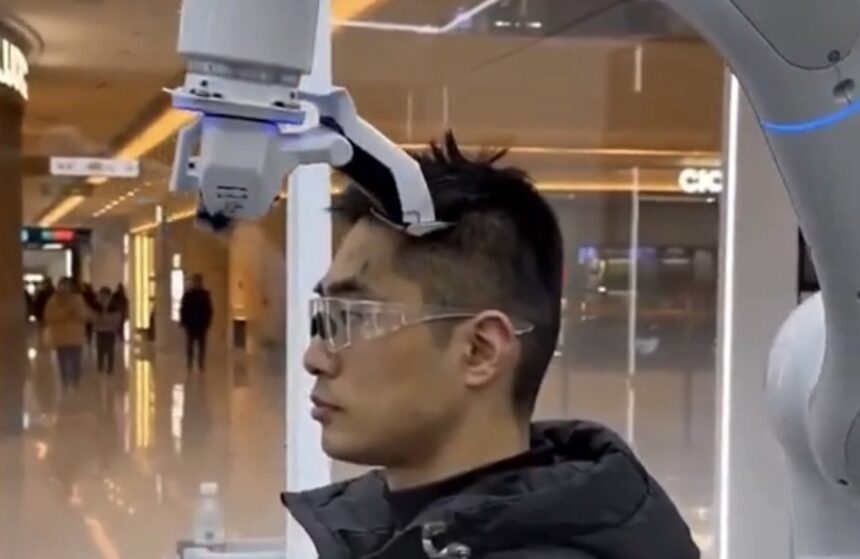
Shenzhen, China — In a striking example of how robotics and AI are infiltrating everyday consumer services, Chinese cities including Shenzhen are deploying AI-driven robot barber kiosks that deliver haircuts in minutes for a fraction of traditional costs.
These automated stations use advanced 3D scanning technology to map a customer’s head shape, facial features, and hair type. A robotic arm then executes the cut with millimeter-level precision, guided by AI algorithms that select and replicate thousands of possible styles. Sessions reportedly take just a few minutes, making them ideal for quick, on-the-go grooming in public spaces like malls.
Affordable Automation in Action
Pricing stands out as a major draw: reports cite costs as low as 3 yuan (roughly $0.40 USD), though some viral posts have referred to “60 yen” (a likely mix-up with Japanese currency, as the service operates in China). This ultra-low barrier positions the kiosks as an accessible option for budget-conscious consumers or those seeking fast, no-frills trims.
A viral video circulating on X (formerly Twitter) and shared by Cointelegraph shows a man wearing safety goggles seated in a public mall while a white robotic arm, equipped with sensors and a cutting tool, trims his hair. Clippings visibly fall as the arm moves with steady, mechanical accuracy.
Precision Grooming: Major urban centers across China have begun commercializing fully autonomous, AI-driven robot barber kiosks to offer rapid and highly uniform haircuts. As captured in image_32.png, the system utilizes advanced 3D structural scanning technology to map out the unique contours of an individual’s scalp and hair density before executing the trim with millimeter precision. Programmed with a wide variety of domestic and international styling templates, these automated booths operate around the clock. They cater heavily to budget-conscious consumers by slashing the price of a standard men’s trim to an ultra-cheap 60 yen ($0.40 USD), heavily disrupting the traditional local grooming service industry.
This rollout aligns with China’s broader push to integrate robotics into daily life. Shenzhen, a tech hub, has become a testing ground for AI applications ranging from robot janitors to smart retail solutions. Companies like RobotAnno, based in Shenzhen, specialize in commercial robotic arms for services including beverages and light industry tasks, technologies that appear adaptable to personal care.
More Read

Benefits and Broader Implications
Proponents highlight several advantages:
- Consistency and speed: Robots eliminate human variability and fatigue.
- Labor relief: In a country facing demographic shifts and rising wages, automation addresses shortages in service sectors.
- Accessibility: Low-cost options could democratize grooming, especially in high-density urban areas.
China’s aggressive robotics adoption extends beyond factories, aiming to maintain its edge in AI and automation amid global competition.
Concerns: Jobs, Trust, and the Human Touch
Not everyone is enthusiastic. Social media reactions include skepticism about safety (“One tiny malfunction and you’re scalped”), loss of the social “barbershop talk” experience, and fears of job displacement for traditional barbers.
Critics note that current systems likely excel at simple, uniform styles (like buzz cuts or basic trims) but may struggle with complex, creative cuts requiring artistic judgment. Hygiene, maintenance, and customer comfort in a public kiosk setting also raise questions.
This development echoes earlier experiments worldwide, from 3D-scanned robotic haircuts in labs to pandemic-era DIY projects, but China’s scale and public deployment mark a significant step toward commercialisation.
The Road Ahead
As these kiosks expand, they could signal wider disruption in personal services. While unlikely to fully replace high-end salons emphasizing creativity and consultation anytime soon, they point to a future where routine tasks become increasingly automated, faster, and cheaper.
Would you trust a robot with your next haircut? For many in China’s bustling cities, the answer may soon be a quick, affordable “yes.” The experiment is underway, and the clips are already going viral.