


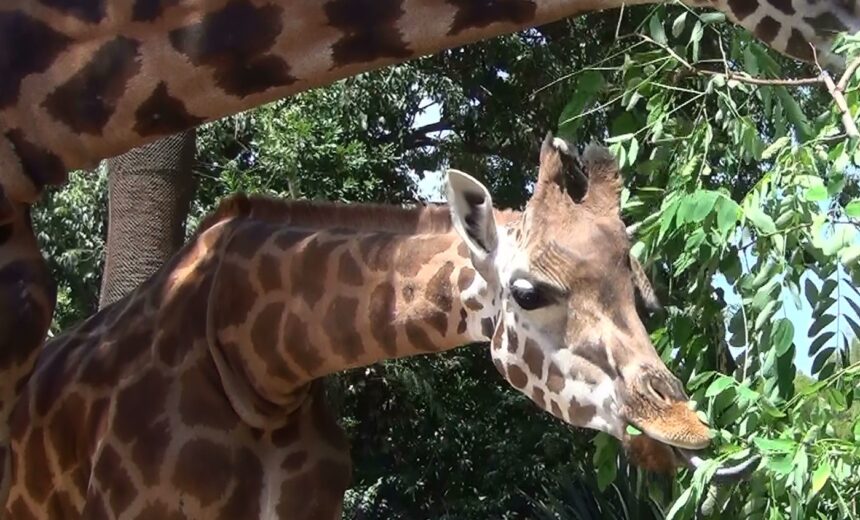
A new scientific study shows that at least some giraffes can mentally track and combine quantities of food in a way comparable to simple addition. In controlled experiments at the Barcelona Zoo, the animals performed significantly better than chance when choosing between hidden piles of carrots after watching additions to one pile.
The peer-reviewed research, published June 26, 2026, in the journal Scientific Reports, adds giraffes to a growing list of animals shown to handle basic numerical tasks without symbols or training. It highlights individual differences among the animals and notes that subtraction-style tasks proved more challenging.
What Happened?
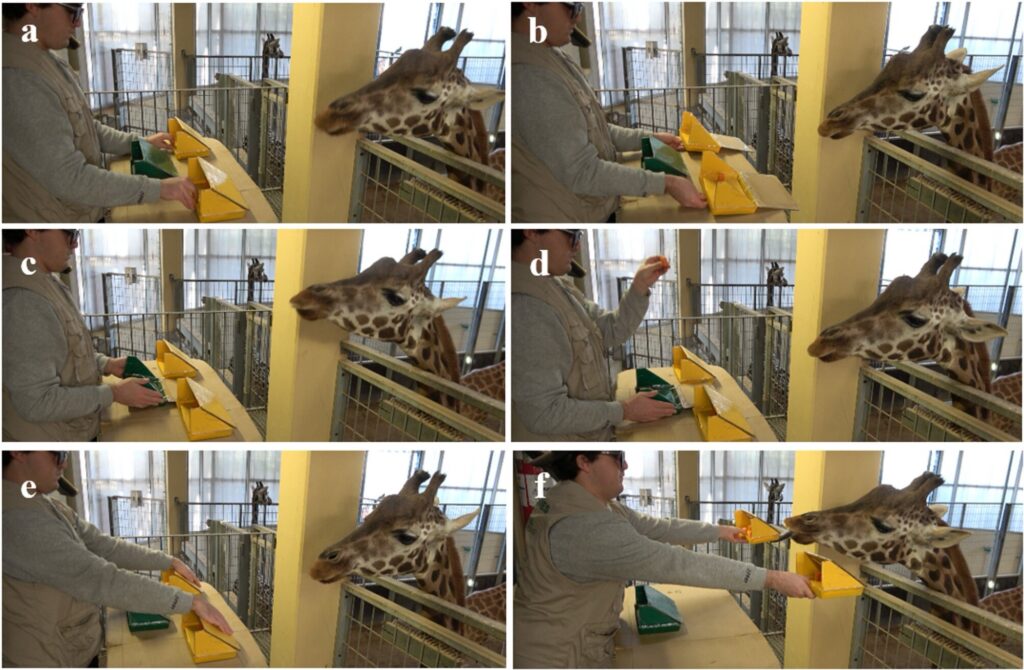
Researchers tested four giraffes using opaque containers and carrot pieces as rewards. The setup required the animals to remember initial quantities they saw briefly, then update those mental representations after watching changes they could not see in full.
In the key “combination” task, a researcher showed each giraffe two yellow containers holding different numbers of carrots. These were covered. A green container then held additional carrots (one to three pieces) that were added to one of the yellow containers while the giraffe watched the action. The giraffe then chose which yellow container it preferred by touching it. It never saw the final totals inside the closed containers.
More Read


Across trials, the giraffes chose the larger total quantity about 68% of the time well above the 50% expected by random chance. Two of the four animals continued to succeed even when researchers accounted for simpler strategies, such as always picking the container the experimenter had last touched.
The same giraffes performed at chance levels in tasks involving removal of items (dissociation, roughly analogous to subtraction) or more complex transfers between containers.
Key Details of the Experiment
More Read

• Subjects: Four captive giraffes at Barcelona Zoo—Nakuru (male, approximately 8 years old), Njano (male, approximately 7 years old), Nuru (female), and Yalinga (female). These same individuals participated in a 2023 study on statistical reasoning.
• Rewards: Carrot pieces in varying small quantities (typically in the range of 1–5 or so per initial pile, with manipulations of 1–3 items).
• Controls: Tasks where quantities remained visible throughout or where no manipulation occurred, to confirm the animals understood the basic choice format.
• Analysis: Statistical modeling accounted for factors like side bias, session effects, and individual differences. Performance was compared against chance using binomial tests.
• No prior training: The giraffes solved the tasks spontaneously based on their existing cognitive abilities.
The study was led by Iker Loidi of the University of Barcelona’s Department of Clinical Psychology and Psychobiology and Institute of Neurosciences, with co-authors from the University of Leipzig, Max Planck Institute for Evolutionary Anthropology, Research Institute for Farm Animal Biology (Germany), and Barcelona Zoo staff.
More Read

Why This Matters
This research expands our understanding of animal cognition beyond the primate-heavy focus of many studies. Giraffes, as ungulates with relatively smaller brains relative to body size compared to great apes, demonstrate capabilities once thought more limited to certain lineages.
For an average reader, it underscores that sophisticated problem-solving can evolve independently in different species facing similar survival pressures. In the wild, giraffes navigate scattered food resources like acacia trees across the savanna and live in fluid social groups that split and merge. The ability to estimate and update quantities could aid efficient foraging decisions—knowing roughly where more food might be available without constant visual confirmation.
The findings also reinforce patterns seen across species: addition-like tasks often prove easier than subtraction-like ones. Researcher Iker Loidi noted consistency with human experience, where “subtraction is more difficult than addition” and engages more controlled, effortful brain processes.
On a broader level, such studies challenge overly human-centered views of intelligence. They show that complex quantitative skills are not exclusive to primates and can appear in other groups through convergent evolution similar solutions arising independently due to comparable ecological demands.
For zoos and animal welfare, insights into cognitive abilities can inform enrichment programs that provide mental stimulation matching animals’ natural capabilities. Public interest in these discoveries also supports science communication and conservation awareness for giraffes, whose wild populations face habitat and poaching pressures.
Background and Timeline
Animal cognition research has a long history, from early 20th-century debates over “Clever Hans” (a horse that appeared to do arithmetic but responded to subtle human cues) to modern ethological and comparative psychology studies. Non-symbolic quantity discrimination judging more vs. fewer without counting appears widespread in vertebrates and even some invertebrates.
Ungulates (hoofed mammals) have received less attention than primates or birds until recently. Giraffes stand out because of their unique anatomy, social structure, and foraging ecology.
Key timeline:
• 2023: The same research team and giraffes publish findings on statistical reasoning abilities, showing the animals could use probabilistic information to maximize food rewards—one of the first such demonstrations in a species with a relatively small brain-to-body ratio.
• June 26, 2026: “Assessing quantity combination and dissociation in giraffes” appears in Scientific Reports (Nature portfolio). DOI: 10.1038/s41598-026-54126-7.
• Early July 2026: University of Barcelona issues communications highlighting the work; widespread media coverage follows.
The new study builds directly on the 2023 work by testing more dynamic quantity manipulations.
What Researchers Have Said
From the University of Barcelona’s Institute of Neurosciences coverage and paper context:
Iker Loidi explained the experimental logic: “The change could involve adding food, as in addition; removing food, as in subtraction; or carrying out sequential operations, such as removing food from one option and adding it to the other.”
On the results and human parallels: “These results are consistent with what we observe in humans: there are individual differences in numerical problem-solving and, in general, subtraction is more difficult than addition.”
Regarding evolutionary context: “The demanding socio-ecological conditions faced by giraffes could explain the notable development of their numerical abilities. They live in communities that split into smaller groups and regroup according to environmental conditions, and their main food sources—particularly acacia trees—are scattered across the savanna, which could encourage the need to estimate where, when and in what quantities these resources are available in order to optimize foraging decisions.”
Loidi also emphasized broader implications: “These findings help challenge an overly anthropocentric view of cognition and highlight the importance of studying a wider diversity of groups and species in order to better understand the evolution of the animal mind.”
The paper itself concludes that giraffes appear capable of mentally tracking quantity manipulations, likely via perceptual memory-based mechanisms that may form a foundation for proto-arithmetic abilities.
Frequently Asked Questions
Do giraffes actually understand math like humans?
No. The study demonstrates basic quantity tracking and mental updating similar to simple addition in a specific food-choice context. It does not involve symbols, counting, or abstract arithmetic.
Why use carrots in the experiment?
Carrots serve as a highly motivating food reward that giraffes readily work for. Small, countable pieces allow precise manipulation of quantities while keeping the task manageable.
How many giraffes were tested, and did they all succeed?
Four giraffes participated. Performance was above chance overall in the addition-like task, with two individuals showing stronger evidence of mental tracking even after controlling for simpler strategies. Individual variation is common in such studies.
Is this the first evidence of numerical abilities in giraffes?
No. The same research group previously demonstrated statistical reasoning in these animals. Quantity discrimination (more vs. fewer) has been shown in various species, but dynamic combination tasks like this are rarer.
What are the limitations of the study?
The sample size is small (four animals), limiting broad generalizations. The setup used manual manipulation by researchers, and future work could employ automated methods. It does not separate pure number from other cues like volume or mass.
Conclusion
The University of Barcelona study provides clear, controlled evidence that giraffes possess cognitive tools for mentally combining quantities in ways that support effective decision-making. While not “math class” for giraffes, it reveals sophisticated perceptual and memory abilities shaped by their environment.
These findings enrich our picture of animal minds and remind us that intelligence takes many forms across the tree of life. Continued research into diverse species will likely uncover even more surprising capabilities.
For readers interested in the science of animal minds, this work offers an accessible entry point into comparative cognition—one carrot at a time.
This article draws directly from the peer-reviewed paper, university communications, and verified experimental details to deliver context and explanation beyond basic news reporting.