


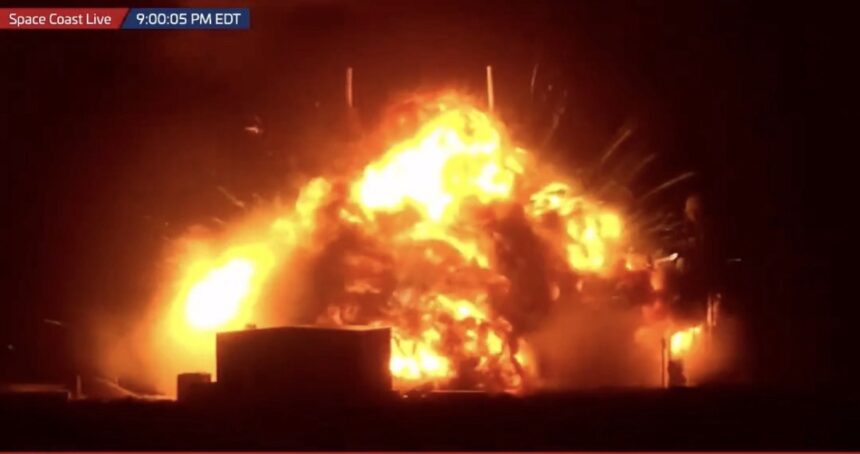
Blue Origin’s New Glenn rocket exploded on the launch pad at Cape Canaveral Space Force Station in Florida tonight during a static fire test, sending a massive fireball into the night sky visible for miles. The explosion occurred at approximately 9:00 PM ET on Thursday, May 28, 2026.
Blue Origin confirmed the incident on X within the hour, stating: “We experienced an anomaly during today’s hotfire test. All personnel have been accounted for.” The company provided no additional details about the cause of the explosion.
Brevard County Emergency Management issued a public notice shortly after 9:30 PM, confirming the anomaly and stating there is no threat to the general public.
What Was Happening When the Rocket Exploded
Blue Origin had been preparing New Glenn for its fourth mission, which was scheduled to carry Amazon Leo internet satellites to orbit. The company had been fueling the rocket Thursday evening in advance of a planned hotfire, or static fire, test of the rocket’s main engines.
A static fire test is a ground-based engine ignition where the rocket remains bolted to the launch pad while engineers verify that the engines are functioning correctly ahead of an actual launch. It is a standard pre-launch procedure used across the spaceflight industry. The rocket does not leave the pad during a static fire. Tonight’s test did not go as planned.
More Read

Live streams from NASASpaceFlight.com and Spaceflight Now captured the moment of the explosion. Footage shared widely on social media shows the rocket engulfed in a fireball at Launch Complex 36 at Cape Canaveral. An image captured by a viewer and shared with local news station News 6 shows the massive fireball visible from a significant distance.
No Injuries Reported
Blue Origin confirmed that all personnel have been accounted for. No injuries have been reported. The explosion occurred at a launch pad and not in a populated area. Brevard County Emergency Management has confirmed there is no threat to the public.
The FAA, NASA, and the US Space Force had not responded to media requests for comment at time of publication.
More Read

New Glenn’s Recent History
New Glenn is Blue Origin’s heavy-lift orbital rocket, named after astronaut John Glenn. It is significantly larger than the company’s older suborbital New Shepard vehicle and represents Blue Origin’s primary vehicle for competing in the commercial launch market dominated by SpaceX’s Falcon 9.
The rocket’s launch history before tonight’s explosion:
Mission 1 (January 2025): New Glenn’s first launch reached orbit successfully, a significant milestone for Blue Origin after years of development delays. The booster did not land successfully on the return attempt.
Mission 2: Details on this mission were not immediately available at time of publication.
Mission 3 (April 2026): New Glenn launched successfully and the reused rocket booster landed for the second time on one of Blue Origin’s drone ships. However, the mission experienced a cryogenic failure in the upper stage during flight, which led to the loss of the satellite payload.
Mission 4 (Tonight): The rocket exploded on the pad during a static fire test before the mission could launch.
The upcoming fourth mission was planned to be the first of 24 launches that Amazon has contracted Blue Origin to carry out as part of its Project Kuiper satellite internet network, known as Leo. Amazon is building the network as a direct competitor to SpaceX’s Starlink. The loss of the vehicle on the pad tonight will significantly delay that program’s launch schedule.
What a Static Fire Test Is and Why It Failed
A static fire test is designed to catch problems before a rocket leaves the ground. The vehicle is fueled, the engines are ignited, and the systems run under real operating conditions while the rocket remains secured to the launch structure. If something goes wrong, it happens on the pad rather than during flight.
Tonight something clearly went wrong. The exact cause of the anomaly has not been disclosed by Blue Origin. An investigation will follow, likely led by Blue Origin internally with oversight from the FAA, which regulates commercial space launches in the United States. The FAA typically opens a mishap investigation for any anomaly of this nature.
The previous mission’s cryogenic failure in the upper stage, which occurred during flight in April 2026, may be relevant context for investigators, though it is too early to draw any connection between the two incidents.
What This Means for Blue Origin and Amazon
Tonight’s explosion is a serious setback for Blue Origin on multiple fronts.
The rocket itself is destroyed. New Glenn is a large, expensive vehicle that takes significant time and resources to build. The loss of the vehicle on the pad means Blue Origin’s launch cadence will pause while the company investigates, rebuilds, and clears the vehicle for return to flight.
The Amazon Kuiper contract is delayed. The fourth New Glenn mission was the first under a 24-launch contract Amazon signed with Blue Origin to build out its Kuiper satellite internet constellation. Amazon has been under competitive pressure to accelerate Kuiper deployment given SpaceX’s substantial head start with Starlink. Tonight’s explosion sets that timeline back.
The investigation will take time. The FAA’s mishap investigation process for incidents of this severity typically takes weeks to months before a return to flight is authorized. Blue Origin cannot launch New Glenn again until the investigation is complete and the FAA grants clearance.
Competitor dynamics. SpaceX, which operates the Falcon 9 and Falcon Heavy rockets and the Starship vehicle, remains the dominant player in the commercial launch market. Blue Origin has been working to establish New Glenn as a credible alternative. Tonight’s incident adds to the challenge.
Blue Origin’s Statement in Full
Blue Origin’s statement on X reads in full: “We experienced an anomaly during today’s hotfire test. All personnel have been accounted for. We will provide updates as we learn more.”
The company has not provided a press conference or further comment as of 10:15 PM ET.
What Comes Next
The immediate next steps following tonight’s explosion are likely to include:
A full site assessment and cleanup at Launch Complex 36. An FAA-led mishap investigation into the cause of the anomaly. Blue Origin’s own internal investigation running in parallel. A return to flight review process before New Glenn can launch again. A revised timeline for the Amazon Kuiper missions.
Blue Origin has not commented on any of these timelines and is unlikely to do so until the initial investigation has had time to establish what caused the explosion.
The Bottom Line
Blue Origin’s New Glenn rocket exploded on the launch pad at Cape Canaveral at approximately 9 PM ET on May 28, 2026, during a pre-launch static fire test. No injuries were reported. The cause of the anomaly has not been disclosed. The explosion destroys the vehicle and delays Blue Origin’s fourth New Glenn mission, which was the first of 24 contracted launches for Amazon’s Kuiper satellite internet network.
This is a developing story. BrieflyUSA will update this article as Blue Origin, the FAA, and federal officials release further information.
Related reading: Anthropic Raises $65 Billion at $965 Billion Valuation, Surpassing OpenAI | Grok Build 0.2.7 Drops: Shared Terminals Across Subagents Are Here | What Is Agentic AI Explained Simply