


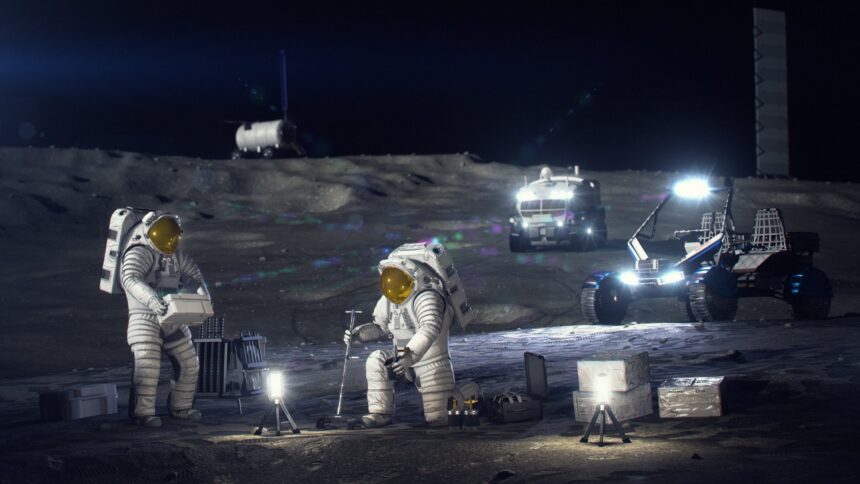
In a bold step forward for human space exploration, NASA has announced plans to establish Moon Base, a permanent lunar habitat supporting long-duration astronaut missions, scientific research, and preparation for future Mars expeditions. The announcement, shared via NASA’s official X account on May 20, 2026, highlights the habitat’s role in the Artemis program and teases a major live briefing scheduled for May 26 at 2 p.m. ET.120
The post features striking imagery of astronauts working on the lunar surface amid illuminated equipment, rovers, and modules against the stark, cratered backdrop of the Moon likely near the South Pole. This vision marks a shift from short Apollo-style visits to a sustained outpost, aligning with broader U.S. space policy goals.
Background: From Artemis to Enduring Presence
NASA’s Moon Base builds on the Artemis program, which aims to land the first woman and next man on the Moon while fostering international and commercial partnerships. Recent milestones include the successful Artemis II orbital mission in April 2026, providing critical data for surface operations.
In March 2026, during NASA’s “Ignition” event, Administrator Jared Isaacman unveiled a phased $20-30 billion plan over the next decade to accelerate lunar landings and establish a U.S. Moon Base by around 2036. This includes pausing the lunar Gateway orbital station in its current form to redirect resources toward surface infrastructure.
The strategy responds to the National Space Policy, emphasizing American leadership amid great-power competition. “The clock is running,” Isaacman stated, underscoring the need for rapid progress.
More Read

Phased Approach to Building the Moon Base
NASA outlines three deliberate phases for Moon Base development at the lunar South Pole, chosen for near-constant sunlight on crater rims, access to water ice in permanently shadowed regions, and scientific potential.
Phase One: Build, Test, Learn (Ongoing through ~2028)
Focus shifts to frequent, modular missions using Commercial Lunar Payload Services (CLPS) and Lunar Terrain Vehicles (LTVs). Up to 21-30 robotic landings will deliver rovers, instruments, power systems (including radioisotope heater units and thermoelectric generators), communications networks, and science payloads. This phase emphasizes mobility, power reliability, and data collection. Key assets include VIPER rover and LuSEE-Night mission.
Phase Two: Establish Early Infrastructure (2029–2032)
Semi-habitable setups enable recurring crewed operations. International partners contribute significantly: Japan’s JAXA provides a pressurized rover for extended expeditions (traveling ~3.5 km/h, carrying cargo, surviving shadows). Additional rovers, payloads, and logistics build operational tempo.
More Read

Phase Three: Enable Long-Duration Human Presence (2033–2036)
Cargo-capable Human Landing Systems (HLS) deliver heavy infrastructure, transitioning to a permanent base. Italy’s ASI Multi-purpose Habitats (MPH), Canada’s Lunar Utility Vehicle, and expanded habitation modules come online. Power scales with solar arrays, RTGs, and eventually nuclear reactors. In-situ resource utilization (ISRU) ramps up for oxygen, water, and construction materials from regolith.40n0PSv”LARGE”
By the mid-2030s, crews could stay for weeks to months, with landings every six months or more frequently as capabilities mature.
Technological Challenges and Solutions
Building on the Moon presents formidable hurdles: extreme temperatures (-170°C to 110°C swings), vacuum, radiation, micrometeorites, and abrasive regolith dust.
Power and Energy: South Pole sites offer near-continuous sunlight but face extended shadows. Initial solar arrays pair with radioisotope systems; nuclear fission reactors (e.g., building on Kilopower/KRUSTY tech) aim for 10-40 kW reliable output. NASA advances Space Reactor-1 Freedom demonstrations.
Radiation Protection: Beyond Earth’s magnetosphere, galactic cosmic rays and solar particle events pose risks. Habitats will use regolith shielding, water layers, or advanced materials. Expandable/inflatable modules from partners like Max Space offer efficient, launch-light options.
Life Support and Habitation: Multi-purpose habitats provide environmental control, life support (ECLSS), airlocks, and workspaces. Designs draw from ISS experience but adapt for lunar gravity (1/6th Earth’s) and dust mitigation. 3D printing with regolith enables on-site construction.
ISRU and Sustainability: Extracting oxygen from regolith, mining ice for water/propellant, and producing construction materials reduce Earth dependency. Robots and autonomous systems handle initial setup.
Mobility: LTVs, pressurized rovers, and hoppers/drones expand exploration range across hundreds of square miles.
Scientific and Strategic Importance
Moon Base unlocks unparalleled science: studying lunar geology, volatiles (water ice could support propellant and life support), solar system history, and astrophysics from a stable platform. It tests technologies for Mars—radiation shielding, ISRU, long-duration psychology, and closed-loop systems.
Economically, it fosters a lunar economy via commercial partnerships, resource utilization, and tourism potential. Strategically, it asserts U.S. leadership while enabling international collaboration under Artemis Accords.
International and Commercial Partnerships
Key contributors include:
- JAXA: Pressurized rover.
- ASI (Italy): Multi-purpose habitats.
- CSA (Canada): Lunar Utility Vehicle.
- Commercial firms via CLPS, HLS (SpaceX, Blue Origin, etc.), and habitat developers.
This collaborative model distributes costs and accelerates innovation.
Public Reaction and Skepticism
The X post garnered massive engagement—millions of views, tens of thousands of likes, and lively replies. Enthusiasm mixes with memes (“Moon Base Alpha,” John Madden references), calls for naming conventions (e.g., Jamestown), and skepticism from conspiracy theorists or budget hawks. Some question timelines and costs amid competing priorities.
Critics note historical delays in Artemis and technical risks, but proponents highlight momentum from reusable rockets, private investment, and policy focus.
Path to Mars and Beyond
Moon Base serves as a proving ground. Lessons in sustained operations, resource use, and deep-space logistics directly inform crewed Mars missions. Nuclear propulsion advancements (e.g., SR-1 Freedom) bridge the gap.
As Isaacman emphasized, success here pales compared to future achievements. The May 26 briefing, featuring Isaacman, acting associate administrator Lori Glaze, and Moon Base program executive Carlos García-Galán, will detail partners, timelines, and progress.
Looking Ahead
NASA’s Moon Base represents humanity’s next giant leap—from flags and footprints to boots on the ground for extended periods, science outposts, and stepping stones to the solar system. Challenges remain—funding, technical hurdles, geopolitical dynamics—but the vision is clear: an enduring human presence beyond Earth.
This isn’t science fiction anymore. With dozens of missions, international teamwork, and commercial innovation, a lunar habitat where astronauts live and work long-term edges closer to reality. Watch the May 26 briefing for the latest updates. The Moon awaits.