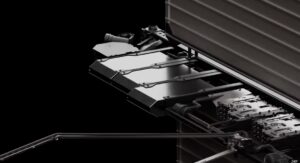


Blue Origin‘s Blue Moon Mark 2 (MK2) spacecraft is a larger, crewed landing system that Bezos’s company hopes will be used to ferry astronauts from a craft in lunar orbit to the moon’s surface and back. MK 2 will potentially take part in 2027’s Artemis III mission, which will test the ability of NASA’s crewed Orion spacecraft to rendezvous and dock with a commercial lunar lander. Both MK2 and a moon lander variant of SpaceX’s Starship are candidates for the mission.
But before Blue Origin’s crewed lander takes center stage, there is an intermediate step that has just added a significant wrinkle to the lunar logistics puzzle. Blue Origin’s “Pathfinder” mission, a test landing of the cargo-only Mark 1 version of its lander on the moon, has been proposed for later this year. According to NASA, if the mission is successful, another Mark 1 lander will, by late 2027, carry the agency’s science rover VIPER (Volatiles Investigating Polar Exploration Rover) to the lunar south pole, where it will prospect for water ice.
The twist: SpaceX’s Starship is being positioned as the launch vehicle for Blue Origin’s uncrewed cargo lander. That arrangement places two competing companies in a partnership where one is literally launching the other’s hardware into space. It is an arrangement born of necessity, desperation, and the peculiar economics of the emerging lunar economy.
The Blue Moon Mk1 “Endurance”: A Stepping Stone
The Mark 1 variant of Blue Moon, which Blue Origin calls “Endurance,” is fundamentally different from the crewed Mark 2 that will eventually ferry astronauts to the lunar surface. During the course of the testing at the agency’s Johnson Space Center, Endurance was subjected to conditions similar to those in space, including extreme temperatures and the stresses of a vacuum. Data from these tests will now be analyzed and used to improve MK1’s design, as well as that of Blue Origin’s Blue Moon Mark 2 (MK 2) spacecraft.
More Read

The Endurance is a cargo vehicle designed to carry payloads, including scientific instruments and exploration equipment, to the lunar surface. It is smaller, lighter, and mechanistically simpler than the crewed variant. But it is also an essential proof of concept. If Blue Origin cannot land an uncrewed cargo lander reliably on the Moon, the prospect of landing astronauts becomes considerably more fraught.
Why SpaceX Is Launching Blue Origin’s Lander
NASA Administrator Jared Isaacman said that SpaceX and Blue Origin would only be able to prepare their landing modules for Artemis III by the end of 2027. As Isaacman noted, both SpaceX and Blue Origin have confirmed their readiness to conduct docking tests and verify module compatibility by the end of 2027.
More Read

That tight timeline is the reason for the unusual partnership. Blue Origin’s New Glenn rocket, which would normally be the natural choice to launch its own lander, has experienced setbacks. Blue Origin just hit a bump in the road toward that liftoff. The company hopes to ramp up the rocket’s launch cadence this year, but it’s been grounded by the Federal Aviation Administration since its last flight on April 20 because it put a satellite in the wrong orbit.
With New Glenn grounded and time running out before the Artemis III mission window, Blue Origin has turned to SpaceX as a launch provider. SpaceX’s Starship, despite its own recent setbacks and delays, remains the most available heavy-lift capacity in the world. Using Starship to launch Blue Origin’s cargo lander is not the outcome either company would have chosen, but it is the outcome the schedule demands.
The Broader Artemis Strategy
Artemis III is an upcoming spaceflight mission, planned to be the second crewed mission in NASA’s Artemis lunar exploration program, with a targeted launch in late 2027. The crew will launch aboard the Space Launch System (SLS) rocket carrying the Orion spacecraft. Astronauts will test the docking of the Orion capsule with at least one, but possibly both, of the lunar landers from SpaceX and Blue Origin. They will also test propulsion, life support, and communication systems of the landers, and test the new spacesuits that will be used on the Moon, the Axiom Extravehicular Mobility Unit (AxEMU).
The strategy is redundancy through competition. NASA is not betting everything on one lander design. It is supporting both SpaceX and Blue Origin, allowing each to develop and test its approach. If SpaceX’s Starship HLS encounters problems during Artemis III, Blue Origin’s Mark 2 exists as a backup. If Blue Origin’s lander fails to perform, Starship is the fallback.
That competition has already begun showing results. NASA shared a photo of a full-scale prototype of the Blue Moon Mark 2 crew cabin, which has arrived at Johnson Space Center in Houston, Texas, to support training and testing. In a statement, the agency said it and its industry partners will use this prototype for Artemis 3 and 4 mission simulations. Meanwhile, SpaceX is conducting its own test flights and refinements to the Starship HLS configuration.
More Read

The New Glenn Factor
The complications around New Glenn are significant because the rocket represents Blue Origin’s long-term strategy for heavy-lift access to space. Unlike SpaceX, which owns and operates Starship exclusively, Blue Origin needed New Glenn to remain competitive in the lunar logistics market. The rocket’s grounding, while temporary, has shifted the near-term timeline and forced Blue Origin into a supplier relationship with a competitor.
NASA Chief and Blue Origin Executives recently inspected the New Glenn explosion site, which is a reference to the earlier setback. Recovery from that incident and getting New Glenn back to regular flight status is now critical not just for Blue Origin’s long-term ambitions but for its ability to execute near-term commitments independently.
What Success Looks Like
For this partnership to work, everything needs to execute on schedule. SpaceX needs to complete its next-generation Starship test flight and then conduct a crewed Artemis III docking demonstration. Blue Origin needs to land Endurance on the Moon, prove that the cargo variant works, and then complete the Mark 2 for crewed operations by 2027. NASA needs all of this to happen while managing the Space Launch System’s own schedule and keeping the Orion spacecraft development on track.
Artemis 3 slips to late 2027 as Starship and Blue Moon lag, delaying NASA’s lunar return timeline and jeopardizing a 2028 moon landing. The timeline is compressed. The technical risks are substantial. But the stakes are extraordinary.
The first human mission to land on the Moon since 1972 will now depend on whether a SpaceX rocket can successfully launch a Blue Origin lander. The Cold War space race was defined by two nations competing. This one is defined by two companies competing within a shared mission, sometimes as collaborators, sometimes as adversaries, always as parties to the highest stakes technology race on Earth.