

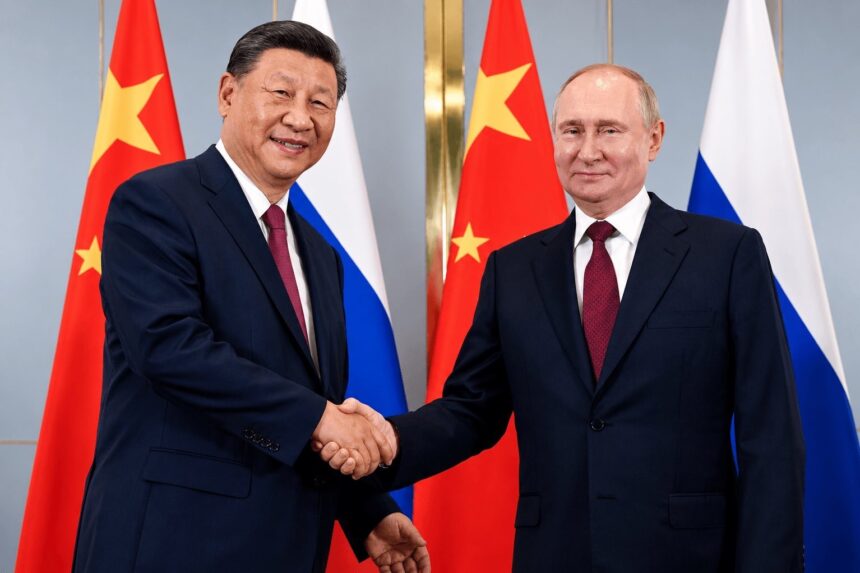
Beijing, May 20, 2026 — Russian President Vladimir Putin arrived in the Chinese capital today for high-level talks with President Xi Jinping, his first foreign visit of the year. The summit, held just days after U.S. President Donald Trump’s own trip to Beijing, underscores the enduring “no-limits” partnership between Moscow and Beijing as both nations navigate a complex geopolitical landscape marked by conflict in the Middle East, shifting U.S.-China relations, and Russia’s ongoing pivot away from European energy markets.6
A Pivotal Summit in a Volatile World
The two leaders, long-time strategic allies, greeted each other with warm handshakes and formal ceremonies outside the Great Hall of the People. Formal discussions focused on trade, energy cooperation, and international issues, with both sides pledging to deepen ties. Kremlin aide Yuri Ushakov confirmed that more than 40 documents are expected to be signed, covering economic and technological collaboration.13
Xi told Putin that China-Russia relations have entered a “new stage” characterized by stronger progress and quicker growth, according to Chinese state media. Putin, in turn, emphasized the “unprecedented level” of bilateral cooperation, highlighting a more than 30-fold increase in trade turnover over the past 25 years.3
The timing of the visit is significant. It follows a recent easing of U.S.-China trade tensions and occurs against the backdrop of the ongoing war in Iran, which has roiled global energy markets and heightened concerns over maritime chokepoints like the Strait of Hormuz. For Russia, the summit offers a chance to secure vital new revenue streams; for China, it provides an opportunity to diversify energy imports away from vulnerable sea routes.8
Power of Siberia 2: The Cornerstone of Energy Ambitions
At the heart of the discussions is the long-awaited Power of Siberia 2 (PoS-2) natural gas pipeline project. This ambitious 2,600-kilometer infrastructure endeavor would transport up to 50 billion cubic meters (bcm) of Russian gas annually from the Yamal Peninsula through eastern Mongolia to northern China.17
More Read

Russia has been aggressively pushing for the deal since losing access to European markets following the 2022 invasion of Ukraine. PoS-2 would complement the existing Power of Siberia 1 pipeline, which has seen its capacity ramped up to around 44 bcm per year, and a newer Far East route. Combined, these could see Russia supplying China with over 100 bcm annually by the early 2030s — roughly equivalent to pre-war European export volumes.25
In September 2025, Gazprom and China National Petroleum Corporation (CNPC) signed what Russia described as a “legally binding” memorandum to advance the project. However, key commercial details — including gas pricing, contract length, and financing — remain unresolved. Russia is seeking terms closer to its former European contracts, while China has driven a hard bargain, preferring lower prices aligned more closely with domestic or spot market rates.14
Analysts note that the Iran conflict has given Moscow renewed leverage. Disruptions in Middle Eastern energy flows have prompted Beijing to reassess its reliance on liquefied natural gas (LNG) imports, making overland pipeline supplies more attractive for energy security. China’s 2026-2030 five-year plan explicitly calls for advancing preparatory work on the “central route” of China-Russia gas pipelines, widely interpreted as a green light for PoS-2.28
More Read

Putin is reportedly seeking Chinese investment and a final commercial agreement during this visit. If successful, deliveries could begin around 2030, providing Russia with a critical economic lifeline amid Western sanctions. For China, the pipeline offers stable, land-based supplies less susceptible to naval blockades or price volatility in global LNG markets.20
Broader Economic and Trade Ties
Beyond energy, the summit highlights the remarkable growth in bilateral trade. Russia has become one of China’s top oil suppliers, with exports growing 35% in the first quarter of 2026. Much of this trade is now settled in rubles and yuan, reducing dependence on the U.S. dollar.37
Cooperation extends to technology, agriculture, and infrastructure. Both nations are exploring joint projects in artificial intelligence, electric vehicles, and Arctic development. Russia provides China with discounted energy and raw materials, while China supplies industrial goods, machinery, and consumer products that Moscow can no longer easily source from the West.32
Trade volume, which hit record highs in recent years, has seen some correction but remains robust at over $200 billion annually. Moscow hopes the summit will reverse recent dips and open new avenues for investment.38
Geopolitical Context: Countering “Hegemony”
The leaders used the platform to signal unity against what they describe as external “hegemony” and instability. Xi and Putin have long advocated for a multipolar world order, coordinating positions in forums like BRICS, the Shanghai Cooperation Organization (SCO), and the United Nations.40
The Ukraine conflict, now in its fifth year, and the Iran war are expected to feature in private discussions. While China has not provided direct military support to Russia, it has offered economic backing and diplomatic cover. Both sides are wary of escalating tensions with the West but see their partnership as a stabilizing force in an uncertain global environment.33
More Read

The summit also comes amid trilateral dynamics involving the United States. Trump’s recent Beijing visit focused on trade and technology issues. Putin’s arrival allows China to demonstrate that it maintains strong relations with multiple powers, enhancing its strategic flexibility.2
Challenges and Skepticism
Despite the optimistic rhetoric, hurdles remain. Some analysts question whether PoS-2 will ever fully materialize, citing prolonged negotiations, high construction costs, and China’s diversified energy strategy, which includes Central Asian pipelines and growing domestic renewable capacity. Beijing has historically been patient, using its strong negotiating position to extract favorable terms.9
Environmental concerns, technical complexities in routing through Mongolia, and potential financing gaps add layers of uncertainty. Deliveries, even if agreed upon, are years away, meaning the project offers limited immediate relief for Russia’s war-stressed economy.24
Looking Ahead
As talks continue into the evening with an informal tea session, expectations are tempered but hopeful. A breakthrough on PoS-2 would represent a major geopolitical win for Putin, solidifying Russia’s eastward reorientation. For Xi, it would bolster energy security and reinforce China’s role as a global power broker.16
The Russia-China partnership, forged through mutual necessity and shared strategic interests, continues to evolve. Whether this summit yields concrete pipeline agreements or remains largely symbolic, it sends a clear message: Moscow and Beijing are committed to deepening cooperation amid shifting global power dynamics.