

Seoul, South Korea — Optimistic forecasts suggest South Korea could significantly outpace Japan in GDP per capita by 2030, driven by its strong position in high-growth sectors like AI, semiconductors, and defense, according to market analyst Ryu Seung-il (@Yussoonn_).
In a widely discussed analysis shared on X, the analyst presented central and bull-case scenarios highlighting South Korea’s momentum. In the central case, South Korea is projected to reach a nominal GDP per capita of $51,000 and $92,000 in PPP terms, compared to Japan’s $41,700 nominal and $66,800 PPP. This would give Korea a 22% lead nominally and 38% in PPP.
The bull case widens the gap further, with South Korea at $56,000 nominal/$99,000 PPP versus Japan’s $46,000/$72,000.0
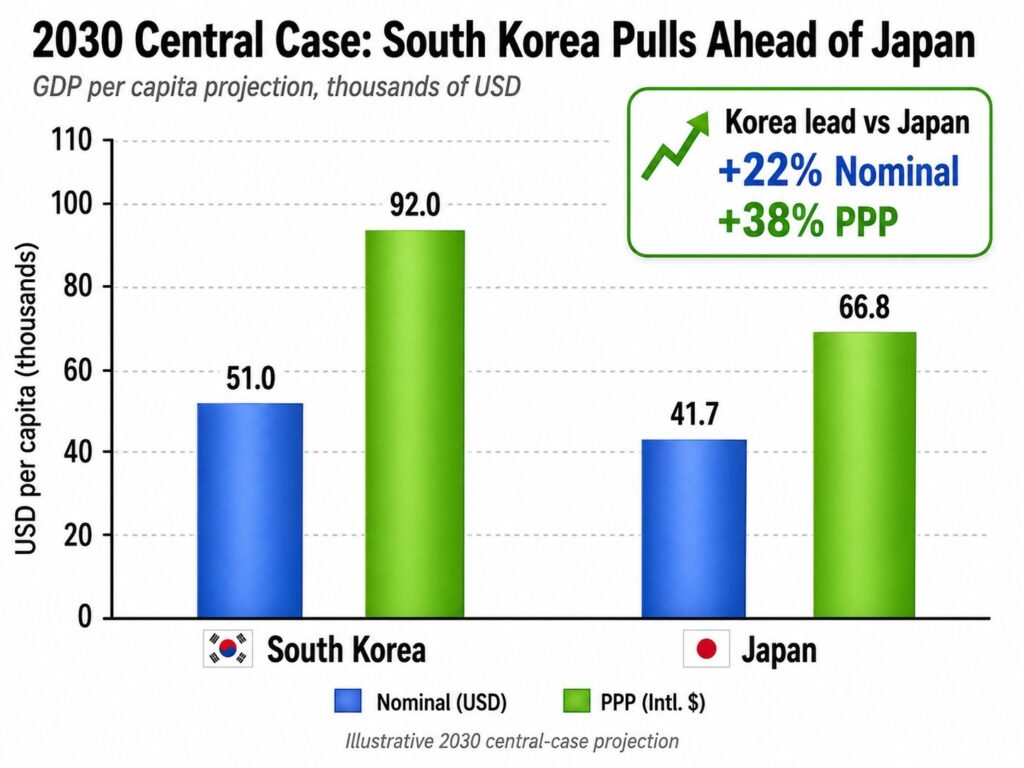
These projections, illustrated in comparative bar charts, assume continued strength in key Korean industries and structural reforms.
Key Drivers for South Korea
The analyst attributes Korea’s potential edge to several factors:
More Read

- AI and Semiconductors: Heavy exposure to the AI capex cycle, particularly high-bandwidth memory (HBM) chips, where companies like Samsung and SK Hynix lead.
- Diversified Exports: Growth in defense exports, electric vehicles/batteries, and shipbuilding.
- Reforms: Capital-market improvements, chaebol governance changes, and gains in SME productivity, potentially unwinding the long-standing “Korea discount.”
- Currency and Momentum: Even in a stronger Japan scenario, Korea benefits from deeper semiconducto upside and faster reforms.
Recent IMF data supports a narrowing gap in the near term. For 2026, the IMF projects South Korea’s nominal GDP per capita at around $37,410, ahead of Japan’s $35,700. Korea is expected to cross the $40,000 threshold by 2028, ahead of Japan.
Japan’s Position and Challenges
Japan maintains strengths in quality manufacturing, technology, and a large domestic market, but faces headwinds including demographic decline, slower productivity growth in some sectors, and currency volatility. A persistently weak yen could boost exports but limit real income gains in dollar terms.
Even assuming a more robust Japanese recovery, the analyst argues Korea’s sector-specific advantages in the global AI boom provide superior momentum.
More Read

Broader Context
South Korea has already surpassed Japan in real (PPP-adjusted) GDP per capita in recent years, a milestone that reversed decades of Japanese dominance. Nominal figures remain sensitive to exchange rates, but the trend reflects Korea’s rapid transformation from a catch-up economy to a high-tech leader.
Both nations navigate shared challenges like aging populations and global trade tensions, particularly around semiconductors and supply chains. Korea’s government has ramped up investments in AI infrastructure, defense tech, and manufacturing transformation, aiming for 500 AI-powered factories by 2030.
These projections remain illustrative and subject to economic uncertainties, including geopolitical risks, commodity prices, and global demand cycles. Institutional forecasts from bodies like the IMF tend to be more conservative than the bull scenarios outlined.
As East Asia’s economic rivalry evolves, South Korea’s focus on frontier technologies positions it for potential leadership in the next decade, while Japan continues efforts to revitalize growth through wage increases and innovation.