


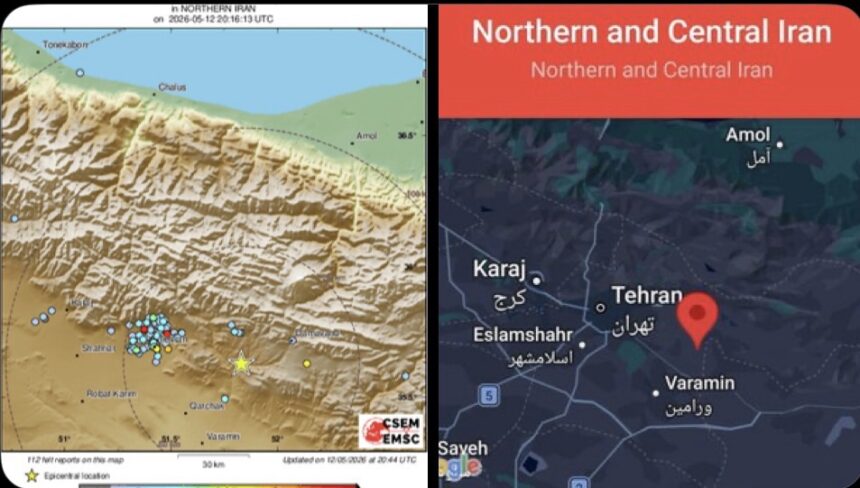
Tehran, Iran – A moderate earthquake shook the Iranian capital and surrounding areas on Tuesday evening, May 12, 2026, prompting residents to rush into the streets and sparking widespread speculation on social media.5
According to preliminary reports from Iranian sources and social media monitoring, the tremor registered approximately 4.6 magnitude and struck near the border between Tehran and Mazandaran provinces at a shallow depth of around 10 km (about 6 miles). The quake was felt strongly in parts of eastern Tehran, including areas like Pardis.0
No immediate reports of major casualties or widespread structural damage have been confirmed by official Iranian authorities as of late Tuesday. Videos circulating online showed people evacuating buildings and mild shaking in residential areas, typical for a quake of this size in a densely populated urban zone.
Seismic Context
Iran lies at the convergence of the Arabian and Eurasian tectonic plates, making it one of the most seismically active regions in the world. Tehran itself sits near several active fault lines, including the Mosha and North Tehran faults. A major earthquake in the capital has long been feared by experts due to the city’s rapid urbanization and older building stock in some districts. The last significant destructive quake directly impacting the Tehran area occurred nearly two centuries ago.
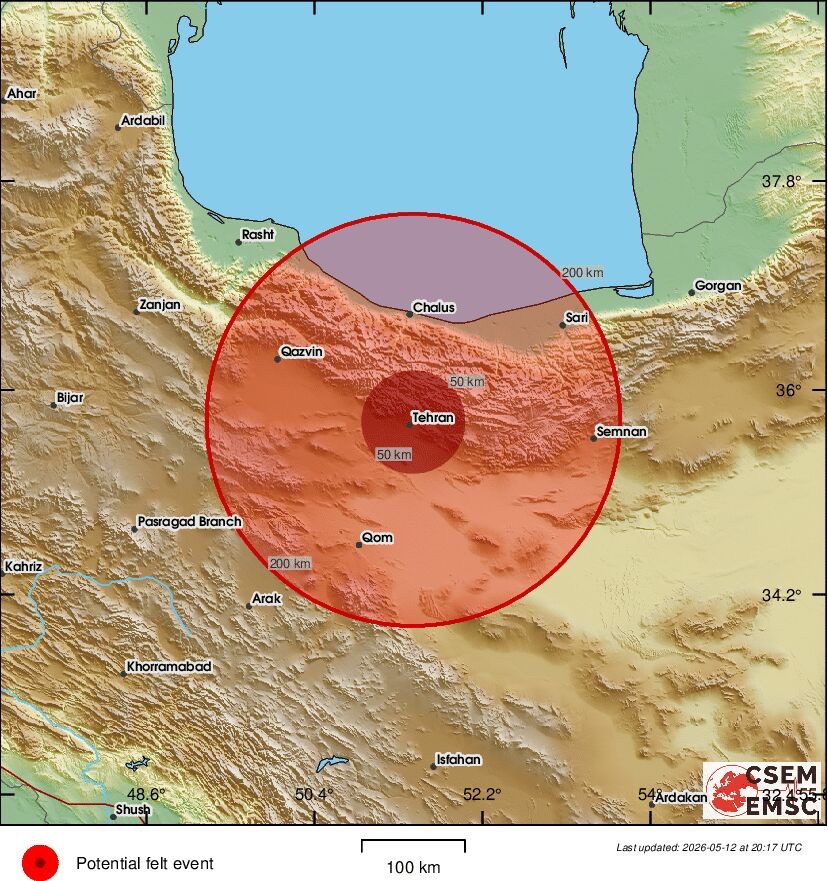
This seismic map from the European-Mediterranean Seismological Centre (EMSC) illustrates the potential impact area of a 4.6 magnitude earthquake that struck near Tehran on May 12, 2026. The inner red circle highlights the 50 km zone where shaking was most likely to be felt, while the broader 200 km radius extends north toward the Caspian Sea and south toward Qom. Despite the significant felt area, there have been no immediate reports of major casualties or infrastructure damage in the capital.
Graphic: EMSC-CSEM
Small to moderate earthquakes occur frequently across Iran. In recent days and weeks, multiple tremors of magnitude 4–5 have been recorded in western, southern, and northern parts of the country, none of which caused major damage.26
Social Media Reaction and Speculation
The timing of the event, amid ongoing geopolitical tensions involving Iran, led to rapid speculation online. The original post from the account @BRICSinfo quickly gained traction, with many replies questioning whether the shaking resulted from natural causes, a possible underground nuclear test, or even “engineered” external interference.5
Such conspiracy theories often surface after seismic events in geopolitically sensitive areas, but seismologists generally distinguish earthquakes (which produce specific waveform patterns) from explosions. No credible evidence has emerged suggesting anything other than natural tectonic activity in this case.
Iranian officials have not yet issued a detailed official statement on the quake’s impact, though local monitoring centers are expected to provide updates soon.
Background on Iran’s Seismic Risks
Experts have repeatedly warned about Tehran’s vulnerability. A large earthquake (magnitude 7+) in the greater Tehran metropolitan area could affect millions and severely strain infrastructure. Iranian authorities have been working on retrofitting programs and early-warning systems, though progress has been uneven.
Residents are advised to follow standard safety protocols: secure heavy furniture, prepare emergency kits, and heed any official guidance regarding aftershocks, which are common after moderate quakes.
This story is developing. Further updates will depend on official assessments from the Iranian Seismological Center and reports on any localized damage.
Note: This report is based on initial social media reports and available seismic data as of May 12, 2026. Official casualty and damage figures, if any, are pending confirmation.