

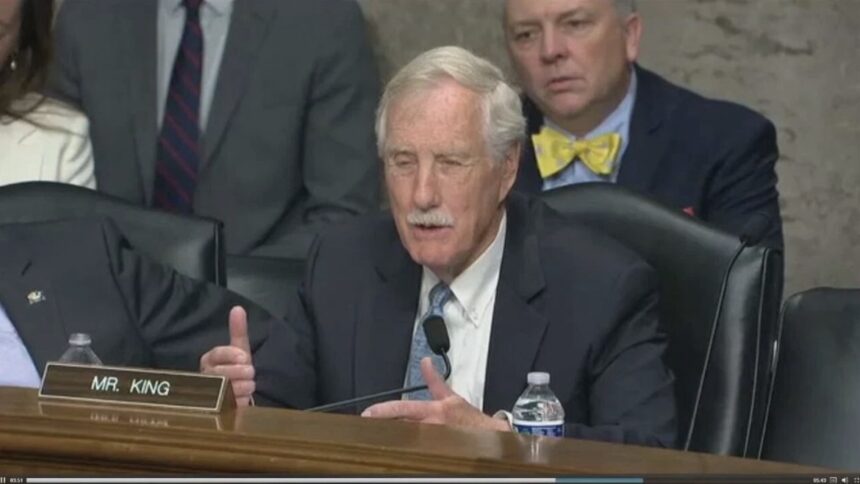
Washington, D.C. — May 21, 2026 — In a pointed rebuke during a Senate Armed Services Committee hearing, Independent Sen. Angus King of Maine lambasted a Pentagon proposal embedded in the Fiscal Year 2027 defense budget that allocates $1.85 billion for a comprehensive feasibility study on outsourcing significant portions of U.S. warship design and construction to allied nations South Korea and Japan.
The study, first reported by USNI News in late April, would examine the viability of adopting or co-producing advanced foreign hull designs including Japan’s stealthy Mogami-class frigates and South Korea’s Daegu-class frigates to bolster the U.S. Navy’s fleet amid persistent domestic shipbuilding bottlenecks.34
King, a staunch advocate for Maine’s shipbuilding industry, did not mince words when addressing Acting Secretary of the Navy Hung Cao. “Building American warships in South Korea or Japan is the worst idea since the Red Sox traded Babe Ruth to the Yankees,” he declared, drawing on local sports lore to underscore his opposition. “We have the skilled workers, the shipyards, and the know-how right here in America—especially at Bath Iron Works.”25
Domestic Shipbuilding Under Strain
The proposal emerges against a backdrop of well-documented challenges plaguing American naval shipbuilding. U.S. shipyards face chronic delays, ballooning costs, labor shortages, and aging infrastructure. Programs like the Virginia-class submarines and Constellation-class frigates have encountered significant setbacks, with delivery timelines slipping by an average of 26 months in recent years.5
Bath Iron Works (BIW) in Bath, Maine, remains a cornerstone of U.S. surface combatant production as the lead yard for Arleigh Burke-class destroyers. The yard has delivered dozens of these versatile guided-missile destroyers, which form the backbone of the Navy’s surface fleet. However, even BIW has struggled with schedule adherence. Construction times for Burke-class ships have roughly doubled compared to earlier flights, prompting the Navy to split recent multi-year contracts between BIW and Huntington Ingalls Industries’ Ingalls Shipbuilding in Mississippi.
More Read

BIW currently has multiple Flight IIA and Flight III Arleigh Burke destroyers under construction, including vessels like the future USS Harvey C. Barnum Jr. (DDG-124) and USS Louis H. Wilson Jr. (DDG-126). Despite recent contract awards exercising options for additional ships, workforce shortages and supply chain issues continue to hamper progress. King and other Maine lawmakers, including Sen. Susan Collins, have repeatedly pushed for sustained funding to protect and expand these domestic capabilities, arguing they are vital for national security and economic vitality in the state.
The Case for Allied Cooperation
Proponents of the Pentagon’s study argue that the U.S. cannot afford to wait for domestic capacity to catch up. China’s People’s Liberation Army Navy (PLAN) has surged ahead, now boasting the world’s largest fleet by hull count—estimated at over 370 ships and growing rapidly. Chinese shipyards, benefiting from massive state investment and dual-use commercial-military facilities, produce warships at a pace far exceeding the United States. Reports indicate China builds naval vessels at rates up to five times faster in some categories.
In stark contrast, South Korea and Japan operate among the world’s most efficient and technologically advanced shipbuilding sectors. South Korea, the global leader in high-tech commercial and naval construction after China, delivers complex destroyers in roughly three years—often at a fraction of U.S. costs. Firms like HD Hyundai, Samsung Heavy Industries, and Hanwha Ocean leverage automation, modular construction, and extensive experience from commercial orders. Japan excels in precision engineering and stealth technology, with the Mogami-class featuring advanced automation and a 5,500-tonne displacement optimized for multi-mission roles.
More Read

U.S. officials have increasingly explored allied integration. Hanwha’s acquisition of Philly Shipyard and ongoing maintenance agreements with South Korean yards signal growing cooperation. Analysts suggest that co-production or component sourcing could serve as a bridge while the U.S. invests in long-term revitalization efforts, including potential Maritime Opportunity Zones and workforce training programs.
The $1.85 billion study would not immediately authorize foreign construction but would assess technical, legal, and security implications. Current U.S. law, rooted in the Buy American provisions and longstanding policy, generally mandates that Navy warships be built domestically unless a presidential national security waiver is granted—a high bar that has rarely been cleared for major combatants.
King’s Counterarguments and Broader Concerns
Senator King submitted documentation during the hearing highlighting backlogs at Japanese and South Korean shipyards, arguing that outsourcing would not magically solve capacity issues and could introduce new vulnerabilities. He warned of technology transfer risks—even to trusted allies—potentially compromising sensitive U.S. systems like Aegis combat suites or advanced radar.
Critics of outsourcing echo these sentiments, emphasizing job losses in key congressional districts, the erosion of the domestic industrial base, and potential supply chain disruptions in a conflict scenario. Unions and shipbuilding associations have voiced strong opposition, framing the proposal as a threat to American manufacturing sovereignty.
Yet, many defense observers counter that the status quo is unsustainable. The Navy’s 30-year shipbuilding plan has faced repeated affordability and execution challenges. Achieving fleet goals often discussed in the range of 350 to 381 ships requires not just more funding but dramatically improved throughput. With only one new Arleigh Burke requested in the FY2027 budget baseline, growth remains modest.
Public reaction on platforms like X has been divided. While some users rallied behind King’s “America First” stance, others highlighted U.S. yards’ inability to deliver on time or on budget, urging pragmatic alliances to counter China. Veterans and analysts pointed to labor shortages, union constraints, and regulatory hurdles as root causes that decades of policy have exacerbated.0
More Read

Historical and Strategic Context
U.S. shipbuilding dominance during World War II when yards like BIW launched destroyers every 17 days—stands in sharp contrast to today’s realities. Post-Cold War drawdowns, consolidation, and the shift of commercial shipbuilding overseas hollowed out the sector. The U.S. now accounts for less than 1% of global commercial ship production, compared to China’s ~50%, South Korea’s ~30%, and Japan’s ~10%.8
This industrial imbalance carries strategic weight in the Indo-Pacific. A potential Taiwan contingency or broader conflict would demand rapid replenishment of losses and sustained logistical support areas where China’s dual-use ecosystem provides a clear edge. Proponents of allied shipbuilding envision a “friend-shoring” model: integrating supply chains with Japan and South Korea for components, maintenance, and perhaps limited hull production under strict U.S. oversight.
The debate also intersects with broader Trump administration priorities on revitalizing American manufacturing. While emphasizing domestic resurgence, officials have signaled openness to targeted allied partnerships to accelerate near-term gains.
Outlook and Next Steps
No final decisions on outsourcing have been made. The feasibility study itself requires congressional approval as part of the FY2027 National Defense Authorization Act (NDAA) and appropriations process. Lawmakers like King are expected to lead efforts to strip or heavily restrict the funding, prioritizing investments in BIW, Ingalls, and emerging yards.
Supporters view the study as a prudent exploration of options rather than a commitment. As one analyst noted, the U.S. must balance industrial sovereignty with the urgent imperative to field a larger, more resilient fleet.
This controversy highlights a fundamental tension in U.S. defense strategy: preserving a robust domestic base versus leveraging global alliances to deter peer competitors. As China continues its naval buildup, the clock is ticking. Whether Congress sides with King’s protectionism or embraces pragmatic internationalism could shape naval power balances for decades.41
The full implications will unfold over the coming months as budget negotiations intensify in the House and Senate. For now, Sen. King’s vocal stand ensures that Maine’s—and America’s shipbuilding heritage remains front and center in the discussion.