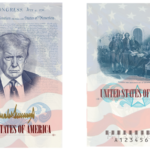


The United States has not introduced a new paper currency denomination in more than a century. The last time a new bill entered American wallets was the $100 note, which became the largest denomination in general circulation after the government discontinued the $500, $1,000, $5,000, and $10,000 bills in 1969. That century-long streak may be about to end, if Congress can first agree to break a law that has stood since 1866.
Treasury Secretary Scott Bessent confirmed at a White House press briefing on Thursday that the Bureau of Engraving and Printing has already begun preparations for a $250 bill featuring President Donald Trump’s portrait, even though the legislation required to make it legal has not yet passed either chamber of Congress.
“For US currency at present, no living person can be on US currency, and the currency must say ‘In God We Trust,'” Bessent told reporters at the briefing. “So right now, there is proposed legislation that is in front of the House, in front of the Senate, to change the first requirement so that a living person, Donald J. Trump, could be on the $250 bill. So we have prepared in advance that if the legislation is passed. But we will stick to the law,” Bessent added.
A Treasury Department official confirmed to CBS News that the Bureau of Engraving and Printing is conducting appropriate planning and due diligence in response to the proposed legislation. In Washington, that kind of bureaucratic phrasing typically means the project is considerably further along than its description implies.
What the Designs Already Look Like
More Read

The bill’s appearance is not hypothetical. Mock-up designs have already been developed, reviewed, and in at least one case personally approved by the president himself.
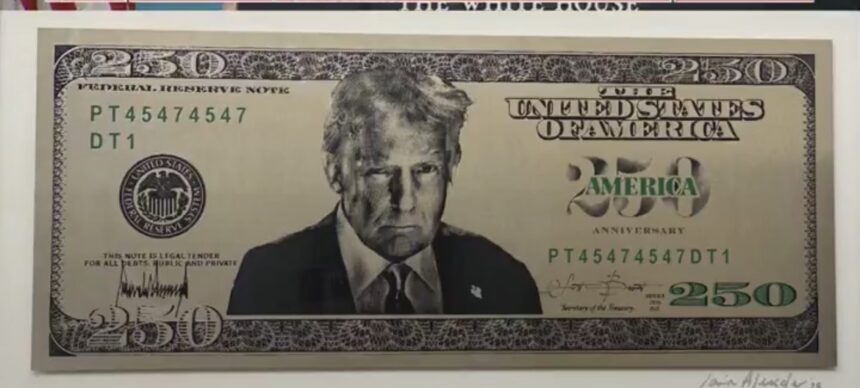
A copy of the $250 bill obtained by the Washington Post shows Trump’s signature to the left of the president’s portrait and Treasury Secretary Scott Bessent’s signature to the right. The portrait was designed by British painter Iain Alexander, and Trump has personally signed off on the designs.
Alexander, who describes himself as a royal portrait artist known for his paintings of Queen Elizabeth II and other public figures, said Trump often referred to him as his “favorite British artist.” Alexander told the Post he had discussed the project directly with Trump. Trump suggested adding details such as the colors of the American flag and a logo marking the 250th anniversary of the United States.
More Read

The legislation behind the bill was introduced by Representative Joe Wilson, a Republican from South Carolina, and would direct the Bureau of Engraving and Printing to put Trump’s face on the new denomination to mark the 250th anniversary of the nation’s founding. The framing as an anniversary commemorative note is deliberate. It connects the bill to the broader America 250 celebrations and gives its supporters a patriotic rationale that extends beyond the obvious political symbolism of a sitting president appearing on legal tender.
In March, the Treasury separately announced plans to print Trump’s signature on all future paper currency starting with the $100 bill in June, marking the first time a sitting president’s signature will appear on American banknotes. Bessent said the change was intended to honor the country’s 250th anniversary.
A Law That Has Held Since 1866
The barrier between the designs already sitting in Treasury computers and a $250 bill entering circulation is not merely bureaucratic. It is statutory, and it has bipartisan roots stretching back to the aftermath of the Civil War.
One law states that only a deceased individual can appear on American currency. Another law outlines the specific bill denominations the Bureau of Engraving and Printing is authorized to produce. Larry R. Felix, a former director of the bureau, was direct about what this means in practice. “A $250 note is not statutorily authorized,” Felix said. “The secretary has to be given authority to do that.” Felix added that Congress would need to approve any effort to create a $250 bill before the Treasury could proceed.
The ban on living persons appearing on currency dates to 1866, when Congress passed legislation specifically to prevent the kind of personality-driven currency branding that had been common in earlier American banking and that many legislators considered incompatible with a democratic republic. The law has never been amended. Every face on every piece of American currency in circulation today belongs to someone who died before it was printed, from George Washington on the dollar to Benjamin Franklin on the hundred.
More Read

Changing that precedent would require an act of Congress, which would then need to be signed into law by the very president whose face would appear on the currency. The self-referential quality of that process has not gone unnoticed by critics.
Alexander told the Post he had also been informed that the project would need to go through Congress. “I’ve been informed that it has to go through Congress,” he said.
Inside the Bureau: Resistance and Pressure
The story of how the $250 bill design got as far as it did before any legislation passed is one of institutional pressure meeting institutional resistance.
According to reporting from the Associated Press, the director of the Bureau of Engraving and Printing, Patricia Solimene, resisted pressure from Brandon Beach, the Treasurer of the United States, and his top aide Mike Brown, stressing to them the lengthy legal and procedural process required to issue new currency. Beach’s office did not respond to AP requests for comment.
The Treasury Department, in a statement, said Beach never asked staff to print the bill before congressional passage. “Should this legislative mandate be signed into law, the BEP is moving proactively to produce a $250 commemorative note which will appropriately recognize the 250th Anniversary of our great nation,” a Treasury spokeswoman said.
The careful wording of that statement, proactively preparing rather than proceeding, reflects the political tightrope Treasury is walking. Bessent has been explicit that the department will not print the bill unless and until the law changes. But the combination of completed designs, confirmed preparation work, and public White House pressure makes the “planning and due diligence” characterization feel like a significant understatement of where things actually stand.
Bessent’s Defense: A Matter of Anniversary, Not Vanity
At Thursday’s briefing, Bessent addressed the obvious political optics question directly and with some defiance.
Asked whether it was politically wise to pursue a bill with Trump’s face on it while Americans were struggling to afford gas and groceries amid the ongoing conflict with Iran, Bessent said he thought the framing was “bifurcated.” “Do you think we should have a 250th celebration?” he asked. He described the anniversary festivities as being funded by private citizens, federal, state, and municipal governments to celebrate the country, and said he did not think there was “anything untoward about having the President of the United States, the person who was President of the United States on the 250th anniversary bill.”
The argument is politically coherent as far as it goes. The United States is marking a once-in-a-generation anniversary, and it is not without precedent for heads of state to feature prominently in national commemorative materials. The Treasury unveiled a series of new designs for the nickel, dime, quarter, and half dollar to be minted in 2026 in December 2025, describing the coin designs as depicting the story of America’s journey toward a more perfect union. A commemorative banknote fits within that broader program, at least in concept.
What does not fit within any established precedent is putting a living president’s portrait on circulating legal tender. The distinction between a commemorative note and standard US currency matters legally and symbolically. Commemorative coins with living persons exist in other countries. Circulating currency bearing a sitting leader’s face is a visual vocabulary more associated with authoritarian governance than with democratic republics, a point that critics have not been slow to make.
Congressional Math and the Road Ahead
The legislation’s prospects in Congress remain uncertain. Bessent acknowledged that the decision rests entirely with Capitol Hill. “It’s all up on Capitol Hill,” he told reporters. The House bill introduced by Representative Wilson has not yet attracted the bipartisan support that would signal a straightforward path to passage. Senate prospects are similarly unclear.
The bill’s supporters will argue the 250th anniversary framing gives it a window that a more explicitly political proposal would not have. Its opponents will counter that the historical prohibition on living persons appearing on currency exists precisely to prevent the kind of political appropriation of monetary symbolism that this proposal represents.
There is also the question of what a $250 bill actually does for the economy. The United States has moved steadily away from high-denomination currency over the past half century, driven by the growth of digital payments, the declining use of cash for large transactions, and law enforcement concerns about high-denomination notes being used to facilitate money laundering and tax evasion. The European Central Bank discontinued its 500-euro note in 2019 for exactly those reasons. Introducing a new $250 denomination runs against that global trend, and no serious economic case for the denomination has been publicly articulated beyond its commemorative value.
A Precedent Unlike Any Other
If the legislation passes and Trump signs it, the symbolic implications extend well beyond the specific design of one banknote. It would mark an extraordinary recognition for a sitting US president, the first time in 160 years that a living American has appeared on legal tender. It would also establish a precedent whose implications future administrations would inherit, for better or worse.
Every future president could point to the Trump $250 bill as justification for their own commemorative currency. The 1866 prohibition was never a partisan principle. It was an institutional one, designed to keep the instruments of monetary trust separate from the personalities of political power. Once broken, such precedents are rarely reassembled.
The designs are done. The legislation is pending. The Treasury Secretary has confirmed the preparation work. What happens next depends on a Congress that has its hands full with a budget, a tax bill, ongoing military tensions in the Gulf, and an administration that has shown consistent appetite for symbolic actions that previous presidents considered off-limits.
Whatever Congress decides, the $250 bill with Donald Trump’s face on it already exists, on paper, in a bureau in Washington. The only question is whether it will ever exist anywhere else.