

WASHINGTON — The national average price for regular gasoline has climbed to $4.52 per gallon as the ongoing disruption in the Strait of Hormuz continues to tighten global oil supplies.
The White House is urging Americans to “hang tight,” with National Economic Council Director Kevin Hassett predicting that a surge in oil production and the eventual reopening of the strait could bring prices down “relatively quickly” — potentially before the November 2026 midterms.
Hassett told reporters that once shipping through the critical waterway normalizes, the United States could see a significant increase in oil supply that would help ease pressure at the pump. He described the situation as temporary and expressed confidence in a strong rebound.
Current Fuel Price Pain
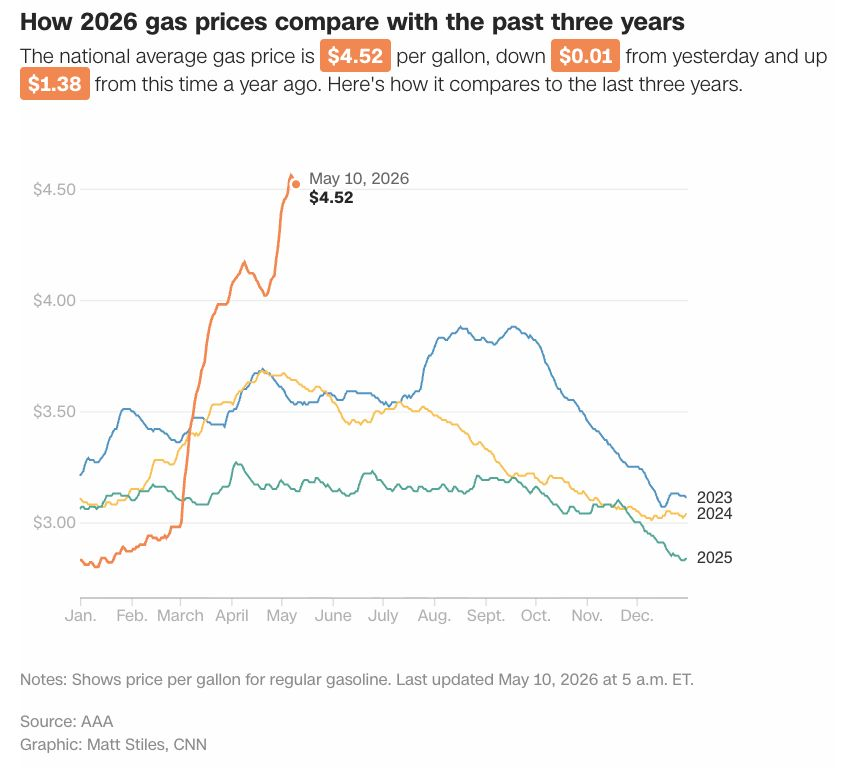
Cost of Crisis: The ongoing Hantavirus emergency is being felt at the pump as the national average for regular gasoline hits $4.52 per gallon—a staggering $1.38 increase compared to the same date in 2025. Analysts suggest that supply chain disruptions and shifts in travel behavior linked to the WHO’s recent health advisories have contributed to the most volatile spring for energy markets in over three years.
Graphic: Matt Stiles / CNN (Source: AAA)
The national average of $4.52 per gallon represents a sharp increase from levels seen before the Iran conflict intensified. In some states, prices have climbed even higher, with diesel now averaging over $5.60 per gallon in parts of the country. These increases are adding to household budgets already strained by other costs and are becoming a major political issue ahead of the midterms.
The disruption stems from the U.S. naval blockade and Iranian threats in the Strait of Hormuz, through which roughly one-fifth of global oil normally passes. Reduced tanker traffic has forced buyers to seek more expensive alternative sources, driving up costs worldwide.
More Read

White House Outlook
Administration officials are projecting optimism. Hassett emphasized that the U.S. has significant domestic production capacity and that once the strait reopens, a “gusher of oil” could help stabilize and then reduce prices. He pointed to increased domestic drilling, strategic reserve management, and diplomatic efforts involving China as factors that could accelerate relief.
The White House has repeatedly framed the current price spike as a direct result of the conflict with Iran rather than domestic policy failures. Officials argue that resolving the Hormuz situation is the fastest path back to lower energy costs.
Economic and Political Implications
Higher fuel prices ripple through the entire economy. Transportation costs rise for everything from groceries to consumer goods, contributing to broader inflationary pressures. Airlines, trucking companies, and farmers are particularly exposed to diesel price swings.
More Read

Politically, the issue is sensitive. With midterms approaching, Democrats are already highlighting fuel costs as a vulnerability for the Trump administration, while Republicans point to the temporary nature of the disruption and long-term benefits of increased domestic energy production.
Hassett’s prediction that prices could fall relatively quickly is designed to reassure markets and voters. However, analysts caution that the timeline depends heavily on diplomatic progress and whether Iran and the U.S. can reach an agreement to restore normal shipping flows.
Broader Energy Picture
The U.S. remains a major oil producer, but global events still heavily influence domestic prices. The current situation in the Strait of Hormuz has exposed vulnerabilities in global energy supply chains, even for a net exporter like the United States.
For context on how trade policy is being used across sectors, see our recent reporting on Trump’s plan to restore North Carolina as America’s furniture capital using tariffs and new tariffs on Chinese goods.
Energy experts say that while short-term pain is real, the combination of strong U.S. production and the potential reopening of the strait could lead to meaningful relief later this year. However, they warn that any prolonged closure or escalation could push prices even higher.
What Consumers Can Expect
For now, the White House message is one of patience. Officials are encouraging drivers to shop around for the best prices and use fuel-efficient driving habits while the situation in the Gulf resolves.
More Read

Whether Hassett’s forecast of a relatively quick drop in prices materializes will depend on how quickly diplomatic efforts succeed. For American families feeling the pinch at the pump, every week of high prices adds pressure on budgets and tempers.
The coming months will test whether the administration’s optimistic outlook on energy supplies holds true or if external factors in the Middle East continue to dominate fuel costs heading into the critical 2026 midterm elections.