

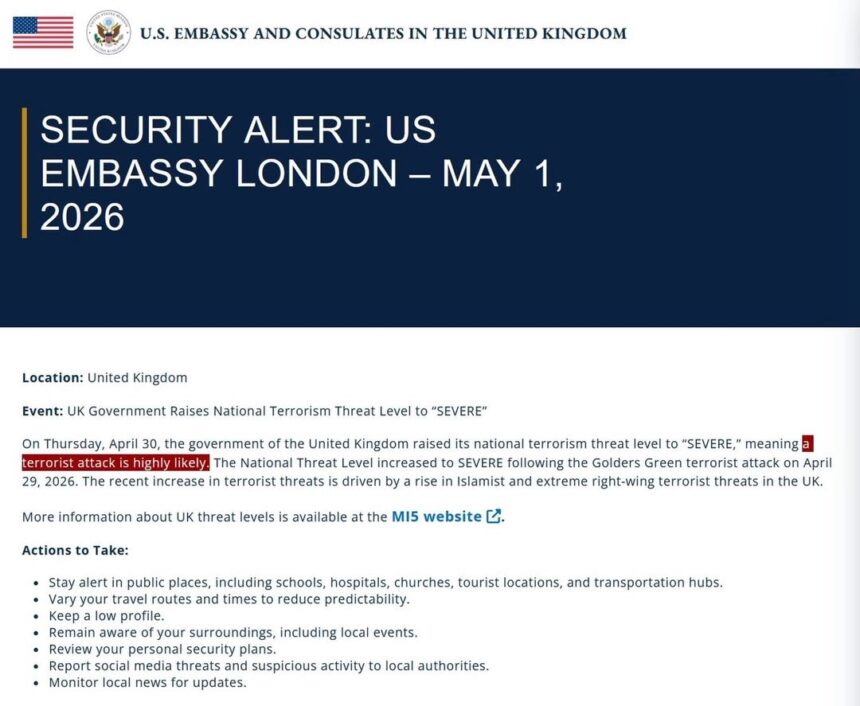
LONDON — The U.S. Embassy in London has issued a strong security alert warning American citizens in the United Kingdom that a major terrorist attack is now “highly likely.” The alert comes amid growing concerns over Islamist extremism and the impact of mass migration on public safety in Britain.
The warning highlights the deteriorating security situation in the UK, particularly in London and other major cities. It urges U.S. citizens to exercise increased caution, avoid large crowds, and remain vigilant when moving around the country. The embassy did not provide specific details about the nature or timing of the potential threat, but the language used signals a serious elevation in risk assessment.
Conservative activist Brigitte Gabriel reacted strongly to the alert, declaring that “London has fallen” due to years of unchecked mass Islamic migration. She called for the deportation of radicals and stricter border controls, arguing that Britain’s failure to integrate migrants and address extremism has turned parts of the country into “conquered territory.”
Rising Terror Threat in the UK
Britain has faced a steady stream of terror-related incidents and plots in recent years. Security services have foiled multiple Islamist-inspired attacks, while knife crime and grooming gang scandals have fueled public anger. The current alert coincides with heightened tensions following conflicts in the Middle East and ongoing migration across the English Channel.
Critics of the Labour government under Prime Minister Keir Starmer argue that soft policies on immigration, combined with what they describe as excessive political correctness, have left the country vulnerable. They point to the rapid growth of certain communities where integration has failed and radical ideologies have taken root.
More Read

Several commentators noted that the alert mentions both Islamist extremism and “far-right” threats, raising questions about whether authorities are deliberately broadening the definition of terrorism to include native citizens expressing concern over mass migration. Some observers accused the government of preparing the ground for crackdowns on dissent rather than focusing primarily on the Islamist threat.
Public and Political Reactions
The U.S. Embassy warning triggered intense debate online and in British media. Many users expressed frustration that successive governments both Conservative and Labour failed to control borders and address the cultural changes brought by large-scale migration from Muslim-majority countries.
Posts on social media reflected a growing sense that “London has fallen,” with users pointing to no-go areas, rising antisemitism, grooming scandals, and frequent terror plots. Some drew comparisons to other European cities facing similar challenges with parallel societies and parallel legal systems.
More Read

Supporters of stricter immigration policies argue that Britain’s experience serves as a warning for other Western nations, including the United States. They say that without decisive action including deportations of radicals and tighter border security, countries risk losing control of their own streets and cultural identity.
Defenders of current policies counter that the vast majority of Muslim immigrants are peaceful and that blaming an entire community is unfair. They accuse critics of stoking Islamophobia and say the real issue is inadequate integration efforts and socioeconomic problems.
Broader Implications
The alert from the U.S. Embassy is significant because Washington rarely issues such direct warnings about its closest ally. It reflects deep concern within American intelligence circles about the UK’s ability to manage the terror threat effectively.
Security experts have warned for years that Britain’s lenient approach to asylum, combined with failures in deportation and monitoring of extremists, has created fertile ground for radicalization. The country now faces the dual challenge of preventing attacks while maintaining social cohesion in increasingly divided cities.
As Britain grapples with these issues, the debate over immigration, national identity, and security is likely to intensify ahead of future elections. The current Labour government faces mounting pressure to demonstrate it can protect British citizens without resorting to what critics call heavy-handed surveillance of native populations.
The U.S. Embassy’s decision to issue the alert serves as a public acknowledgment that the situation in parts of the UK has become serious enough to warrant caution from American travelers. For many Britons, it is a stark reminder that years of open-border policies and multiculturalism experiments have come with real costs.
More Read

Whether this latest warning leads to meaningful policy changes or simply adds to the growing list of alerts remains to be seen. What is clear is that Britain’s security challenges are no longer abstract they are visible, persistent, and increasingly difficult to ignore.