



A Alaska Superior Court judge has overturned state election officials’ decision to keep a second Dan Sullivan off the August primary ballot, ruling Friday that the retired teacher from Petersburg can challenge incumbent U.S. Senator Dan S. Sullivan in the GOP primary.
The development, highlighted in a breaking post by prediction market platform Polymarket, adds another layer of drama to Alaska’s high-stakes 2026 Senate race.
What the Judge Decided
Superior Court Judge Thomas Matthews ruled that Dan J. Sullivan is an eligible candidate. He struck down the June 15 disqualification issued by Alaska Division of Elections Director Carol Beecher, who had claimed the challenger’s filing was not made in good faith and was designed to confuse voters.
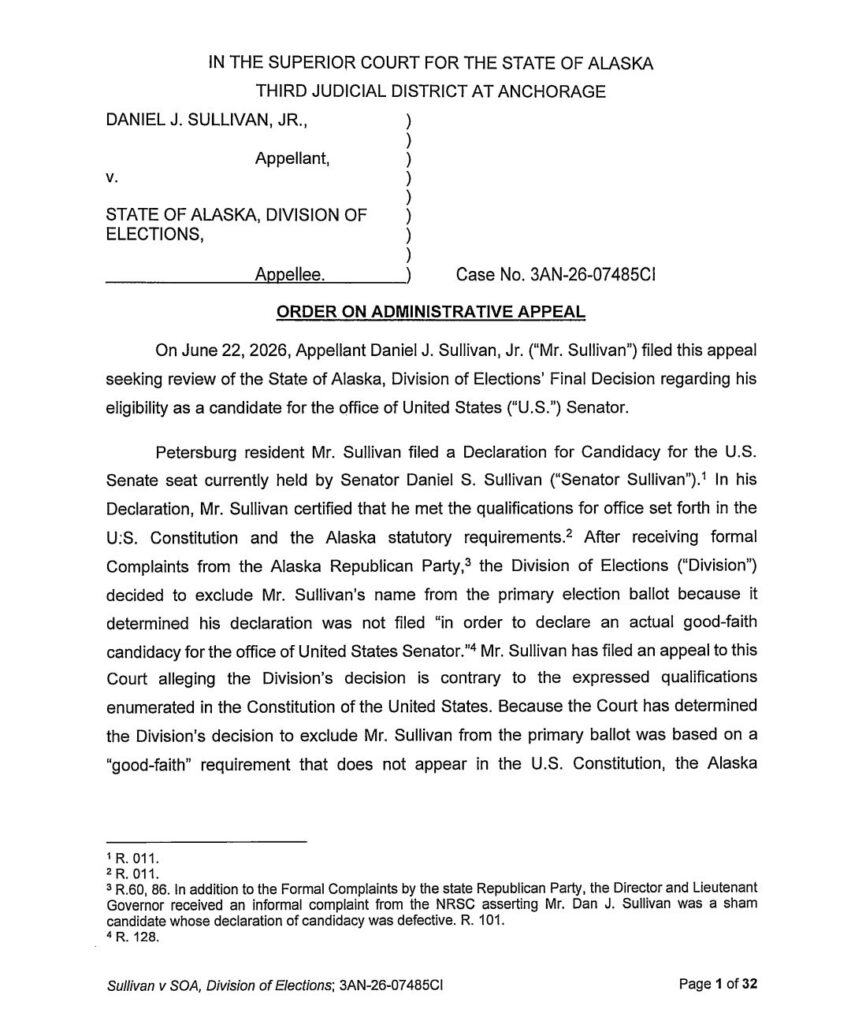
Matthews wrote that election officials relied on a “good-faith criteria” that does not exist in the U.S. Constitution or Alaska election law. He also found no strong evidence that the challenger intended to mislead voters.
The ruling keeps the race on track for the August 18 top-four primary under Alaska’s ranked-choice voting system.
How the “Two Dan Sullivans” Saga Started
Dan J. Sullivan, a 69-year-old retired teacher and former U.S. Forest Service employee, filed his candidacy in May 2026. He shares the same name and Republican Party affiliation as the two-term incumbent senator.
State and national Republicans, including the National Republican Senatorial Committee, raised alarms almost immediately. They accused the challenger of running a “sham” campaign to siphon votes and confuse voters, possibly with help from Democrats backing former Rep. Mary Peltola.
Election officials investigated after complaints about the challenger’s party registration, a campaign website that resembled the senator’s, and his hiring of a consultant with Democratic ties. On June 15, Beecher disqualified him.
The challenger appealed, arguing the state had no legal authority to remove him based on subjective “good faith” concerns.
Why the Name Similarity Matters
Incumbent Sen. Dan Sullivan has publicly worried that having two candidates with the exact same name on the ballot could confuse voters especially in a state where many ballots are cast by mail or in rural areas.
His allies argued it could hurt Republican turnout or split the GOP vote in the primary, potentially helping Democrats in November.
Dan J. Sullivan has pushed back, saying he’s running because he’s frustrated with the incumbent’s record and views the name similarity as an “instant megaphone” for his message. He and his supporters deny any coordination with Democrats.
What Happens Next
The Division of Elections must begin printing ballots by noon Tuesday, June 30. The state is expected to appeal the ruling quickly to the Alaska Supreme Court.
If the higher court upholds the decision, both Dan Sullivans will appear on the primary ballot. If it reverses the ruling, the challenger could be removed before ballots are finalized.
Why This Race Matters Beyond Alaska
This isn’t just a quirky local story. The Alaska Senate seat is one Democrats are targeting in their bid to regain the majority. Incumbent Dan Sullivan has been a reliable Republican vote, and any confusion or vote-splitting in the primary could ripple into the general election against a strong Democratic challenger.
Prediction markets like Polymarket are already tracking developments closely, with bettors watching how this legal fight plays out in real time.
For now, Alaskan voters and political observers nationwide are left wondering exactly how two candidates named Dan Sullivan will share the same ballot line this summer.