

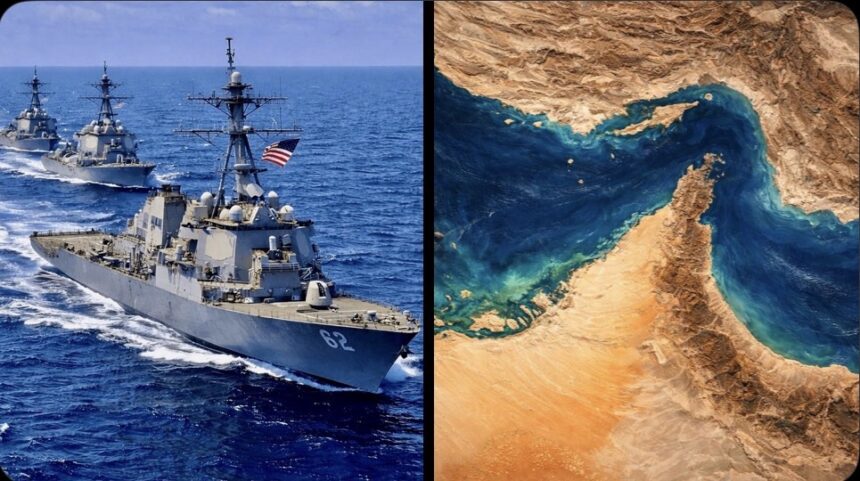
In a significant escalation just nine days after a US-Iran ceasefire framework was signed, the US military has carried out new strikes in the area of the Strait of Hormuz, according to a breaking report cited by financial commentator The Kobeissi Letter and attributed to Axios.
The strikes mark the first US military action in the strategically vital waterway since the Memorandum of Understanding (MOU) was signed around June 17, 2026. Details on the targets, scale, or exact timing remain limited in initial reports, but the development has already sparked concerns over renewed tensions in one of the world’s most critical oil transit routes.
Background: Fragile Ceasefire After Months of Conflict
The Strait of Hormuz, a narrow passage between Iran and Oman connecting the Persian Gulf to the Gulf of Oman, handles roughly 20% of global oil trade and is a frequent flashpoint in regional conflicts.
Earlier in 2026, the US and Israel conducted operations against Iranian targets amid escalating hostilities. Iran responded by closing or restricting the strait, leading to exchanges of fire, including Iranian missile and drone attacks on US naval assets and a reported downing of a US Army AH-64 Apache helicopter near the strait in early June.
The June 17 MOU, described as a 14-point framework agreement signed electronically by US President Donald Trump and Iranian President Masoud Pezeshkian (with mediation involving Pakistan), aimed to de-escalate the conflict. Key provisions included:
- Extension of the ceasefire for 60 days.
- Iran’s commitment to allow safe, toll-free passage for commercial vessels through the Strait of Hormuz for 60 days (with demining and technical preparations within 30 days).
- US efforts to lift its naval blockade of Iranian ports.
- Establishment of a $300 billion private investment fund for Iran’s reconstruction and economic development (US not required to contribute directly).
- Commitment that Iran would never acquire a nuclear weapon.
- Deferral of core issues like Iran’s nuclear program, ballistic missiles, and sanctions relief to further negotiations during the 60-day period.
The agreement was hailed by some as a pragmatic step to reopen shipping lanes and stabilize global energy markets, though analysts noted it as a temporary “time-buying” measure rather than a comprehensive peace deal.
Latest Developments and Reactions
The reported US strikes come amid lingering frictions. Social media reactions, particularly in financial circles, highlighted the timing—late Friday after US markets closed—and potential market fallout. Oil futures were widely expected to rise sharply on Monday’s open, with traders noting the strait’s sensitivity to any military activity.
Some observers pointed to prior patterns of incidents, including reported Iranian actions against shipping or US assets, followed by US responses. One X reply referenced possible Iranian downing of a US Apache and subsequent CENTCOM strikes on locations such as Qeshm Island, Bandar Abbas, Sirik, and Jask echoing earlier June exchanges.
President Trump has previously described certain responses as measured or “proportional,” while emphasizing a hardline stance against perceived violations. Iranian officials have historically condemned US actions as violations of sovereignty and threatened retaliation.
Broader Implications
Any disruption in the Strait of Hormuz risks driving up global oil prices, inflating shipping insurance costs, and straining supply chains. Previous tensions in the region contributed to volatility in energy markets throughout 2026.
The reported strikes test the durability of the recent MOU. With only nine days elapsed since signing, the incident raises questions about enforcement, trust between parties, and the path to longer-term negotiations on nuclear issues and sanctions.
US Central Command (CENTCOM) has not yet issued an official statement on the latest reported action as of this writing. Axios reporting is cited as the primary source for the breaking claim.
Markets, governments, and energy analysts will be closely watching developments over the weekend and into next week for confirmation, Iranian response, and any impact on the fragile 60-day ceasefire window.
This article is based on the reported development from The Kobeissi Letter citing Axios, combined with verified background on the US-Iran MOU and prior regional events from multiple credible sources. Further official statements are expected.