

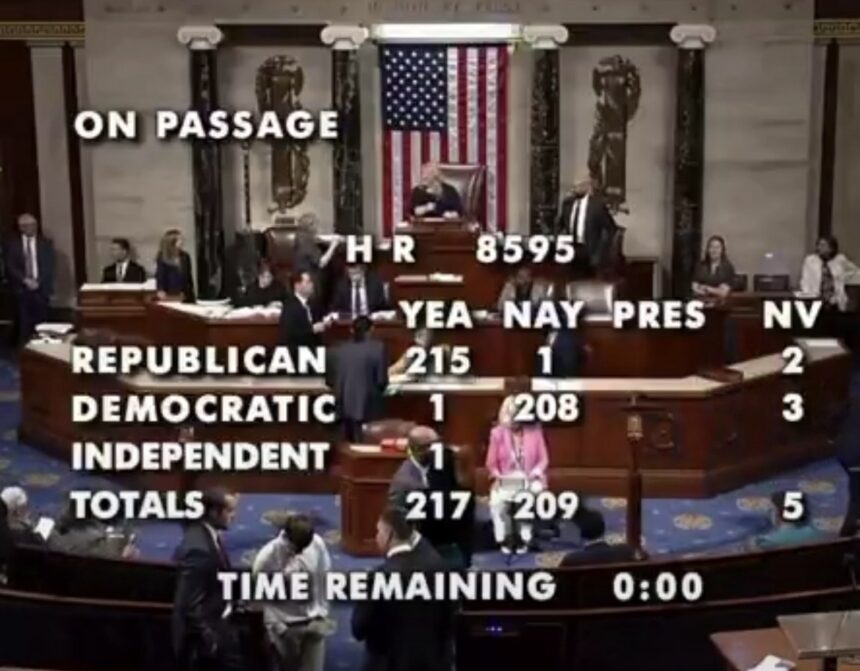
The U.S. House of Representatives has approved the SAVE America Act by attaching it to must-pass national security appropriations legislation. The measure passed by a narrow 217-209 vote on Wednesday.
The action represents a significant step forward for the bill, which aims to strengthen federal election integrity requirements. House leadership, including Speaker Mike Johnson, advanced the legislation through procedural maneuvers and internal party negotiations despite opposition from Democrats.
What the SAVE America Act Requires
The Safeguard American Voter Eligibility (SAVE) America Act would implement several key changes to federal election law:
- Require individuals to provide documentary proof of U.S. citizenship when registering to vote in federal elections. Acceptable documents include passports, certified birth certificates, or other forms of identification that confirm citizenship status under the REAL ID Act.
- Mandate photo identification for voting in federal elections.
- Direct states to remove non-citizens from voter rolls using federal data sources.
- Establish penalties for election officials who knowingly register non-citizens.
- Create a private right of action allowing citizens to sue election officials who fail to enforce citizenship verification rules.
Proponents argue these measures close loopholes and ensure that only eligible U.S. citizens participate in federal elections. Critics contend the requirements could create barriers for some eligible voters and note that documented cases of non-citizen voting remain extremely rare.
Legislative Context and Path Forward
The SAVE America Act builds on earlier versions of similar legislation that have passed the House in previous sessions. By attaching it to a national security funding bill (H.R. 8595 for fiscal year 2027), Republicans increased the likelihood of advancing the provisions without separate standalone consideration.
More Read

The House also signaled continued efforts to include related election security measures through the budget reconciliation process.
The bill now heads to the Senate, where Republicans face the challenge of securing passage. Senate GOP leaders have faced pressure from colleagues to prioritize the measure and avoid delays ahead of the August recess. Some senators have called for staying in session until action is taken on the legislation.
Broader Implications for Election Security
Supporters describe the SAVE America Act as essential for restoring public confidence in the electoral process. They point to the principle that voting in federal elections should be reserved exclusively for U.S. citizens, a requirement already established in federal law but lacking uniform enforcement mechanisms for documentation.
More Read

Opponents, primarily Democrats, have characterized the bill as overly restrictive and potentially disenfranchising, arguing that existing safeguards and state-level processes are sufficient. They have highlighted studies showing minimal instances of non-citizen voting in federal contests.
The legislation’s advancement comes amid ongoing national debates over voting access, election administration, and safeguards against fraud. If enacted, it would mark one of the most substantial federal updates to voter registration and identification requirements in decades.
The Senate’s handling of the attached provisions will determine whether the SAVE America Act reaches the president’s desk in its current form.