


The CMCC’s Closure Signals Growing Dysfunction in Washington’s Flagship Gaza Strategy, as Aid Stalls and Allies Pull Back
What Is Being Closed and Why It Matters
A U.S. military-run coordination centre in southern Israel, established as the operational core of President Donald Trump’s Gaza peace plan, is set to be shut down, multiple sources familiar with the matter told Reuters. The closure of the Civil-Military Coordination Centre, known as the CMCC, comes seven months after it was stood up with considerable fanfare as the mechanism that would enforce the Israel-Hamas ceasefire, manage aid flows, and lay the groundwork for Gaza’s reconstruction.
The closing of the CMCC in Israel, which has not been previously reported, underscores the difficulties facing U.S. efforts to oversee the truce and coordinate on aid, as Israel seizes more Gaza territory and Hamas firms its grip in areas under its control.
It also raises uncomfortable questions for the dozens of allied nations that committed personnel and funding to a mission now being wound down before its core objectives were met.
What the CMCC Was Supposed to Do
The CMCC was established in October 2025 as part of the ceasefire framework that took effect on October 10, 2025, following a peace plan devised by Trump and former British Prime Minister Tony Blair. The 20-point plan called for the creation of an International Stabilization Force to provide security and oversee demilitarization and reconstruction in Gaza. The CMCC was intended to serve as the main coordination hub for those stabilization efforts, monitoring ceasefire implementation and facilitating humanitarian aid delivery.
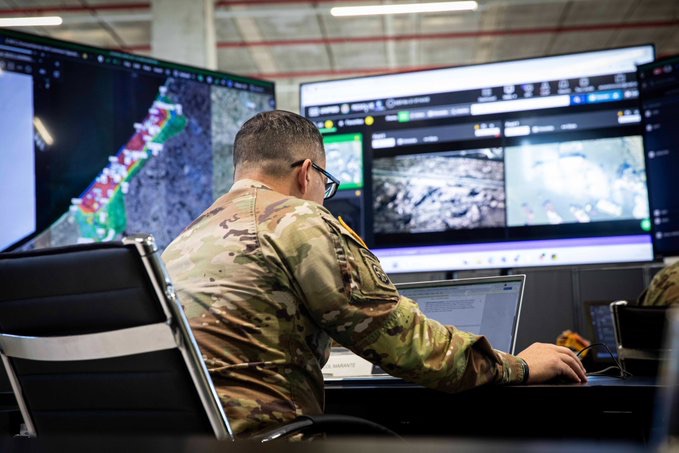
At its peak, the centre brought together US officers, IDF personnel, and representatives from more than 20 countries alongside international civil society groups. Operating out of an industrial warehouse in Kiryat Gat in southern Israel, teams of military personnel and civilian specialists monitored oversized screens displaying maps and imagery of Gaza, working on security coordination, intelligence sharing, humanitarian logistics, infrastructure, and civil governance planning.
It was, by any measure, an ambitious undertaking. It was also one that ran into structural problems almost immediately.
What Went Wrong
The CMCC’s failure was not sudden. It was an accumulation of unresolved tensions between what the centre was mandated to do and what the conditions on the ground actually permitted.
Diplomats say the CMCC lacked the authority to enforce the ceasefire or ensure aid delivery, making it a coordination hub in name more than in practice. Aid levels remained largely stagnant despite some commercial goods entering Gaza, with Israel banning many items it characterizes as dual-use, including poles needed for tents in displaced persons camps and heavy machinery required to clear rubble.
Palestinians were excluded entirely from discussions at the centre, and attempts to bring Palestinian voices into meetings via video link were repeatedly cut off by Israeli officials. Internal U.S. planning documents referred to Palestinians only as “Gazans.” Diplomats and aid workers expressed concern that the CMCC mixed military and humanitarian functions without a clear international mandate.
Compounding those operational problems was a surveillance dispute. Concerns over Israeli surveillance inside the joint base prompted U.S. Commander Lt. General Patrick Frank to summon an Israeli counterpart and insist that the recording of U.S. and allied forces had to stop, after sources alleged that Israeli operatives had been conducting both open and covert recording of conversations at the facility. Israel denied the claims, calling them absurd.
Allied nations were also losing patience. Eight foreign diplomats described the centre as either “directionless” or “a disaster,” with one adding, “Everybody thinks it’s a disaster, but there is no alternative.” Countries including France, Germany, and Britain, all of which initially sent military planners and intelligence officials to the centre, saw their participation dwindle, with some sending representatives as infrequently as once a month.
A Rebranding, Not a Replacement
The closure is not a complete abandonment of the coordination function, at least not officially. Once the CMCC is folded into the International Stabilization Force, the centre is expected to be rebranded as the International Gaza Support Centre, likely led by U.S. Major General Jasper Jeffers, the White House-appointed ISF commander.
But diplomats say the CMCC already lacked authority to enforce the ceasefire or ensure aid, making it unclear whether folding it into the ISF would have much practical effect on the ground. A rebranding that does not resolve the underlying authority deficit changes the name but not the problem.
Leadership at the centre had already been in transition. The CMCC’s civilian lead, career diplomat Steve Fagin, returned to his post as U.S. Ambassador to Yemen after serving in a transitional role, with no replacement announced. The State Department offered no explanation for the vacancy.
The Cost in Human Terms
The scorecard on what the CMCC was supposed to deliver versus what it achieved is difficult to read charitably.
More than 800 Palestinians and four Israeli soldiers have been killed since the ceasefire was supposed to halt the fighting. During the preceding conflict, Israel reduced much of Gaza to rubble, displaced nearly the entire two million population, and destroyed the infrastructure needed for water distribution, sanitation, and electricity.
Despite the influx of some commercial goods, aid levels have remained largely stagnant. Even basic supplies such as tent poles and school materials including pencils and paper have faced unexplained bans, with Israel maintaining control over the aid policy regardless of the CMCC’s nominal mandate to facilitate deliveries.
The vast majority of Gaza’s more than two million people now live in a small strip of land outside an Israeli-occupied zone, mostly in makeshift tents or damaged buildings.
What Allies Are Left Holding
For the countries that committed diplomatic capital and personnel to the CMCC in response to U.S. encouragement, the closure lands awkwardly.
Dozens of countries including Germany, France, Britain, Egypt and the United Arab Emirates sent personnel including military planners and intelligence officials to the centre, seeking to influence discussions on Gaza’s future. Trump’s Gaza rebuilding plan, which they were effectively endorsing through their participation, has been effectively on hold.
Diplomats indicated that countries were unlikely to formally exit the centre, partly to avoid angering Trump and partly to preserve the option of future engagement, and partly because leaving would cede more post-war policy influence to Israel, given that no Palestinians were present at the hub at all.
With the CMCC now closing rather than being reformed, that calculation has been overtaken by events. The question allies are now confronting is what leverage, if any, they retain over the shape of whatever comes next in Gaza, and whether Washington’s plan for the territory has enough coherence left to be worth following at all.