

Congressional Report Highlights 42 Planes and Drones Hit or Destroyed in Operation Epic Fury
Washington, D.C. – A recent report to Congress has confirmed substantial U.S. aircraft losses during military operations against Iran, raising questions about the costs and risks of the campaign now entering its fourth month.
Operation Epic Fury, the U.S.-led strikes that began on February 28, 2026, in coordination with Israel, has seen American forces target Iranian military sites, nuclear facilities, and proxy networks. While officials have described major successes in degrading Iran’s capabilities, the toll on U.S. air assets has drawn attention from lawmakers and military analysts.
(Photo credit: Supplied / @EGYOSINT)
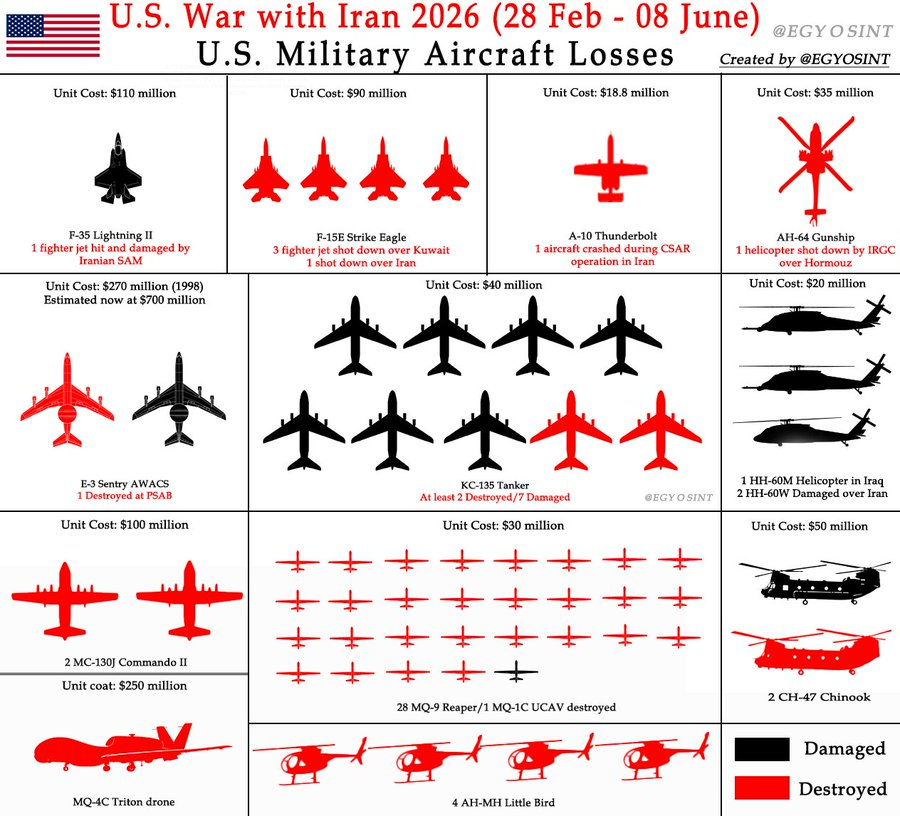
According to a Congressional Research Service document dated May 13, at least 42 fixed-wing, rotary-wing, and uncrewed aircraft were lost or damaged through mid-May. This figure draws from Pentagon statements, CENTCOM updates, and verified news reports. The total replacement cost for destroyed equipment could reach several billion dollars, with overall operation expenses already estimated near $29 billion.
Key losses include:
More Read

- Four F-15E Strike Eagle fighters. Three were destroyed in a friendly fire incident over Kuwait in early March when Kuwaiti defenses mistakenly engaged them. A fourth was shot down by Iranian forces in April, though both crew members were rescued after a large search-and-rescue effort.
- One F-35A Lightning II stealth fighter damaged by Iranian ground fire in March. The pilot landed safely despite taking hits.
- An A-10 Thunderbolt II ground attack plane lost during combat operations near the April F-15E incident.
- An E-3 Sentry airborne warning and control aircraft destroyed on the ground during an Iranian missile and drone strike on Prince Sultan Air Base in Saudi Arabia.
The report also notes multiple refueling tankers (KC-135s), special operations MC-130Js, helicopters, and a large number of MQ-9 Reaper drones damaged or destroyed. Many drone losses came from Iranian air defenses, while some crewed aircraft were hit during rescue missions.
Pentagon officials emphasize that the overall campaign has achieved its primary goals of neutralizing immediate threats from Iran’s missile and drone programs. President Trump and senior advisers have repeatedly called the operation a success, pointing to the destruction of much of Iran’s naval and air forces. However, fighting has continued in fits and starts, with recent escalations reported near the Strait of Hormuz.
Military experts say the losses, while notable, reflect the challenges of operating against a defended adversary. The friendly fire episode early in the conflict highlighted coordination issues with coalition partners, and Iranian asymmetric tactics have proven effective against both high-end stealth platforms and cheaper drones.
More Read

As lawmakers review the figures, questions remain about long-term strategy, force readiness, and whether further escalation can be avoided. The Department of Defense has not released a full official tally, citing ongoing operations and classification concerns. Numbers could still change as more details emerge.
This conflict continues to test U.S. airpower in a high-intensity scenario not seen in recent decades.