


Four-Person Team Will Lead Orbital Docking Tests with Commercial Landers in Low Earth Orbit as Agency Prepares for 2028 Lunar Landing
In a major step forward for America’s return to the Moon, NASA today revealed the four astronauts who will fly the agency’s Artemis III mission, scheduled for launch in late 2027. The crew, consisting of experienced space veterans from NASA and the European Space Agency, will not head straight to the lunar surface. Instead, they will conduct critical tests in low Earth orbit, practicing rendezvous and docking maneuvers between the Orion spacecraft and privately built human landing systems from SpaceX and Blue Origin.
The announcement, made at NASA’s Johnson Space Center in Houston, marks another milestone in the Artemis program, which aims to establish a sustainable human presence on the Moon and eventually send astronauts to Mars. Artemis III comes after the successful uncrewed Artemis I flight and the crewed Artemis II lunar flyby earlier this year. But unlike those missions, this one shifts the focus to proving that Orion can safely link up with the next-generation landers that will actually touch down on the lunar south pole.
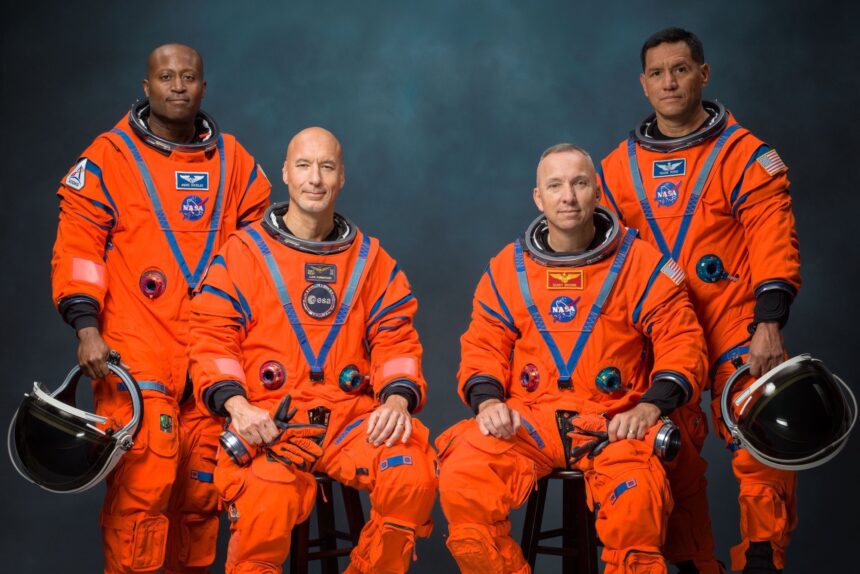
A striking new portrait released alongside the news shows the crew in their bright orange flight suits, helmets in hand, looking ready for the challenge ahead. Commander Randy Bresnik stands on one side, joined by Mission Specialists Andre Douglas and Frank Rubio, with Pilot Luca Parmitano seated prominently in the center. Their selection highlights NASA’s emphasis on blending deep flight experience with fresh perspectives as the agency tackles the complex engineering required for deep-space operations.
Randy Bresnik, a U.S. Marine Corps colonel and NASA veteran, will command the mission. Selected as an astronaut in 2009, Bresnik has already logged more than 300 days in space across two previous missions. He flew aboard the space shuttle Discovery on STS-129 in 2009 and later served as a flight engineer and commander during a long-duration stay on the International Space Station as part of Expedition 52/53. Known for his calm leadership and extensive extravehicular activity experience, Bresnik brings proven skills in spacecraft command and international crew coordination. His role here will be pivotal as the team practices procedures that mirror those needed for future lunar landings.
Serving as pilot is Luca Parmitano, an Italian astronaut representing the European Space Agency. Parmitano, a former Italian Air Force test pilot, has flown twice to the ISS and holds the distinction of being the first European to command the station during Expedition 61 in 2019. He has completed multiple spacewalks, including some that tested new suit technologies and repaired critical systems under challenging conditions. His expertise in orbital piloting and European contributions to the Orion spacecraft’s service module make him an ideal choice for this international collaboration. NASA and ESA have worked closely on Artemis, with Europe providing key components that keep the program moving forward.
More Read

Mission Specialist 1 is Frank Rubio, a NASA astronaut and U.S. Army lieutenant colonel with a background in medicine and aviation. Rubio made headlines during his record-setting 371-day mission aboard the ISS from 2022 to 2024, the longest single spaceflight by an American at the time. A flight surgeon by training, he brings unique insights into the physiological effects of long-duration spaceflight, an area that will be crucial as crews prepare for multi-week lunar missions. His selection underscores NASA’s focus on crew health and resilience as missions grow more ambitious.
Rounding out the team as Mission Specialist 2 is Andre Douglas, a relatively newer face in the astronaut corps but one with impressive credentials in engineering and operations. Douglas, part of a recent astronaut class, has quickly risen through training with a focus on systems integration and human factors in spaceflight. His background includes work on advanced spacecraft technologies and simulation-based testing, skills that will prove invaluable during the intricate docking sequences planned for Artemis III.
The mission itself represents a smart pivot by NASA to address ongoing delays in the commercial human landing systems. Originally envisioned as the first crewed lunar landing under Artemis, the flight profile has been adjusted to stay in low Earth orbit. There, the four astronauts will launch aboard the massive Space Launch System rocket carrying the Orion spacecraft from Kennedy Space Center in Florida. Once in orbit, they will rendezvous and dock with one or both of the lunar landers: SpaceX’s Starship Human Landing System and Blue Origin’s Blue Moon vehicle. These landers will be launched separately on commercial rockets, creating a complex orbital ballet that tests interoperability, life support handoffs, and transfer procedures between vehicles.
Engineers want to confirm that Orion can safely connect with these new systems, evaluate spacesuit performance during potential spacewalks, and gather data on how crews move between spacecraft without the added complexity of lunar gravity or distance. Success here will clear the path for Artemis IV, now targeted for 2028, which is expected to deliver the first astronauts to the Moon’s surface since the Apollo era ended more than five decades ago.
This approach also reflects the evolving nature of NASA’s partnerships. By working with SpaceX and Blue Origin, the agency is leveraging commercial innovation to accelerate progress while keeping safety paramount. The Artemis program operates under the Artemis Accords, a framework signed by more than 40 nations that promotes peaceful exploration and sustainable practices on the Moon. Including an ESA astronaut like Parmitano further strengthens those global ties, showing how the United States is leading but not going it alone.
Of course, challenges remain. The SLS rocket, Orion capsule, and both landers have faced technical hurdles and schedule slips in recent years. Starship has undergone rapid testing with promising results, but Blue Moon is still catching up. NASA officials have emphasized that Artemis III will fly only when all systems are ready, a lesson learned from past programs where rushing led to setbacks. Crew training will ramp up immediately, with the astronauts diving into simulators, suit evaluations, and joint operations with their commercial partners.
For the broader public, this mission signals that the Golden Age of space exploration is not just a memory from the 1960s but a living reality unfolding today. Images of astronauts floating between Orion and a Starship lander could capture imaginations worldwide, much like the Apollo 9 tests did in Earth’s orbit before the first Moon landing. It also highlights the human element: these four individuals represent thousands of engineers, technicians, and support staff working behind the scenes at NASA centers, contractor facilities, and international labs.
As the crew begins their preparation, excitement is building across the space community. Bresnik, Parmitano, Rubio, and Douglas will train as a tight-knit unit, honing the skills that could one day help establish a lunar base or even support a crewed trip to Mars. Their flight will generate valuable data on everything from docking dynamics to radiation exposure in the van Allen belts, informing every mission that follows.
Looking ahead, Artemis III stands as more than a test flight. It is a bridge between the proven capabilities of Orion, demonstrated in Artemis II, and the bold ambition of landing boots on lunar regolith once again. With this crew at the helm, NASA is sending a clear message: the journey back to the Moon is on track, and the next generation of explorers is ready to push the boundaries of what is possible.
More Read

The space agency has invited the public to follow the crew’s progress through live events, social media updates, and educational resources. For anyone who grew up watching shuttle launches or dreaming of walking on the Moon, this is a moment to celebrate. Four dedicated professionals are stepping up to ensure that when the time comes for humanity’s next giant leap, every system works flawlessly.
In the end, Artemis III is about more than hardware and schedules. It is about people pushing the limits of exploration, international cooperation in the pursuit of knowledge, and the enduring human drive to reach for the stars. As launch day approaches in late 2027, the world will be watching as these astronauts turn today’s announcement into tomorrow’s history.