

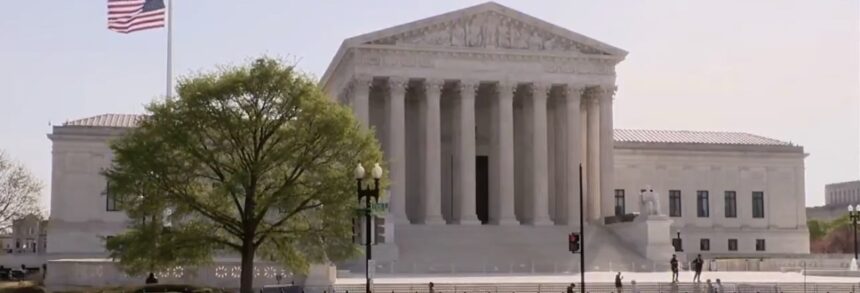
The US Supreme Court is at the center of one of the most chaotic election cycles in modern American history. In the span of a few weeks, a single ruling from the conservative majority has triggered a nationwide redistricting scramble, suspended elections in Louisiana, delayed primaries in Alabama, sparked emergency filings from Virginia Democrats, and prompted a confidence crisis so severe that a recent NBC News poll shows public trust in the court is at an all-time low.
Here is a full breakdown of everything the Supreme Court is doing right now and what it means for the 2026 midterms.
What Did the Supreme Court Rule in Louisiana v. Callais?
At the center of everything is the court’s April 2026 ruling in Louisiana v. Callais, a landmark decision that significantly weakened Section 2 of the Voting Rights Act of 1965.
Writing for the conservative majority, Justice Samuel Alito argued that “the Constitution almost never permits the Federal Government or a State to discriminate on the basis of race” and that Louisiana did not have a compelling interest to justify drawing its congressional district map based on race. The ruling struck down Louisiana’s second majority-Black congressional district.
Liberal Justice Elena Kagan penned a forceful dissent, arguing the majority had gutted the Voting Rights Act and that plaintiffs alleging schemes to dilute minority voter representation will now find it “nearly impossible” to succeed in court. Senate Democratic Leader Chuck Schumer declared the ruling “upends half a century of precedent” and “defies the spirit of the American Civil Rights Movement.”
More Read
Republicans hailed it as a major victory. Within an hour of the decision, the Republican-controlled Florida House approved a new congressional map that could net Republicans four additional House seats after the 2026 election, putting Democratic Representatives Kathy Castor, Darren Soto, Jared Moskowitz, and Debbie Wasserman Schultz in danger of losing their seats.
Which States Are Being Affected Right Now?
The Callais ruling set off a chain reaction across Republican-led states that is still playing out today.
Louisiana: Some mail-in ballots had already been returned when Governor Jeff Landry announced that House elections originally scheduled for May 16 would be suspended to allow for redistricting under the new ruling. Elections were canceled mid-process.
More Read
Alabama: Primaries scheduled for today, May 19, in affected districts have been pushed back to August. The Supreme Court allowed Alabama to move forward with its preferred map, which had previously been blocked by a lower court injunction.
Florida: Within hours of the ruling, the state legislature passed a new aggressively gerrymandered map. Critics say it could strip representation from multiple Democratic incumbents.
Mississippi and North Dakota: In a brief unsigned order on Monday, the Supreme Court sent cases involving state legislative maps in both states back to lower courts for reconsideration in light of the Callais ruling. The court effectively took an off-ramp from ruling on what could have been the next major Voting Rights Act fight.
Virginia: Virginia Democrats filed an emergency application with the Supreme Court after the Virginia Supreme Court blocked the Republican-drawn congressional map. In an unusual twist, the Democrats invoked the Independent State Legislature Theory, an argument Republicans championed after the 2020 election, to try to get the federal Supreme Court to override the state court’s decision. The Virginia Republicans described their state court’s ruling as “judicial defiance” of the Commonwealth’s constitution.
Missouri, Arkansas, South Carolina: Republican senators from these states have indicated their maps will need to be reviewed in light of the ruling. Senator Josh Hawley of Missouri acknowledged it will “certainly apply” to his state.
Is the Supreme Court Being Accused of Hypocrisy?
Yes, loudly and from multiple directions.
More Read

The Supreme Court has a long-standing principle called the Purcell principle, which holds that courts should not change election rules close to an election because doing so creates voter confusion and logistical chaos. The court has invoked this principle repeatedly over recent years to block lower court judges from changing election maps or rules shortly before elections.
Critics, including liberal justices dissenting from recent orders, now say the court is violating its own rule. The Supreme Court’s majority decisions in the Louisiana and Alabama cases that allowed redistricting to proceed close to elections did not mention the Purcell principle at all. Liberal Justice Ketanji Brown Jackson, dissenting in the Louisiana case, pointedly referenced “the so-called Purcell principle” as a reason the court should not have intervened. Justice Alito responded sharply, calling it “groundless and irresponsible” to suggest the court was abusing its power.
Election law expert Derek Muller at Notre Dame Law School offered a distinction: the Purcell principle does not apply when a court is lifting an injunction rather than imposing one, which is technically what the Supreme Court did in the Alabama case. Critics say that is a distinction without a practical difference when the result is elections being suspended after ballots have already been cast.
Kareem Crayton, a lawyer at the Brennan Center for Justice at New York University, was direct: “I don’t think you can see this as anything other than a raw exercise of power.”
What Are the Biggest Cases Still Coming This Term?
The redistricting battles are dominating headlines right now, but the Supreme Court’s opinion season runs through late June, and several other major cases are still pending.
Birthright citizenship. The court is weighing President Trump’s executive order restricting birthright citizenship for children of undocumented immigrants. The case has massive implications for constitutional interpretation of the 14th Amendment.
Campaign finance. A challenge to federal limits on coordinated spending between political parties and their candidates, originally brought by Vice President J.D. Vance when he was a senator, could gut a landmark 2001 decision on campaign finance law.
Mail-in ballot deadlines. The court is weighing whether states can count mail-in ballots that arrive after Election Day if postmarked by Election Day. More than a dozen states have similar laws. With midterms approaching, the ruling could reshape how votes are counted across the country.
Trump administration firings. The court is reviewing multiple challenges to Trump’s firing of officials at agencies long considered independent from direct presidential control, including cases involving the Federal Reserve and other regulatory bodies.
Transgender athletes. A case involving transgender athletes in school sports is expected to produce a significant ruling before the term ends in June.
What Does the Public Think of the Supreme Court Right Now?
A recent NBC News poll found that confidence in the Supreme Court is at an all-time low, a finding the court’s own chief justice has acknowledged in indirect terms.
Last week, Chief Justice John Roberts complained publicly that the American public wrongly perceives the justices to be “political actors.” The comment drew immediate backlash from legal scholars who noted the irony of a chief justice defending the court’s neutrality in the same week it was suspending elections and overriding lower court injunctions to benefit one political party’s redistricting efforts.
The court has also faced sustained criticism for its frequent rulings in favor of the Trump administration across a range of cases, which liberal critics say reflects a court that is not applying the law equally across political actors. Conservative defenders of the court say the rulings reflect sound constitutional interpretation that happens to align with Republican priorities because those priorities are constitutionally sounder than Democratic ones.
What Happens Next?
The redistricting chaos is not over. The Supreme Court has more emergency applications pending from multiple states. Opinion season runs through late June, when the court is expected to hand down decisions on its most significant pending cases.
The broader question hanging over all of it is what the midterm elections will look like if maps continue to be redrawn weeks or days before November voting begins. Louisiana’s suspended election, Alabama’s delayed primary, and Virginia’s emergency filing are all previews of what could be a November characterized by legal chaos at the polling level.
For live tracking of Supreme Court orders and opinions, SCOTUSblog remains the essential resource. For political analysis of the redistricting fallout, NBC News Politics and The Hill are covering developments in real time.
Key Takeaways
- The Supreme Court’s April ruling in Louisiana v. Callais weakened the Voting Rights Act and triggered a nationwide redistricting scramble ahead of the 2026 midterms.
- Louisiana suspended elections after ballots had already been returned. Alabama pushed primaries scheduled for today back to August. Florida passed a new gerrymandered map within hours of the ruling.
- The court sent Mississippi and North Dakota redistricting cases back to lower courts Monday, sidestepping the next major Voting Rights Act fight for now.
- Critics including dissenting justices say the court is violating its own Purcell principle by changing election rules mid-process, a charge Justice Alito called “groundless.”
- Public confidence in the Supreme Court is at an all-time low according to a recent NBC poll, even as Chief Justice Roberts insists the justices are not political actors.
- Major pending decisions still to come include birthright citizenship, campaign finance, mail-in ballot deadlines, Trump administration firings, and transgender athletes in schools.