

Aerial Assessment of Launch Complex 36
NASA Administrator Jared Isaacman conducted a high-altitude aerial inspection of Launch Complex 36 at Cape Canaveral Space Force Station today to personally assess the widespread structural damage caused by a catastrophic rocket explosion. Isaacman, an experienced military jet pilot and commercial astronaut who assumed leadership of the space agency in late 2025, piloted the survey aircraft. He was joined in the cockpit and cabin by Blue Origin Founder Jeff Bezos and Chief Executive Officer Dave Limp. The executive team spent nearly an hour circling the perimeter of the historic Florida launch facility, analyzing the scorched impact zone and reviewing the structural integrity of remaining support buildings from the air.
The joint agency and corporate inspection follows a massive explosion that occurred on Thursday night during a routine prelaunch static fire engine test of Blue Origin’s heavy lift New Glenn rocket. The vehicle was undergoing final integrated testing ahead of its fourth planned commercial flight, which had been scheduled to launch on June 4. The mission was designed to deploy a critical batch of 48 internet satellites for Amazon’s Project Kuiper broadband constellation. Although the satellites themselves were safely housed in a nearby processing facility and were not mounted to the launch vehicle during the test, the rocket itself was completely consumed in the blast.
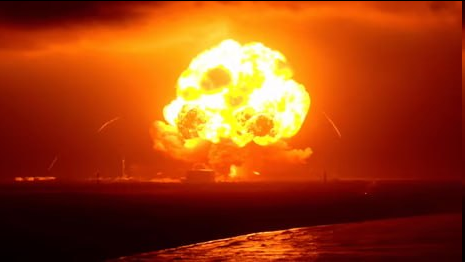
A spectacular fireball erupts as Blue Origin’s New Glenn rocket explodes during a launchpad hot-fire engine test in Florida.
Source: Associated Press / NASASpaceflight
Eyewitness accounts from the surrounding Space Coast communities described an explosion so powerful that it lit up the night sky for miles and rattled residential windows in nearby Titusville and Cocoa Beach. Regional tracking data indicated a massive thermal flare at exactly 9:00 p.m. Eastern Time, corresponding with the scheduled ignition sequence of the rocket’s first stage. Video footage captured by local launch photographers showed a sudden breach near the base of the vehicle, followed fractions of a second later by a blinding detonation that completely enveloped the multi-story structure in a rolling fireball.
The flight today provided the first clear look at the scale of the destruction. Representatives from both NASA and Blue Origin used high-resolution cameras and optical scanners to map the debris field, which spans several hundred yards around the pad. The data gathered during the flight will be used to establish a baseline for the formal accident investigation board, which will include representatives from Blue Origin, the United States Space Force, and NASA technical advisory panels.
Extensive Pad Damage Threatens Lunar Timelines
The aerial survey confirmed that the explosion resulted in the total loss of the 320 foot tall New Glenn vehicle and inflicted severe, systemic damage on the primary ground infrastructure of Launch Complex 36. Ground support equipment critical to flight operations appeared warped, melted, or displaced by the overpressure wave of the blast. Most notably, observers confirmed that the massive steel transporter erector system, used to roll the rocket from its assembly hangar and raise it to a vertical launch posture, was reduced to a charred pile of mangled metal.
Furthermore, one of the facility’s 600 foot tall standalone lightning protection towers was completely toppled by the force of the detonation, with segments of the lattice steel structure resting across the pad perimeter. The destruction of the tower complicates immediate recovery efforts, as technicians must ensure the structural stability of the remaining towers before ground crews can safely enter the immediate blast zone. It remains unclear whether the underground propellant transfer lines, cryogenic storage tanks, and high-capacity water sound suppression systems suffered internal fracturing or contamination from the heat and pressure.
The operational impact of this incident on Blue Origin cannot be understated. Launch Complex 36 is currently the company’s sole operational launch facility capable of supporting the New Glenn flight manifest. While Blue Origin has invested heavily in manufacturing facilities just outside the Space Force Station gates, the physical pad infrastructure takes years to construct, certify, and calibrate. Aerospace industry analysts are already comparing the severity of Thursday’s accident to the 2016 pad explosion experienced by SpaceX at nearby Launch Complex 40, an event that sidelined that specific facility for more than a year during a complex rebuilding process.
A prolonged closure of Launch Complex 36 introduces significant complications for NASA’s upcoming exploration initiatives. Under the leadership of Administrator Isaacman, the agency has aggressive mandates to accelerate commercial partnerships and solidify timelines for returning American astronauts to the lunar surface. NASA recently selected the heavy lift New Glenn vehicle to launch several highly anticipated scientific and exploratory payloads. These include the VIPER lunar rover, which is designed to search for water ice at the south pole of the Moon, and the initial uncrewed test flights of the Blue Moon Mark 1 cargo lander. If Blue Origin cannot restore launch capability rapidly, NASA may be forced to evaluate alternative commercial launch vehicles or accept multi-year delays for these foundational elements of its exploration strategy.
Investigation and Regional Impacts
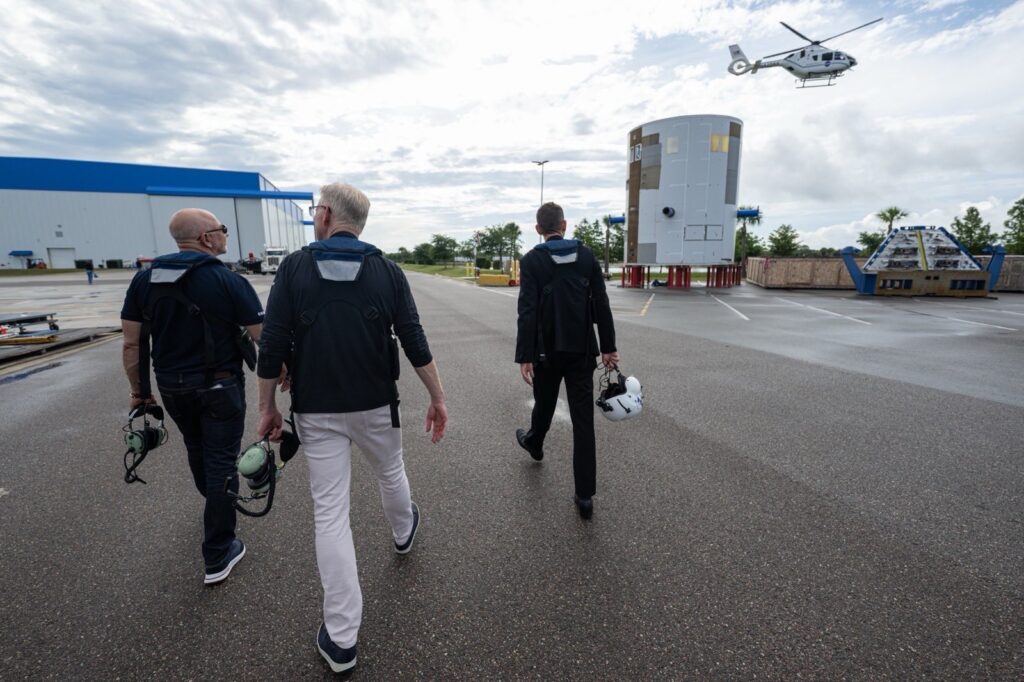
Executives walk across the Cape Canaveral flight line with helmets in hand after examining New Glenn flight hardware remnants.
Source: Reuters / Spaceflight Now
While the hardware and infrastructure losses are immense, Blue Origin officials confirmed that safety protocols functioned exactly as designed. The entire launch complex had been completely evacuated in the hours leading up to the hot fire test, ensuring that no technicians or engineers were within the hazard corridor when the anomaly occurred. In an official update released early Friday morning, the company confirmed that all personnel working the shift were accounted for and that no injuries of any kind had been reported to emergency medical teams.
The environmental and regional cleanup response is already underway, managed in coordination with Space Launch Delta 45, the Space Force unit that oversees operations at Cape Canaveral. Due to the force of the explosion, a significant amount of lightweight composite material and metallic insulation was lofted into the upper atmosphere. Military officials issued a formal advisory to the public warning that specialized rocket debris could wash ashore along public beaches and inland waterways across Brevard County over the coming weeks. Local residents have been instructed not to touch or collect any recovered materials, as residual hypergolic propellants or sharp carbon fiber edges could pose health and safety risks. Instead, the public is urged to report any sightings to emergency services for proper military mitigation and cataloging.
Despite the localized disaster, the broader functionality of Cape Canaveral Space Force Station appears intact. In a testament to the resilience of modern range operations, Space Launch Delta 45 announced that the Eastern Range remains fully mission capable. Proving this adaptability, the range successfully supported a completely unrelated SpaceX Falcon 9 launch from a neighboring pad just 12 hours after the New Glenn explosion. Space Force leadership emphasized that their operational posture is designed to absorb unexpected emergencies without halting the broader national security and commercial space missions of the United States.
Corporate Resolve and Government Partnership
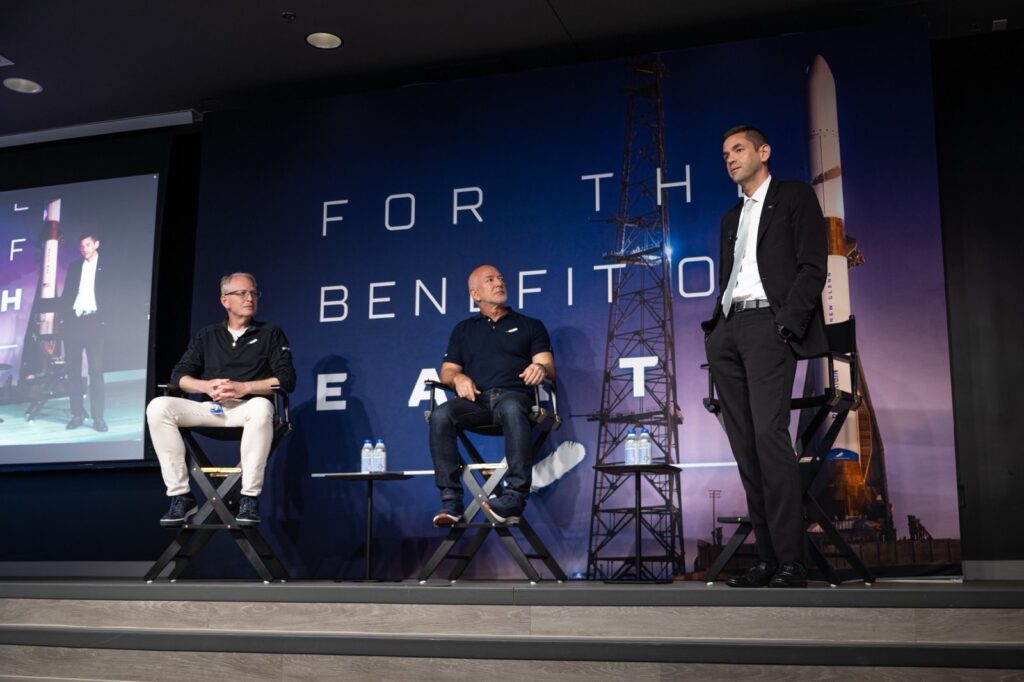
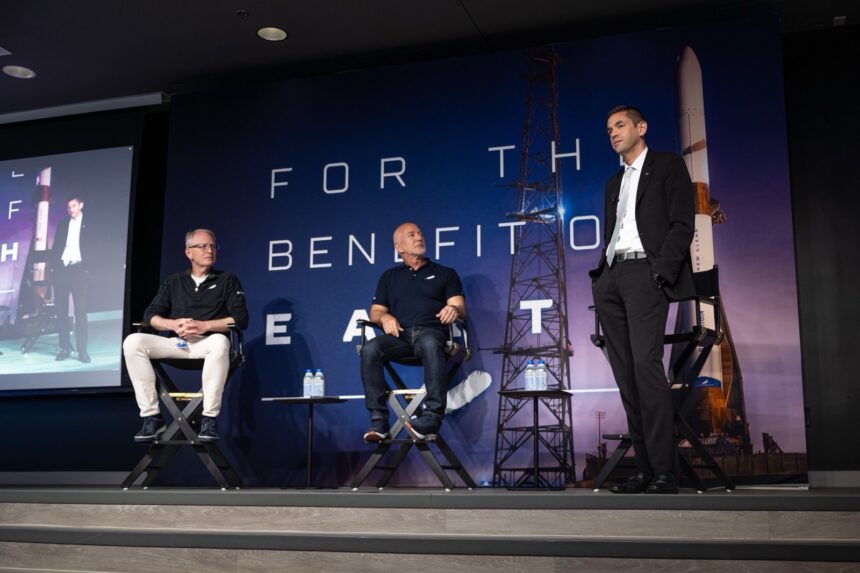
Blue Origin CEO Dave Limp, founder Jeff Bezos, and NASA Chief Jared Isaacman address the media regarding pad reconstruction plans.
Following the aerial inspection, the leadership team expressed a unified determination to overcome the setback. Jeff Bezos released an open statement acknowledging that while Thursday was an incredibly difficult day for the thousands of engineers who spent years developing the New Glenn system, the underlying vision of the company remains unchanged. Bezos emphasized that the financial resources are fully available to rebuild Launch Complex 36 with enhanced safety features and more robust ground support equipment, vowing that the company will return to flight status as quickly as the investigation allows.
The structural failure comes at a critical time for Blue Origin’s competitive standing in the commercial launch sector. New Glenn made its highly anticipated operational debut in January 2025, positioning itself as a direct competitor to mature heavy lift systems like the SpaceX Falcon Heavy and the United Launch Alliance Vulcan Centaur. The rocket boasts a massive seven meter wide payload fairing, offering nearly twice the internal volume of standard commercial fairings, which makes it highly attractive for multi-satellite deployment manifests. Navigating the aftermath of a total vehicle loss so early in the operational life of the program will test the company’s engineering depth and supply chain resilience.
From the government perspective, NASA Administrator Isaacman reiterated his support for the commercial space flight model while acknowledging the harsh realities of cutting edge aerospace development. Isaacman noted that spaceflight is an inherently unforgiving endeavor and that testing vehicles to their limits will occasionally result in catastrophic failures. He affirmed that NASA engineering teams will provide whatever analytical support is necessary to help Blue Origin identify the precise root cause of the failure, whether it originated in the liquid methane burning BE-4 engines or within the ground fluid management systems.
Over the coming weeks, attention will shift from the air to the ground as investigators deploy robotic crawlers and automated drones into the debris field to recover physical components and data recorders. Engineers will systematically review terabytes of high frequency telemetry data, pressure readings, and structural vibration logs captured during the final seconds of the countdown. The findings of this joint investigation will ultimately dictate not only the timeline for the reconstruction of Launch Complex 36 but also the broader cadence of American commercial operations on the path to the Moon.