


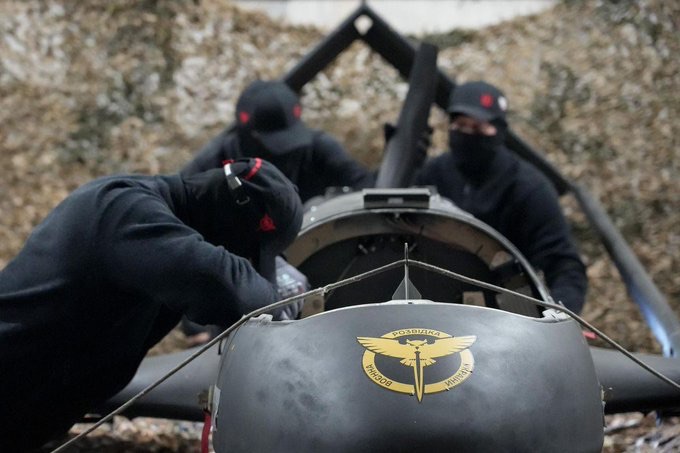
Ukrainian officials announced that the country’s domestically produced drones are now able to hit targets beyond 1,000 kilometers, with some sources reporting the capability now extends to 3,500 kilometers into Russian territory. That distance is not abstract. It is a strategic weapon system rewriting the calculus of the entire conflict.
To understand what that means, consider the geography. Moscow sits approximately 500 kilometers from the Ukrainian border. Russia’s most critical military and industrial sites, the production facilities that manufacture weapons, the energy infrastructure that powers the war economy, the command centers that coordinate military operations, all exist within what Moscow once considered the secure rear. That security assumption no longer exists.
During spring 2026, a series of spectacular drone strikes against port terminals succeeded in disrupting Russian exports, while attacks on refineries led to reports of significantly reduced capacity. Ukrainian officials believe that by targeting Russia’s energy industry, they can deprive the Kremlin of a vital economic lifeline that funds the ongoing invasion.
Redefining the Strategic Rear:
Graphic: Defense Intelligence of Ukraine (HUR) / Ukrinform
The strategic implication is stark. Russia used to worry about defending its borders. Now it has to worry about defending its depth.
How Ukraine Got Here
More Read

Ukraine did not start the war with the capacity for deep strikes. The early drone operations in 2022 and 2023 were primarily tactical weapons, used to disrupt supply lines and harass forward positions. The extensions came gradually, through improvisation, ingenuity, and access to Western weapons systems.
Ukraine hit targets over 1,000 kilometers last year for the first time, with one attack occurring 1,800 kilometers from the border in Russia’s Murmansk Oblast. Ukraine’s military said on April 23 that it struck a Russian facility producing combat drones located more than 1,000 kilometers from Ukraine’s border. That strike hit an Alabuga Special Economic Zone facility in Tatarstan that manufactures Iranian-style Shahed drones and Russian-made variants. The facility manufactures up to 300 Iranian-style Shahed drones and their Russian-made variants, Gerans, per day, according to the General Staff.
The trajectory from that breakthrough to today’s 3,500-kilometer capability has been one of steady, methodical expansion. In 2026, Ukraine began systematically degrading Russia’s ability to defend against aerial threats. For example, in April, the Defence Forces of Ukraine destroyed nearly twice as many air defense systems and radars as in October last year. According to the General Staff of the Armed Forces of Ukraine, the neutralization of 81 russian air defense systems has been confirmed since March 1, 2026.
More Read

Each air defense system destroyed opens new corridors for deep strikes. Each radar neutralized removes a layer of Russia’s early warning infrastructure. Ukraine is not just conducting individual drone attacks. It is systematically dismantling the architecture that would defend against those attacks.
The Swarm Strategy
What makes the extended range capability operationally decisive is the scale at which Ukraine has learned to deploy it. From February 1 to March 18, 2026, Ukrainian forces launched at least 110 drone strike packages against individual Russian targets ranging from energy infrastructure to military units, and from ammunition dumps to factories producing military electronics, explosives, and munitions.
Those numbers accelerated into spring. One of the biggest swarms of the entire war took to the air overnight Wednesday-Thursday with a reported 250-300 kamikaze aircraft penetrating Russian airspace according to Ukrainian military information platforms.
A swarm of 250-300 drones simultaneously saturates Russian air defenses. No air defense network can engage that volume of incoming targets across that distance simultaneously. Some drones will get through. Many will reach their targets. The sheer quantity of ordnance becomes as strategically significant as the individual accuracy of each strike.
During March 2026, Ukraine’s drone bombardment campaign of Russia delivered another first: For the first time in the war, in rough terms, the number of long-range drones launched by Russia at Ukraine was on par, and on some nights even less, than the number of long-range drones Ukraine launched at targets in Russia. That reversal is extraordinary. Russia began this war with massive air superiority. Ukraine has methodically eroded that advantage to the point where the initiative has flipped.
More Read

The Energy War Within the War
On new year’s eve the lights went out all over Moscow as temperatures fell far below zero. 600,000 Russian people lost power after electricity sub-stations were damaged by drone strikes. In Krasnodar, drones hit another oil refinery from a range of 380 km.
Those strikes are not accidents or side effects of military targeting. They are the primary objective. Ukraine has made a deliberate strategic choice to target Russian energy infrastructure because energy is the connective tissue binding Russia’s war economy together. Ukrainian officials believe that by targeting Russia’s energy industry, they can deprive the Kremlin of a vital economic lifeline that funds the ongoing invasion.
The arithmetic is brutal and visible. Every refinery damaged reduces fuel production. Every power station hit reduces electricity available for military manufacturing. Every port facility struck shrinks export revenue that finances weapons procurement. The drone campaign is not just military. It is economic warfare directed at the foundation that sustains the military.
What Russia Says It Cannot Do
The Russian military has not disputed Ukraine’s capability claims. Instead, military analysts have essentially conceded that Russia cannot defend against them at scale.
Russian State Duma Deputy Andrei Gurulyov, a retired lieutenant general and pro-Kremlin figure often commenting on military matters, said Russia is “too massive” to fully defend against Ukrainian deep drone strikes and that Russia “lacks the air defense forces needed to create a continuous protective shield…(forces) are stretched too thin.”
That statement, made by a pro-Kremlin figure, is a remarkable concession. Russia is acknowledging that it cannot defend the depth of its own territory against drones. The vastness that was supposed to be Russia’s strategic advantage in a continental war has become its vulnerability. Ukraine can hit targets 3,500 kilometers away. Russia cannot defend all of those targets simultaneously.
Defense analyst James Marinero, commenting on the attacks, called the damage to Russian capacity to stop Ukrainian drones a “fundamental shift” and “strategic masterstroke” that is “reshaping the conflict’s dynamics.”
Tactical Reality: Life on the Ground
The macro-strategic picture manifests in the tactical reality of Ukrainian drone operators. In a corn field in eastern Ukraine, soldiers fired drones into the sky using a slingshot, aiming at military targets in the country’s Russian-occupied east, dozens of kilometers away. Their commander from the 1st Center of Unmanned Systems Forces said, “We’re focusing on the enemy’s bases in the field, ammunition depots and air-defence systems.”
Middle-strike drones, including the FP-2, Hornet, and Bulava, play a critical role in these operations. Middle-strike drones enable systematic strikes at ranges of around 30-200 km, filling the gap between frontline FPV drone strikes and strategic deep-strike attacks.
What appears from Moscow as a strategic crisis appears from a Ukrainian farmer’s field as a profoundly practical advantage. The soldiers launching drones do not think in terms of geopolitics. They think in terms of ammunition depots destroyed, air defense systems neutralized, and supply lines disrupted. But those tactical victories accumulate into strategic transformation.
The Implication for the War’s Duration
The extended drone range capability suggests that the conflict’s trajectory is not one of Russian advantage. Russia was supposed to grind Ukraine down through attrition. Instead, Ukraine is grinding down Russian capacity through systematic strikes on the infrastructure sustaining the war.
Every refinery damaged is an irreplaceable loss in Russia’s finite military production capacity. Every power station hit reduces the electricity available for weapons manufacturing. Every drone facility struck slows the replacement of losses. Russia can replace soldiers. It cannot replace industrial capacity destroyed from 3,500 kilometers away at a rate that matches the rate of destruction.
The strategic advantage in a grinding war of attrition has shifted. Ukraine, the smaller, weaker power that was supposed to be overwhelmed in months, is now the one capable of striking deep into enemy territory at will. Russia, the larger power that was supposed to dictate the terms of conflict, is now the one scrambling to defend targets it once considered secure.
The 3,500-kilometer range is not just a technical achievement. It is a declaration that the war’s outcome will not be determined by who can field more troops on the battlefield. It will be determined by who can sustain their war economy longer, and Ukraine has just ensured that Russia cannot sustain its war economy at all.
That changes everything about how this conflict gets resolved.