


In a move that underscores the explosive demand for artificial intelligence infrastructure, SpaceX has entered into a significant cloud services agreement with Google. The partnership, disclosed in a recent SEC filing, highlights how even tech giants like Google are scrambling for additional computing capacity amid the AI boom. This deal not only provides SpaceX with a substantial new revenue stream but also signals a shift in how hyperscalers are sourcing compute resources.
The agreement comes as SpaceX prepares for its highly anticipated IPO, positioning the company as more than just a leader in space exploration. It is rapidly becoming a major player in high-performance computing.
The Details of the Agreement
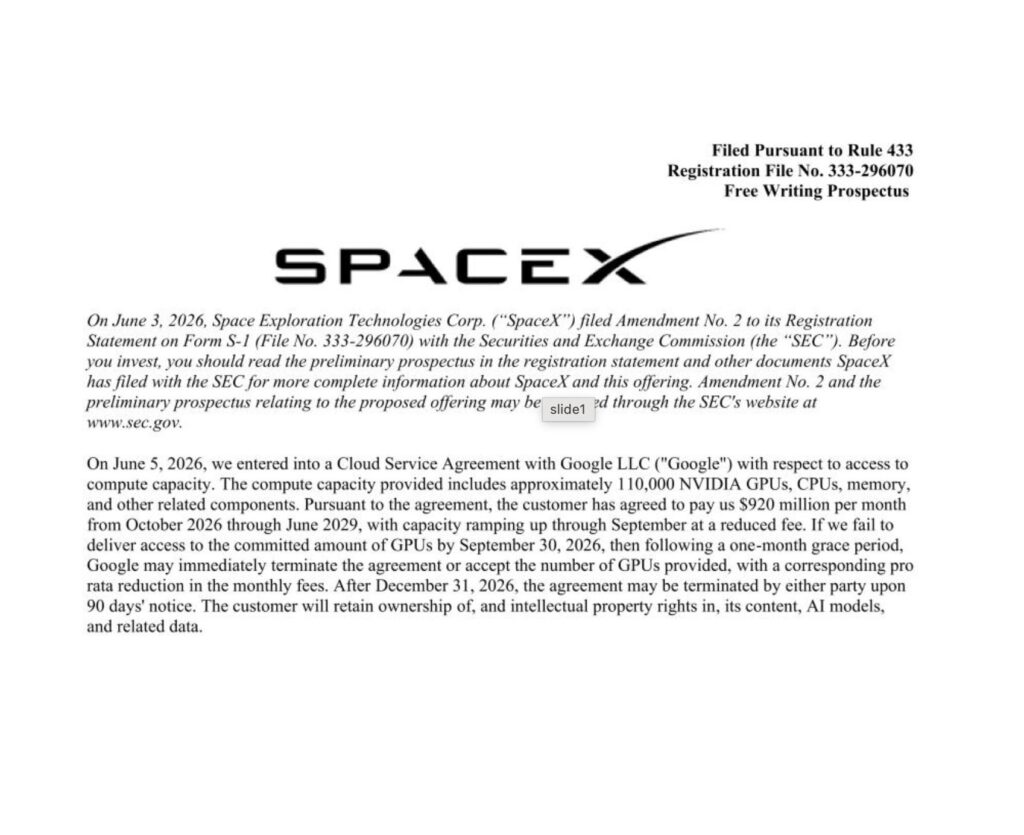
According to the filing, Google will gain access to compute capacity that includes approximately 110,000 NVIDIA GPUs, along with associated CPUs, memory, and other related hardware components. Payments kick in at full rate starting in October 2026, with Google committing to $920 million per month through June 2029. A ramp-up period runs through September 2026 at reduced rates.
This is no small commitment. Over the core term of the contract, the total value could exceed several billion dollars. The compute resources are likely hosted in SpaceX’s advanced data centers, which benefit from the company’s expertise in managing massive energy and cooling demands, honed through its rocket and satellite operations.
Termination clauses add flexibility to the deal. Either party can end the agreement with 90 days’ notice after December 2026. If SpaceX fails to deliver the full GPU capacity by September 30, 2026, Google has options to terminate after a one-month grace period or accept a prorated reduction in fees. Google will retain ownership of its data, AI models, and other content processed on the infrastructure.
More Read

This structure suggests the partnership serves as a bridge solution for Google while it ramps up its own long-term capacity builds.
Why Google Needs This Capacity Now
Google Cloud has been aggressively expanding its AI offerings, particularly with products like Gemini Enterprise. Recent statements from Google point to demand surging beyond initial expectations. In an official response, the company described the deal as a timely measure to meet customer needs for its agent platform.
The AI landscape has evolved rapidly. Training and running large language models require enormous clusters of GPUs. NVIDIA hardware remains the gold standard, but supply constraints, power availability, and data center build times create bottlenecks. Even a company with Google’s resources and custom Tensor Processing Units (TPUs) finds itself turning to external partners for surge capacity.
This is not Google’s first foray into external compute deals, but the scale here is notable. It reflects broader industry trends where hyperscalers are increasingly willing to lease from non-traditional providers to stay ahead in the AI race.
SpaceX’s Pivot into AI Infrastructure
For SpaceX, this deal builds on momentum from other major partnerships. Earlier agreements, such as the one with Anthropic involving even larger GPU clusters, have already established the company as a serious contender in AI compute. Reports indicate SpaceX’s Colossus data centers are powering these operations, leveraging the firm’s engineering prowess in power management and liquid cooling systems originally developed for rocket engines.
Elon Musk’s companies have long overlapped in talent and technology. Expertise from Tesla’s Dojo supercomputer projects and Starlink’s global network infrastructure translates well to building efficient, high-density data centers. SpaceX’s locations, potentially near energy-rich sites or with dedicated power solutions, offer advantages that traditional cloud providers might struggle to match quickly.
This Google agreement pushes SpaceX’s disclosed monthly AI compute revenue run rate significantly higher when combined with prior deals. It strengthens the company’s valuation narrative ahead of its public debut, showing diversified revenue beyond launches and satellite internet.
Broader Implications for the AI Industry
The deal shines a light on the intense competition for compute resources. NVIDIA GPUs are in high demand, but the real constraints now often center on power, cooling, and permitting for new facilities. SpaceX’s ability to deliver 110,000 GPUs worth of capacity speaks to its operational scale and execution speed.
Industry analysts see this as evidence that the moat around traditional cloud giants like AWS, Azure, and Google Cloud itself may be narrowing. Hyperscalers are leasing from rocket companies and AI startups are partnering directly with infrastructure innovators. This diversification could accelerate innovation in data center design while pressuring incumbents to optimize costs and efficiency.
More Read

For NVIDIA, the deal reinforces strong demand for its hardware. Even as new chip architectures emerge, the installed base and ecosystem lock-in keep demand robust. Broader market effects could include upward pressure on GPU valuations and increased scrutiny on energy consumption in the AI sector.
Google’s willingness to pay premium rates for this capacity also highlights the economic value of AI applications. If enterprises and developers are driving such high utilization, the return on investment for model training and inference must be compelling.
Challenges and Risks Ahead
No major deal is without potential hurdles. SpaceX must deliver reliable uptime and performance to meet Google’s standards. Data center operations at this scale involve complex challenges around power procurement, hardware maintenance, and network connectivity.
The short-term nature of the agreement, with easy termination options, means both parties are hedging. Google may view this as temporary bridge capacity while it expands its own TPU fleets and data centers. SpaceX, meanwhile, gains immediate revenue and proves its capabilities to attract future customers.
Regulatory and geopolitical factors could also play a role. Export controls on advanced AI hardware, energy regulations, and national security considerations around compute infrastructure remain ongoing concerns in the industry.
Looking to the Future
This SpaceX-Google partnership could mark the beginning of deeper collaboration. SpaceX’s Starlink network might eventually provide low-latency connectivity for distributed AI workloads, while Google’s AI expertise could enhance SpaceX’s internal projects, such as autonomous flight systems or satellite operations.
As AI adoption accelerates across industries, expect more creative infrastructure deals. Orbital data centers, advanced cooling technologies, and novel energy sources may become mainstream topics. Companies that can solve the physical world problems of compute, power, and cooling will hold significant advantages.
For investors, SpaceX’s IPO just became even more intriguing. The company is no longer solely a space play. It is an AI infrastructure powerhouse with contracts from leading tech firms. Google, for its part, secures critical capacity to maintain its competitive edge in generative AI.
In the end, this $920 million monthly agreement is more than a contract. It is a snapshot of an industry in hypergrowth, where traditional boundaries between space, automotive, and cloud computing are blurring. The race for AI supremacy is reshaping corporate strategies and capital allocation at an unprecedented pace. As more details emerge in the coming months, this deal may prove to be a pivotal moment in the evolution of the AI ecosystem.