


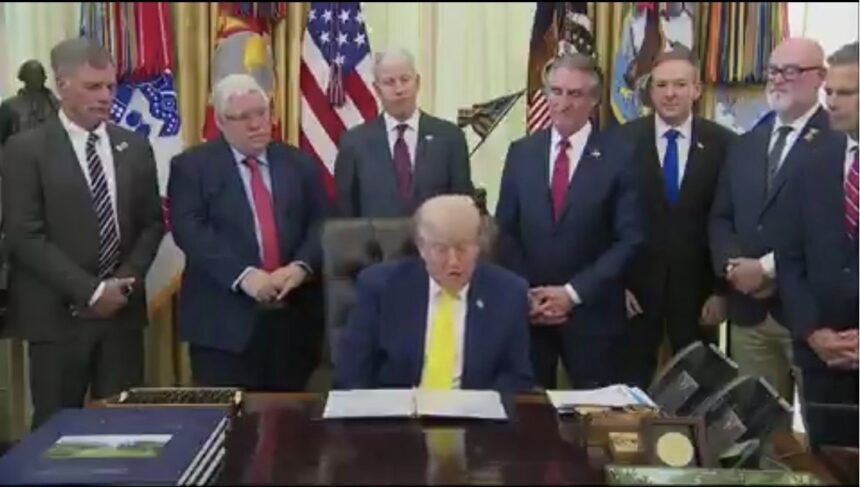
President Donald Trump has once again delivered on a core campaign promise, signing an executive action that channels almost $1 billion through the Defense Production Act to bolster the nation’s coal sector. This move is not just about propping up an old industry. It represents a strategic push for energy reliability in an era of exploding electricity demand from artificial intelligence, data centers, and heavy industry.
While renewables dominate headlines, this funding highlights the tech realities of baseload power: consistent, dispatchable electricity that keeps the grid stable when the sun does not shine or the wind does not blow.
The Details of the Funding Package
The allocation breaks down into targeted investments designed to modernize, expand, and secure coal infrastructure across the country.
$425 million goes toward upgrades at 13 existing coal-fired power plants. These funds will support life-extension projects, efficiency improvements, and reliability enhancements. Many plants will receive technology upgrades that improve emissions controls and operational flexibility.
$185 million supports new construction and restarts. This includes building fresh coal plants in Alaska and West Virginia, plus restarting the AES Warrior Run facility in Maryland. These projects mark the first new coal plants in the United States since 2013, signaling a reversal of years of decline.
More Read

$75 million targets a major coal export terminal in Oakland, California. The West Gateway terminal could open doors for shipping up to 12 million tons of coal annually from western states like Wyoming and Montana to international markets.
Additional support flows to coal mines and related logistics, including rail and barge systems. Overall, the administration says the investment will protect 14 coal plants and 42 mines while enabling two new builds and one major export hub.
Trump himself described the impact during the announcement: “As a result of the $700 million investment that I’m announcing today, we will protect 14 coal plants and 42 coal mines… and build two new coal plants and one massive new export terminal.”
More Read

Why the Defense Production Act?
The Defense Production Act (DPA), a Cold War-era tool, allows the president to prioritize industrial capacity for national security reasons. In this case, the administration ties coal directly to defense readiness. Reliable baseload power is essential for military installations, critical infrastructure, and the surging needs of emerging technologies.
Earlier in 2026, Trump issued presidential determinations under the DPA for coal supply chains, explicitly citing risks to AI development and industrial expansion without stable electricity. Intermittent renewables alone cannot meet the constant, high-volume demands of hyperscale data centers powering everything from ChatGPT training runs to advanced manufacturing. Coal plants provide that always-on foundation, and the funding aims to keep them viable while integrating modern controls.
This is not the first coal-focused action. Previous executive orders in 2025 reinvigorated leasing on federal lands, restored the National Coal Council, and directed long-term power purchase agreements with the Department of Defense. The latest DPA push builds on that momentum, using federal dollars to de-risk private investment and accelerate projects that might otherwise stall.
Tech Upgrades Transforming “Clean Coal”
Critics often paint coal as outdated, but the funded projects emphasize modernization. Today’s coal technology looks very different from plants built decades ago. Advanced supercritical boilers, improved combustion systems, and enhanced scrubbers reduce emissions significantly. Some facilities explore carbon capture, utilization, and storage (CCUS) to trap CO2 for industrial use or sequestration.
These upgrades align with broader energy tech trends. Grid operators need flexible resources that can ramp up or down quickly to balance variable solar and wind. Modern coal units with digital controls and AI-optimized operations can provide exactly that. They also support critical mineral recovery from coal ash, turning waste into resources for electronics and defense applications.
For regions like Appalachia and the Powder River Basin, this means more than jobs. It means investment in skilled technical roles: engineers maintaining high-efficiency turbines, technicians deploying sensor networks, and operators using predictive analytics to prevent outages. The export terminal in California adds another layer, strengthening supply chain tech for bulk materials handling and port logistics.
More Read

Energy Security in the AI Era
Electricity demand is skyrocketing. Data centers alone could consume 8-10 percent of U.S. power by the end of the decade. Add electric vehicles, electrified manufacturing, and population growth, and the math becomes clear. Many experts warn that retiring baseload plants too quickly risks blackouts and higher costs.
Coal currently provides about 15-20 percent of U.S. electricity, depending on the season, and it excels at providing inertia and voltage support that help stabilize the grid. By preserving and expanding this capacity, the administration argues it is preventing a reliability crisis that could hamstring technological progress.
Alaska’s new plant, for instance, addresses remote energy needs where renewables face extreme weather challenges. West Virginia projects leverage local resources and existing workforce expertise. Restarting Maryland’s facility keeps regional power online without forcing abrupt transitions that strain transmission infrastructure.
Economic Ripple Effects and Job Creation
The coal sector supports hundreds of thousands of direct and indirect jobs, from mining to rail transport to power generation. These are often high-wage, technical positions in communities that have faced economic headwinds. The new funding is expected to sustain and create roles in construction, engineering, and operations.
Export capabilities could boost domestic production, lowering costs for U.S. utilities while generating revenue from overseas sales. This fits into a larger “energy dominance” strategy that treats abundant resources as strategic assets rather than liabilities.
Private industry is responding. Utility companies and developers see federal backing as a signal for long-term viability, encouraging matching investments that multiply the impact of the public dollars.
Balancing Perspectives in a Polarized Debate
Environmental advocates argue that subsidizing coal delays the shift to zero-carbon sources and prolongs air quality concerns in some areas. They point to falling costs for solar, wind, and battery storage as evidence that the market is already moving on.
Proponents counter that an all-of-the-above approach is pragmatic. Natural gas, nuclear, renewables, and coal each have roles. Premature coal retirements have already contributed to tight capacity margins in parts of the country. With AI and electrification accelerating demand, keeping reliable assets online buys time for next-generation nuclear and long-duration storage to scale.
The DPA mechanism itself is technology-neutral in intent. It has been used across administrations for everything from semiconductors to medical supplies. Applying it here prioritizes domestic supply chain resilience over ideological purity.
Looking Ahead: What This Means for Energy Tech
This $700 million-plus commitment is substantial but represents just one piece of a broader infrastructure puzzle. It pairs with parallel DPA actions on grid equipment, natural gas, and large-scale energy projects. Together, they aim to create a more robust, diversified power system.
Success will depend on execution: timely permitting, private capital mobilization, and genuine technology integration. If the upgraded plants deliver higher efficiency and lower emissions while providing the reliability the grid craves, the investment could pay dividends for years.
In an age where electricity is the lifeblood of innovation, treating baseload power as critical infrastructure makes technical sense. Trump’s coal push, framed through the lens of national security and economic strength, underscores a simple truth: the future of tech runs on reliable electrons, whatever their source.
Whether this sparks a genuine renaissance or serves as a bridge to newer technologies remains to be seen. For now, it delivers tangible support to an industry many had written off, while addressing immediate challenges in powering America’s digital ambitions.