

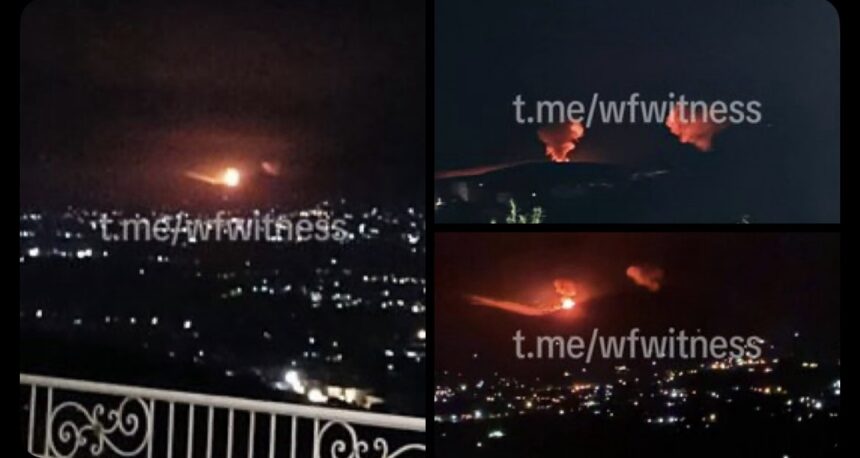
Shaky nighttime footage circulating on social media platforms, including a prominent post by commentator Mario Nawfal, shows bright orange fireballs and explosions lighting up the sky over the town of Brital in eastern Lebanon’s Bekaa Valley. The videos, captured from a distance with visible foreground railings and trees silhouetted against the blasts, depict what local sources and eyewitnesses describe as intense Israeli airstrikes occurring on the evening of May 22.
The clips, bearing Telegram watermarks typical of rapid dissemination from conflict zones, capture multiple detonations. Some appear as massive fireballs rising into the dark sky, while others show sustained glows suggesting secondary explosions or fires on the ground. While independent verification of casualties and exact targets remains ongoing as of late Friday, the incident underscores the persistent fragility of a U.S.-brokered ceasefire established in mid-April 2026.
Background: A Region Long in the Crosshairs
Brital, a town in the Baalbek District of the Bekaa Valley, lies approximately 80 kilometers east of Beirut and close to the Syrian border. The area has historically served as a strategic corridor for various armed groups, including Hezbollah, due to its rugged terrain, proximity to supply routes from Syria, and agricultural expanses that can conceal infrastructure. The Bekaa Valley as a whole has been a focal point in multiple Israel-Hezbollah confrontations. It is valued for its role in alleged weapons storage, command centers, and launch sites.
This latest reported strike is not isolated. Israeli operations in the Bekaa have intensified at various points since the broader escalation that began in early March 2026. At that time, Hezbollah launched rockets and drones toward Israel in solidarity with Iran amid regional conflicts. Prior incidents in Brital and nearby areas like Nabi Chit and Al-Nabi Sheet include strikes on suspected underground facilities, weapons production sites, and militant positions. For instance, earlier in May and throughout April, reports documented airstrikes in the Brital plains and surrounding heights. These often targeted what the Israel Defense Forces (IDF) described as Hezbollah infrastructure.
Lebanese state media and Hezbollah-affiliated outlets have frequently reported civilian casualties in such operations. Israel maintains that its actions are precise, intelligence-driven responses to imminent threats. The IDF has repeatedly emphasized operations against Hezbollah military sites, including tunnels, missile depots, and command nodes embedded in civilian-adjacent areas.
More Read

The Ceasefire: A Temporary Pause Fraught with Violations
The current tensions unfold against the backdrop of a ceasefire agreement announced on April 16, 2026, by U.S. President Donald Trump. This followed direct talks between Israeli and Lebanese representatives. The initial 10-day cessation of hostilities was extended multiple times. It was first extended by three weeks, then reportedly for another 45 days. The goal was to de-escalate the 2026 Lebanon war and create space for longer-term negotiations on border security, disarmament of non-state actors, and Lebanese sovereignty.
Under the terms, both sides committed to halting attacks. Lebanon pledged to curb Hezbollah activities along the border. However, implementation has been uneven. Israel has continued targeted operations, citing Hezbollah’s alleged rearmament, drone incursions, and rocket preparations. Hezbollah, for its part, has dismissed aspects of the truce as meaningless while accusing Israel of repeated violations.
As of mid-May 2026, Lebanese health authorities reported over 3,000 deaths since March 2, when intensified fighting resumed. Strikes have hit southern Lebanon, Beirut suburbs, and the Bekaa. These have displaced thousands and strained an already fragile economy and healthcare system. Recent examples include deadly attacks in Zellaya in western Bekaa, killing municipal officials and families, and operations near Baalbek.
More Read
Evacuation warnings issued by Israel for villages in southern Lebanon and parts of the Bekaa have led to large-scale civilian movements toward Beirut. This has exacerbated humanitarian concerns. International observers, including the UN, have warned that such actions risk unraveling the truce entirely.
Tonight’s Events: What We Know So Far
Mario Nawfal’s post, timestamped around 8:58 PM GMT on May 22, shared two videos alongside earlier reports of heavy Israeli airstrikes in Lebanon’s Bekaa Valley. The footage shows dramatic nighttime explosions consistent with airstrikes or munitions impacts. One clip displays a bright orange streak and fireball. Another reveals twin red-orange plumes rising against a dark horizon.
Local residents described hearing thunderous booms and seeing the sky illuminated for several minutes. Sources close to Hezbollah-linked channels claimed the strikes targeted areas near Brital’s outskirts. These possibly included fortifications or storage sites. No immediate official casualty figures from Lebanese authorities were available at the time of reporting. Past similar strikes have resulted in double-digit deaths when impacting populated zones.
The Israeli military has not yet issued a detailed statement on this specific incident. This follows a pattern of confirming operations only after initial assessments. In previous Bekaa strikes, such as the elimination of Palestinian Islamic Jihad commander Wael Mahmoud Abdel Halim near Baalbek on May 17-18, the IDF highlighted the targeting of militants coordinating with Hezbollah.
Broader Geopolitical Context
The Israel-Hezbollah dynamic remains intertwined with larger regional instabilities. These include the aftermath of U.S.-Iran confrontations earlier in 2026. Hezbollah’s intervention in March, firing projectiles toward Haifa and other areas, prompted a robust Israeli response across Lebanon. Despite the April ceasefire, low-level exchanges such as drones, rockets, and pinpoint strikes have persisted. This has prevented a return to normalcy.
Analysts note that the Bekaa Valley’s role has evolved. Once primarily a rear-area logistics hub, it has seen increased Israeli attention. This is as Hezbollah allegedly attempts to rebuild capabilities dispersed from the south. Israel’s strategy appears focused on degrading long-range threat infrastructure. It seeks to avoid full-scale re-invasion, though ground operations in southern Lebanon have created a buffer zone that remains contentious.
More Read

International reactions have been mixed. The U.S. has urged restraint and supported diplomatic extensions of the truce. European nations and Arab states have called for full implementation of UN resolutions calling for Hezbollah’s disarmament south of the Litani River. Iran, a key backer of Hezbollah, has condemned the strikes but faces its own post-conflict challenges.
Humanitarian organizations report severe impacts: hospitals overwhelmed, schools closed in border regions, and agriculture in the fertile Bekaa disrupted. Over a million Lebanese have been displaced at various peaks. Many are reluctant to return amid recurring alerts.
Voices from the Ground and Analysis
Residents in Brital and nearby Baalbek express exhaustion. One local, speaking anonymously to regional media in past incidents, described constant fear from overflights and distant explosions. Municipal leaders in affected Bekaa towns have appealed for international protection and reconstruction aid.
Security experts assess that while the ceasefire has reduced the intensity compared to March-April peaks, it lacks robust enforcement mechanisms. Hezbollah’s political integration in Lebanon complicates disarmament efforts. Israel’s security imperatives, protecting northern communities from rocket fire, drive continued operations.
Potential flashpoints include further Israeli incursions into eastern Bekaa or Hezbollah retaliatory barrages. Diplomatic efforts, possibly involving U.S. mediation or UN facilitation, aim to transition the temporary truce into a more durable framework. This could include border demarcation and monitoring.
Looking Ahead
As details from Brital emerge, potentially including confirmed casualties, target assessments, and responses, the incident serves as a stark reminder of the conflict’s volatility. With the ceasefire’s extensions under strain, both sides risk a return to open warfare that could draw in broader actors.
Lebanon’s government faces pressure to assert control over armed groups. Israel balances military necessities with international scrutiny. For civilians in Brital and across the Bekaa, tonight’s explosions represent yet another night of uncertainty in a cycle that has defined the region for decades.
This report will be updated as more information becomes available from official sources, on-the-ground verification, and statements from involved parties. The human cost of these repeated escalations remains the most pressing concern. It highlights the urgent need for a sustainable political resolution.