


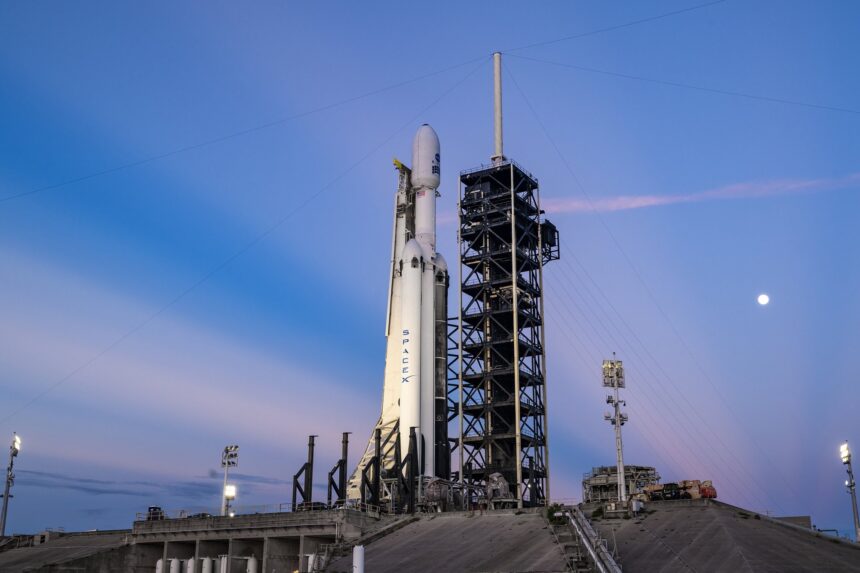
Cape Canaveral, Florida — NASA’s next-generation flagship observatory, the Nancy Grace Roman Space Telescope, successfully launched early Sunday morning aboard a SpaceX Falcon Heavy rocket from Launch Complex 39A at Kennedy Space Center. Liftoff occurred at 7:26 a.m. EDT, sending the $4.3 billion infrared telescope on its way to the Earth-Sun Lagrange Point 2 (L2), about 1.5 million kilometers from Earth.
The mission lifted off nearly nine months ahead of its formal launch readiness date of May 2027, a notable achievement for a complex astrophysics flagship project. NASA and SpaceX had targeted the August 30 window after the spacecraft arrived in Florida months earlier and completed final processing on schedule.
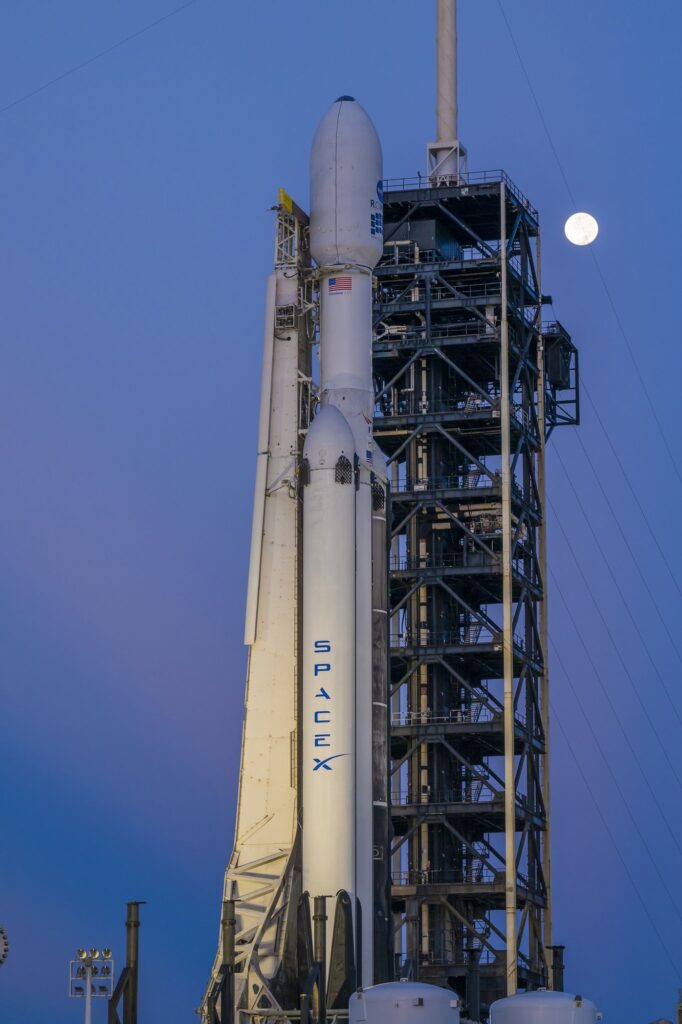
Source: NASA / SpaceX (official mission photograph, NASA Kennedy Space Centre).
A Major Step Forward for Cosmology and Exoplanet Science
Named after Nancy Grace Roman, NASA’s first Chief of Astronomy and a pioneering figure often called the “Mother of Hubble,” the Roman Space Telescope is designed to deliver panoramic views of the universe with a field of view at least 100 times larger than the Hubble Space Telescope while maintaining comparable sharpness in infrared wavelengths.
Key science goals include:
- Mapping the distribution of dark matter and probing the nature of dark energy through large-scale surveys of galaxies and gravitational lensing.
- Discovering and characterizing thousands of exoplanets via microlensing and other techniques.
- Conducting wide-field infrared astrophysics surveys that will generate vast public datasets for the global scientific community.
The observatory carries a 300-megapixel wide-field instrument and is planned for a five-year primary mission, with the potential to operate longer depending on remaining fuel.
More Read

Falcon Heavy Delivers High-Performance Launch
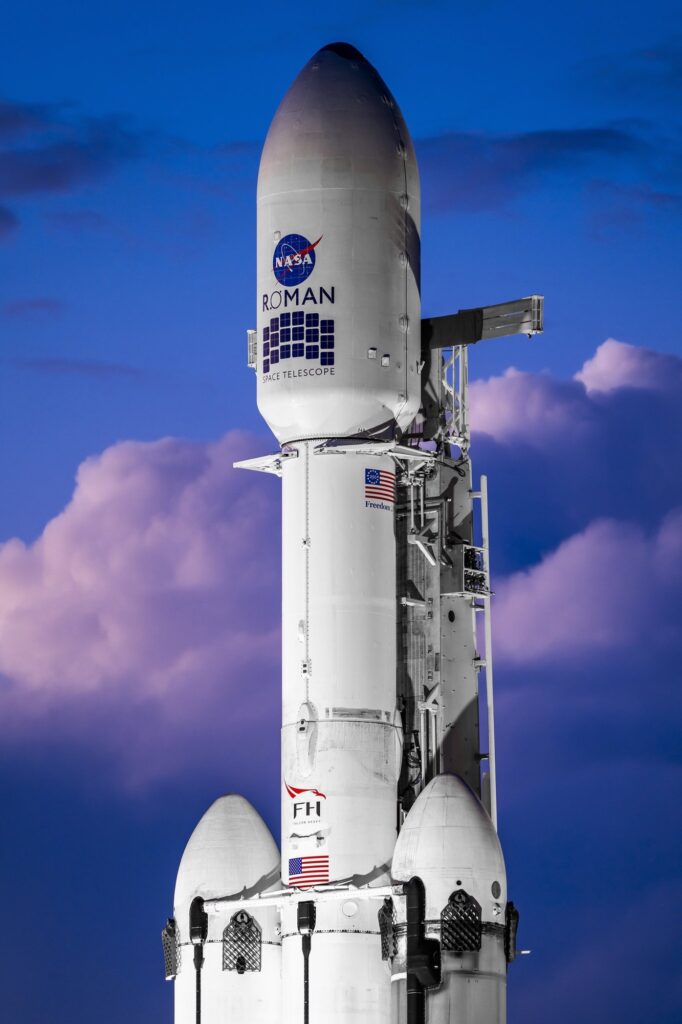
Source: NASA / SpaceX (NASA Goddard Space Flight Center / Kennedy Space Center artist render/concept photograph).
SpaceX’s Falcon Heavy, with its 27 Merlin engines generating more than 5 million pounds of thrust, was selected to loft the roughly school-bus-sized spacecraft on the required high-energy trajectory toward L2. Side boosters were planned for recovery, consistent with SpaceX’s reusable launch approach. The launch proceeded through favorable conditions after weather monitoring in the final hours.
NASA officials had previously highlighted the program’s disciplined cost and schedule management, which enabled the early readiness. Once at L2, the spacecraft will undergo commissioning over roughly 100 days before beginning science operations.
Why This Launch Matters
Roman builds on the legacies of Hubble and the James Webb Space Telescope by prioritizing survey speed and sky coverage rather than extreme depth on single targets. Its data are expected to transform understanding of cosmic acceleration, the growth of structure in the universe, and the prevalence of planets beyond our solar system. All science data will be made publicly available after processing, maximizing community impact.
More Read

The successful early launch marks a strong start for one of NASA’s highest-priority astrophysics missions of the decade and underscores the growing partnership between the agency and commercial providers like SpaceX for complex science payloads.
As the Roman Space Telescope begins its journey, astronomers worldwide are preparing for the flood of new infrared survey data that will reshape cosmic research in the years ahead.