


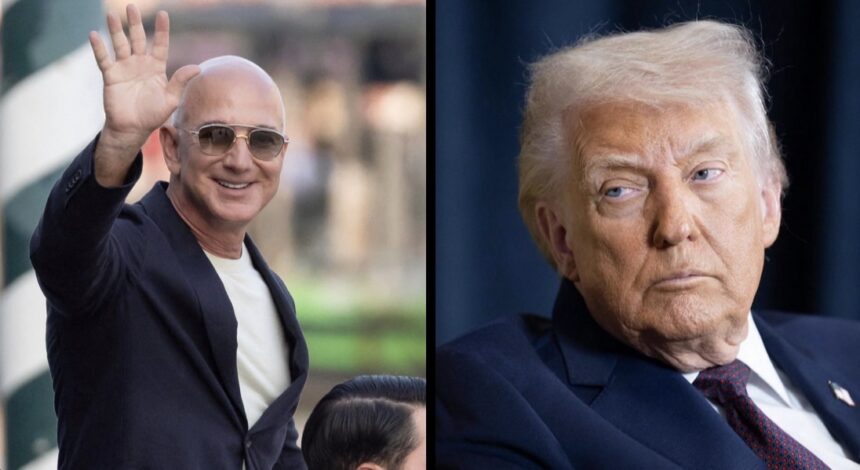
In a candid CNBC interview last month, Amazon founder and executive chairman Jeff Bezos proposed a bold shift in U.S. tax policy: eliminate federal income taxes entirely for the bottom half of American earners.
The suggestion has quickly gained attention far beyond Washington. For an industry built on talent, scaling, and long-term innovation, it raises fresh questions about workforce economics, consumer spending power, and how companies like Amazon operate in a high-cost environment.
The Core Proposal and the Human Example
Bezos made his case during a May 20, 2026 appearance on “Squawk Box” with Andrew Ross Sorkin. He highlighted stark numbers: the bottom 50 percent of taxpayers contribute just 3 percent of total federal income tax revenue, while the top 1 percent shoulder around 40 percent.6
“We shouldn’t be asking this nurse in Queens who makes $75,000 to send money to Washington,” Bezos said. “They should be sending her an apology.”9
He noted that such a worker can lose more than $1,000 per month to taxes. That money, he argued, could instead go toward rent, groceries, or other daily pressures in expensive cities. For Bezos, zero is not just an adjustment. It carries symbolic power. “There is something very powerful about zero,” he emphasized.14
More Read

Why This Matters for the Tech Sector
Tech companies rely heavily on a broad base of employees, from engineers and data scientists to warehouse workers, customer service reps, and support staff. Many of those roles fall into income brackets that would benefit directly from the change Bezos describes.
Lower taxes on middle- and lower-income households could mean:
- More disposable income for consumers buying everything from Prime memberships to cloud services and devices.
- Reduced financial stress for talent in high-cost tech hubs, potentially easing recruitment and retention challenges.
- A stronger argument for companies to invest in domestic hiring rather than offshoring, as workers keep more of their pay.
Bezos, who also leads Blue Origin, framed the idea while walking the factory floor at his space company. The setting underscored a broader point: American innovation thrives when everyday workers have breathing room, not when government takes a cut from paychecks that barely cover basics.9
More Read
Reactions and Potential Pushback
The proposal has drawn mixed responses. Some see it as a pragmatic move to simplify the tax code and reduce administrative burden. Others worry it could widen deficits or shift even more burden onto higher earners and corporations. Bezos himself acknowledged the ongoing debate about whether billionaires should pay more, but he pushed back on the idea that soaking the rich alone solves deeper affordability issues.4
In tech circles, the conversation quickly turns practical. Amazon, like many large employers, already offers competitive benefits and wage growth. Eliminating income taxes for half the country could amplify those efforts by putting real dollars back into employees’ pockets without changing company payrolls.
Critics on social media have questioned motives. Some view it as image polishing for one of the world’s wealthiest individuals. Supporters, however, point out the math: if the bottom half truly delivers only a tiny slice of revenue, removing it might not create the fiscal hole some fear.
Broader Economic Implications
Median U.S. household income sits around $83,000, with the bottom half averaging closer to $54,000 in adjusted gross income.7 A full tax exemption at that level could act as one of the largest middle-class relief measures in decades.
For the tech industry, which drives much of U.S. productivity growth, the ripple effects could include stronger domestic demand and a more motivated workforce. Entrepreneurs might also find it easier to take risks if early employees keep more of their compensation.
Whether policymakers take up Bezos’s idea remains to be seen. But the Amazon leader has put a clear stake in the ground: stop collecting pocket change from people who need it most, and focus the system where the real revenue already flows. In an era of rapid automation and AI advancement, giving working Americans more financial oxygen could prove to be smart economics, not just good politics.