

Central banks added a net 244 tonnes of gold to their reserves in the first quarter of 2026, according to World Gold Council data. Official reports captured through standard channels, however, showed just 16 tonnes.
That leaves roughly 228 tonnes (93% of the total) acquired through channels that never made it into public disclosures. The gap shows up in trade flows, vault movements, and other indirect activity rather than direct announcements from the banks themselves.
The World Gold Council’s Q1 2026 Gold Demand Trends report puts net central bank purchases at 244 tonnes, up 17% from the previous quarter and above the recent average. Poland led visible buying with 31 tonnes, followed by Uzbekistan at 25 tonnes. China added 7 tonnes to its reported holdings. Other buyers included Kazakhstan, the Czech Republic, Malaysia, and several smaller central banks entering or returning to the market.
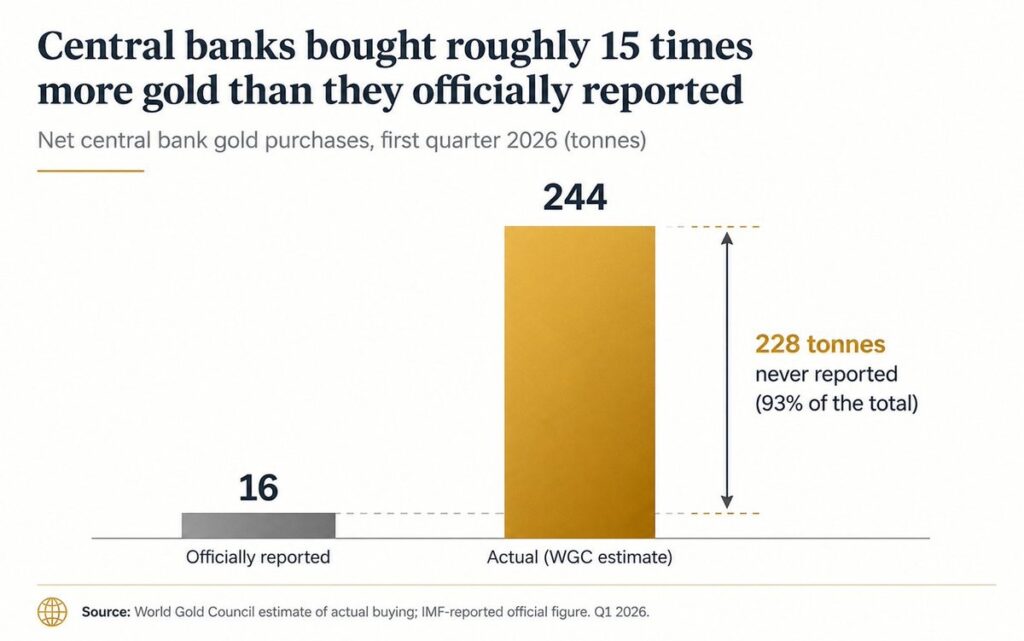
A wide gap has emerged in global gold markets as central banks covertly acquired roughly 15 times more gold than officially disclosed during the first quarter of 2026. Financial tracking reveals that while only 16 tonnes were officially reported to the IMF, actual institutional buying reached an estimated 244 tonnes—leaving 93% of the total volume unrecorded.
Source: World Gold Council (WGC) / International Monetary Fund (IMF)
At the same time, some reported sales occurred, notably from Turkey, Russia, and Azerbaijan, but these were more than offset by the broader buying. The WGC notes that unreported purchases have stayed elevated since 2022, reflecting a pattern where many institutions prefer not to broadcast every move.
The 16-tonne official figure comes from direct IMF-reported data and central bank disclosures. The much larger 244-tonne estimate combines those reports with market and refinery data that capture activity not yet declared. This distinction has become a regular feature of the central bank gold story in recent years.
More Read

Countries continue turning to gold as a strategic reserve asset amid geopolitical tensions and questions around traditional reserve currencies. The buying has run for more than three years now, with central banks as a group posting net purchases in the large majority of quarters since 2022.
For gold markets, the trend has provided consistent physical demand even as prices reached record levels. The latest numbers show the pace held steady into early 2026 despite higher prices and some visible selling.
The accumulation shows no immediate sign of stopping. Central banks have repeatedly signaled they view gold as a core holding for diversification and long-term stability, and the gap between reported and actual purchases suggests the real scale of that shift remains understated in official statistics.