

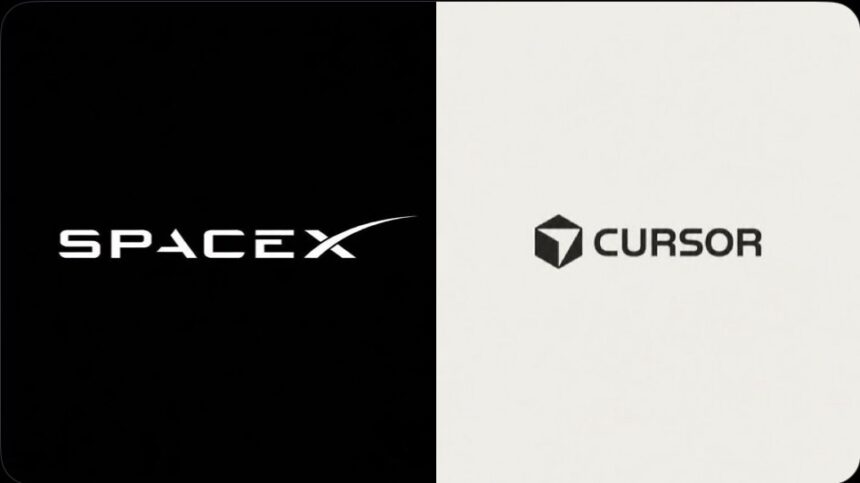
In a move that underscores just how fiercely companies are racing to dominate the next wave of artificial intelligence, SpaceX has reached a definitive agreement to acquire Anysphere, the San Francisco startup behind the popular AI coding tool Cursor. The all-stock deal values the target at $60 billion and is expected to close in the third quarter of this year, pending regulatory approvals.
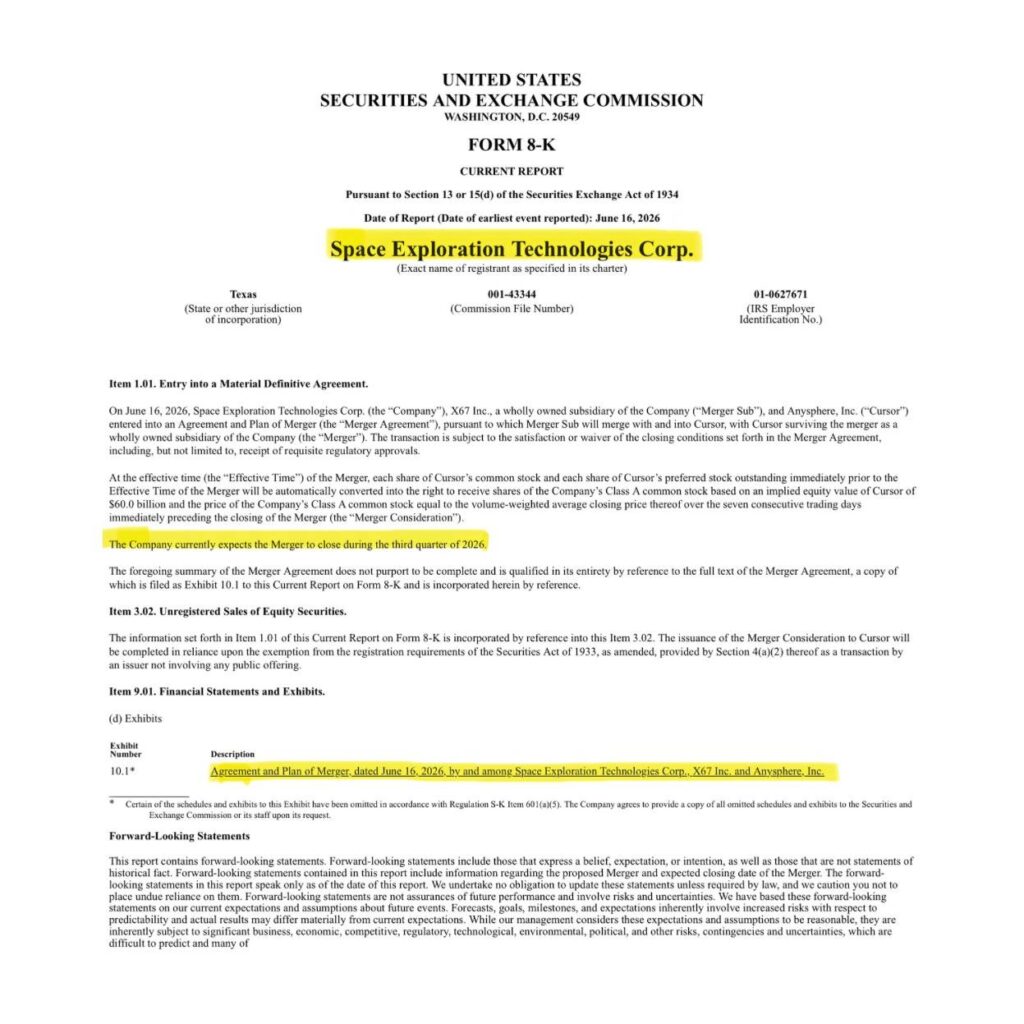
(Photo credit: Supplied / SEC.gov)
This is no small transaction. For context, it comes just days after SpaceX’s own blockbuster Nasdaq debut, which valued the combined SpaceX-xAI entity at well over $2 trillion. The acquisition folds one of the fastest-growing software companies in recent memory into Elon Musk’s expanding empire, pairing Cursor’s slick user interface and massive developer base with the immense computing power of xAI’s Colossus supercluster.
How We Got Here
The story started heating up back in April. That’s when SpaceX first announced a close partnership with Cursor. At the time, the companies framed it as a collaboration to build the world’s best coding and knowledge-work AI. Cursor would get access to Colossus, described as having the equivalent of a million H100 GPUs, to train more powerful models. In return, SpaceX secured an option: buy the whole company later in 2026 for $60 billion, or simply pay $10 billion for the joint development work if things did not progress to a full takeover.
That structure gave both sides flexibility. Cursor, which had been in talks for a funding round around the $50 billion mark, got guaranteed compute and a huge payday either way. SpaceX got time to integrate the technology while preparing for its public listing. Now, with the IPO behind it and shares trading strongly, the company has exercised that path forward through a stock-based merger involving its subsidiary X67.
If the deal terminates for certain reasons, SpaceX could owe a $10 billion fee. Antitrust snags would trigger a separate $4 billion payment. Either way, it is a structured bet that reflects the high stakes in AI infrastructure right now.
More Read

The Rise of Cursor
Anysphere launched in 2022, founded by four MIT graduates: Michael Truell (CEO), Sualeh Asif, Arvid Lunnemark, and Aman Sanger. They started with the frustration every developer knows: clunky tools that slow down real work. What began as a fork of VS Code with deeper AI integration quickly evolved into something more ambitious: a full AI-native coding environment.
Cursor lets engineers describe changes in plain English, generate code, debug issues, and even run autonomous agents for complex tasks. It moved beyond simple autocomplete to handle entire workflows. Early on, it rode the wave of models like those from Anthropic, but the team quickly pushed to build its own, Composer, to reduce reliance on third parties and improve performance.
Growth has been explosive. By late 2025, Cursor crossed $1 billion in annualized revenue. That doubled to over $2 billion by February 2026, and recent estimates put it near $3-4 billion as enterprise deals accelerate. More than half of Fortune 500 companies use it. Millions of developers rely on it daily, from solo coders to massive engineering teams at places like Nvidia, Uber, and Adobe.
More Read

Investors took notice. The company raised billions from top names including Andreessen Horowitz, Thrive Capital, Nvidia, and Google. Its valuation ballooned in private rounds, but nothing quite like this $60 billion all-stock exit for the founders and early backers. For a group of friends who met in college dorms working on side projects, it is a staggering outcome.
Why This Deal Makes Sense for SpaceX
On the surface, buying a code editor for tens of billions sounds outsized. But dig deeper, and it fits Musk’s pattern of vertical integration. SpaceX already builds rockets, satellites, and now AI systems through xAI. Coding tools sit at the foundation of software that runs everything from Starlink networks to autonomous vehicle stacks to future Mars missions.
Access to Cursor’s user data and distribution among top engineers gives xAI a direct pipeline to real-world feedback. Developers interact with these tools in complex, high-stakes ways that general chatbots do not capture. That data can train better models for Grok and beyond. Meanwhile, Colossus provides the raw power Cursor needed to scale its own Composer models without hitting compute walls.
The timing also aligns with broader industry shifts. AI coding assistants are one of the few areas where generative AI has shown clear, measurable productivity gains for businesses. Companies pay premium prices because even small speedups across large teams translate to huge savings. Rivals like GitHub Copilot (from Microsoft) and tools from Anthropic and OpenAI are competing hard, but Cursor carved out a lead by focusing on the full editor experience rather than plugins.
For SpaceX, this strengthens its position ahead of what could be even bigger AI ambitions. The company has been leasing out parts of its data centers to others, but retaining prime capacity for internal priorities, including Cursor, gives it an edge.
Broader Implications
This deal highlights how quickly the AI landscape is consolidating. Startups that nail product-market fit can scale to unicorn or decacorn status in months, not decades. Yet they still need massive capital and infrastructure to reach the frontier, which pushes them toward partnerships or acquisitions by the big players with compute and cash.
More Read

Regulators will scrutinize the transaction, especially given SpaceX’s dominant position in space tech and growing AI footprint. Antitrust concerns around data, talent, and market power in developer tools are real. But the stock-based structure and Q3 timeline suggest both sides are confident it can clear hurdles.
For developers, the upside could be substantial: deeper integration between Cursor’s intuitive interface and xAI’s models, potentially faster iteration and more capable agents. The downside? Less independence if the product becomes too tied to one ecosystem.
Cursor’s founders have emphasized building tools that feel magical to use, not just incrementally better. In interviews and blog posts, they have talked about moving beyond code completion to true collaboration with AI. With SpaceX’s resources, that vision might accelerate.
Looking Ahead
As the merger moves toward completion, expect plenty of integration announcements. Will Cursor remain a standalone product with its own branding? How quickly will new models trained on Colossus roll out? And what does this mean for open-source alternatives or smaller competitors?
One thing is clear: the $60 billion price tag is not just about today’s revenue. It is a wager on the future of how software gets built. In an era where AI is reshaping every industry, controlling the tools that programmers use daily is like owning the picks and shovels in a new gold rush.
SpaceX has placed its bet. Now the industry watches to see what they build with it. Whether this cements leadership in AI coding or sparks even fiercer competition remains to be seen. But for a tool born in MIT classrooms, the journey from dorm-room idea to cornerstone of a multi-trillion-dollar empire is already the stuff of tech legend.