

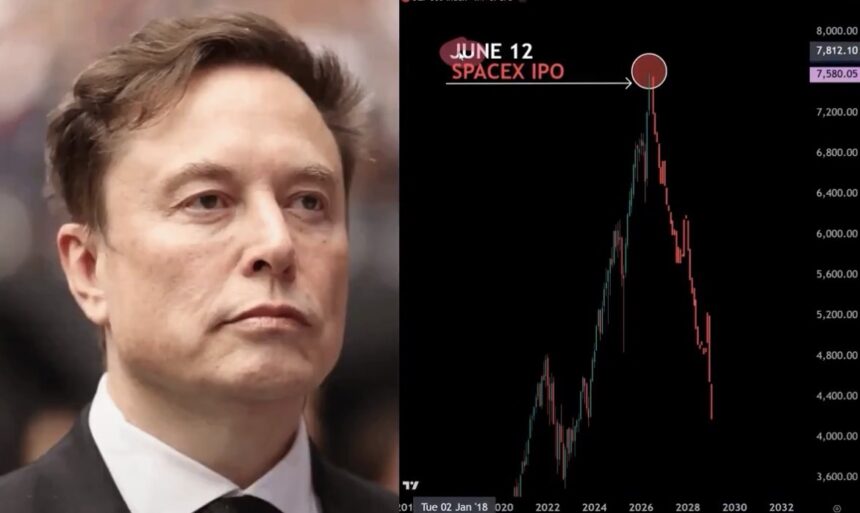
SpaceX IPO returns are finally real numbers you can look at, and depending on when you got in, the gap between those numbers is breathtaking. The largest initial public offering in history priced at $135 per share on June 11, 2026, opened on the Nasdaq at $150 the following morning, and closed its first day at $160.95. It then ran as high as $225.64 before pulling back to trade around $153 as of June 27. In less than two weeks, Elon Musk became the world’s first trillionaire, a $600 million bet made nearly two decades ago turned into a $50 billion paper windfall, and retail investors who chased the peak are now sitting on a loss. Here is exactly what the SpaceX IPO returns look like, broken down by who you were on June 12, 2026.
A Record That Will Not Be Broken Anytime Soon
The SpaceX IPO raised $86 billion in total when underwriters exercised their overallotment option, easily making it the largest public offering in history. That number dwarfs Saudi Aramco’s 2019 debut, which raised roughly $29.4 billion, by nearly three times. At the $135 offering price, SpaceX entered the public markets carrying a $1.77 trillion valuation. By the end of the first trading day, the market cap had crossed $2.1 trillion, positioning the company as the sixth most valuable publicly listed firm in the United States on its debut.
The listing happened on the Nasdaq Global Select Market under the ticker SPCX. But it was not a typical listing in any structural sense. SpaceX negotiated a rule change that allows the company to join the Nasdaq-100 index just 15 trading days after its debut rather than the standard minimum of three months. That index inclusion is set for July 7, 2026. Analysts estimate it will trigger approximately $4.3 billion in automatic buying from passive index-tracking funds, a built-in demand catalyst that requires no improvement in the business itself.
First-Day Returns Depended Entirely on When You Clicked Buy
The single most important variable in first-day SpaceX IPO returns was timing. If you received IPO shares at the $135 offering price, you made 19.2% when the stock closed at $160.95 on June 12. If you bought at the open, which was $150 per share, your first-day return was approximately 7.3%. If you chased the stock as it surged to $192.50 on the second full day of trading, your position is now roughly 20% underwater.
The intraday high of $225.64 hit on June 16 before three consecutive sessions of selling dragged shares back to the mid-$150s. Anyone who bought near that peak is carrying an unrealized loss of around 32%. That kind of swing in less than two weeks is not unusual for a highly anticipated IPO, but the sheer scale of SpaceX makes the dollar amounts involved extreme.
More Read

What made the first-day performance exceptional beyond the price gain was volume. SpaceX traded more than 500 million shares on its debut, approaching Facebook’s record of roughly 580 million shares on its 2012 Nasdaq debut. That level of volume reflects something deeper than professional trading desks; it signals millions of individual investors participating in real time, which brings up the next detail that made this IPO structurally different from anything that came before it.
How Retail Investors Actually Got Access
Roughly 30% of SpaceX’s IPO shares were reportedly earmarked for retail investors, a dramatically higher allocation than the single-digit percentages typical in large public offerings. Shares were distributed through Charles Schwab, Fidelity, Robinhood, SoFi, and E*TRADE, which meant any adult with a standard brokerage account could request shares at the $135 price rather than paying the market premium that shows up after institutional buyers have already cleared out the supply.
That structure shifted who actually captured the first-day gain. In a conventional large IPO, institutions get most of the offering-price shares and retail investors absorb the day-one premium when they buy in the open market. The difference between the offer price and the opening price is effectively a wealth transfer from individuals to funds. SpaceX flipped a meaningful chunk of that dynamic. A retail investor who secured an allocation at $135 and held through June 12’s close made the same 19% as the institutional buyer sitting beside them at the same price.
More Read

Those who still hold that $135 position are currently up about 13.5% in two weeks, with the Nasdaq-100 inclusion catalyst still ahead. Whether that turns out to be a smart trade depends on what happens between now and August 6, when the company reports its first earnings as a public company.
What the Venture Capital World Actually Walked Away With
For investors who got in years before the IPO, SpaceX IPO returns belong in an entirely different conversation. Founders Fund, the Peter Thiel-backed firm that first put $20 million into SpaceX in 2008 and followed up across multiple rounds for a total of roughly $600 million, holds approximately a 3% stake. At the $135 IPO price, that position is worth more than $50 billion. That is a return of somewhere between 80 and 100 times the invested capital, ranking among the greatest single venture bets in recorded history.
Valor Equity Partners holds a position that makes even Founders Fund’s outcome look modest in dollar terms. Valor, run by Antonio Gracias who is a longtime confidant of Musk, invested between $400 million and $500 million from SpaceX’s early years through 2021. At the first-day closing price, Valor’s stake was valued at approximately $81 billion, a figure that exceeds the firm’s total assets under management as reported before the IPO.
Sequoia Capital, which first backed SpaceX in 2019 and invested roughly $2 billion across several rounds, holds approximately 1.5% of the company, now worth more than $20 billion. That is a return of more than 10x on invested capital. Andreessen Horowitz led a $750 million funding round in January 2023 when SpaceX was valued at $137 billion and holds a position worth more than $10 billion at the IPO price, which the firm called the largest exit in its history. For a fund that made early bets on Airbnb, Facebook, and Coinbase, that ranking says everything.
Fidelity Investments ran perhaps the most patient institutional play of all. The Boston-based firm began buying SpaceX shares in 2015 when the company was valued at roughly $10 billion and participated in 27 rounds over more than a decade. By March 2026, SpaceX represented 4.7% of the $177 billion Fidelity Contrafund. The appreciation from a $10 billion to a $1.77 trillion valuation means Fidelity’s early position grew more than 100 times in paper value over roughly 11 years.
The Business Behind the Valuation
One persistent source of friction in discussions of SpaceX IPO returns is that SpaceX is not yet profitable under standard accounting rules. The company posted a GAAP net loss of nearly $5 billion in 2025 while generating $18.67 billion in total revenue. Its Connectivity segment, which runs Starlink’s satellite broadband network, is the only division currently generating operating profit. Starlink brought in approximately $11.4 billion in revenue in 2025, up 50% from 2024, and now serves more than 10.3 million active subscribers across 160 countries.
More Read

The Space segment, which covers Falcon rocket launches and related services, is carrying significant operating losses due to heavy Starship development spending. The AI segment, which encompasses xAI after the February 2026 merger between SpaceX and xAI, generated $7.7 billion in capital expenditures in just the first quarter of 2026, driven by orbital data center infrastructure buildout and AI model training capacity.
That spending profile means investors buying SPCX today are simultaneously making three distinct bets: that Starlink grows from 10.3 million to a projected 17 million subscribers by end of 2026, that Starship eventually generates launch economics that justify its development cost, and that SpaceXAI finds paying institutional clients for orbital computing power delivered from space. None of those outcomes are guaranteed. The company also disclosed in its IPO filings a $530 million accrual for litigation losses tied to Grok AI-related lawsuits, adding another variable to the financial picture.
What Analysts Actually Think of SPCX Right Now
The spread of analyst opinions on SPCX tells the story of how divided Wall Street is on the company’s prospects. CFRA initiated coverage at the time of the IPO with a sell rating and a $115 price target, citing the gap between the company’s current financials and its valuation multiples. Morningstar pegged fair value at $63 per share, which would represent roughly 59% downside from current levels. The firm argued that SpaceX’s valuation implies investors must wait decades for earnings to grow into the current stock price.
On the other side, NewStreet Research initiated with a $165 price target, arguing that SpaceX holds at least a ten-year competitive lead in launch capacity, controls roughly 90 to 95% of orbital launch volume, and deserves to be evaluated on a 20 to 25-year investment horizon rather than traditional near-term multiples. The average 12-month consensus price target currently sits around $187, which would represent a 22% gain from current levels.
Former Nasdaq CEO Robert Greifeld observed publicly that SPCX is trading not on fundamentals but on the aspiration of what is possible, and added that the window is now open for OpenAI and Anthropic to follow SpaceX to the public markets. That framing captures what is driving SPCX pricing: not cash flow modeling, but confidence in where a category-defining company can be in 2035 or 2040.
The Variable Every Investor Needs to Watch
Near-term catalysts will define whether SPCX trades toward the bull case or the bear case. The Nasdaq-100 inclusion on July 7 brings forced passive buying regardless of conviction. The August 6 earnings report will be the first time management addresses public market analysts with forward guidance, and any miss or cautious commentary will likely move the stock sharply. Elon Musk has already posted publicly that SpaceX might reach roughly $1 trillion in annual revenue by 2030 and that he would be surprised if revenue is not above that level by 2031, statements that are now part of the public record and will be measured against actual results.
The more important long-term variable is the lockup schedule. Most pre-IPO investors are bound by a 180-day restriction on selling, though some may be eligible to sell portions earlier following SpaceX’s quarterly earnings announcements. If the stock is still trading above $135 when those windows open, the market will face meaningful additional supply from investors sitting on returns of 10x to 100x who have every financial incentive to take some money off the table. The way SPCX handles that wave of insider supply will say more about its long-term trading stability than any single news event between now and then.
For retail investors holding shares at $135, the current picture is a 13.5% gain in two weeks with structural tailwinds from passive fund buying still ahead. For anyone who bought above $190, the analysis is different. And for the institutional investors who got in between 2008 and 2019, the numbers already written down in their books are the kind that get cited as case studies for the next twenty years.