

“They can change voter registration and your vote. We know it’s possible. There’s not a question.”
In a direct and urgent statement, U.S. Department of Homeland Security (DHS) Secretary Markwayne Mullin highlighted serious security vulnerabilities in America’s voting systems, warning that foreign adversaries hold critical components and could potentially manipulate voter registrations and ballots.1
B4JrZ“LARGE” a0NG1“LARGE”
Mullin’s Stark Warning on Voting Machine Security
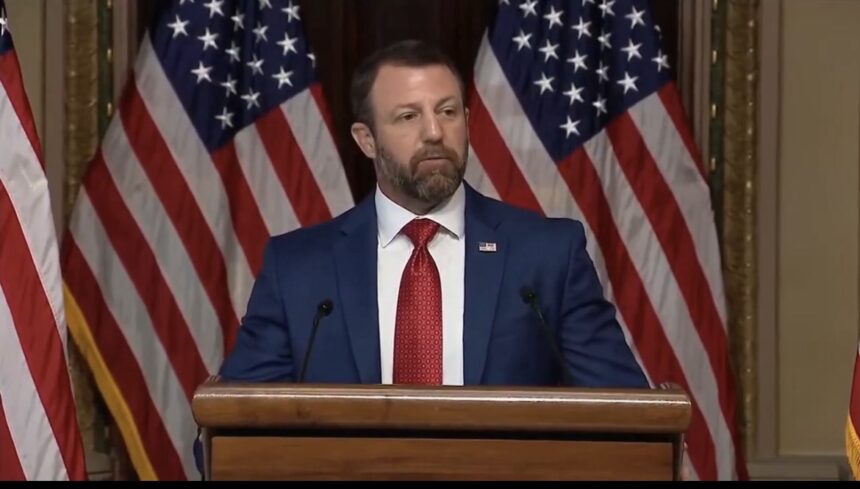
Speaking at a podium with American flags in the background, Secretary Mullin stated:
“Foreign adversaries have parts that are vital pieces in our voting machines. We know that they can access what they consider the key to the back of these machines. We know that they can change voter registration and your vote. We know it’s possible. There’s not a question. It’s not even up for debate. And what we are saying is that every state should partner with us to work to secure this.”
The remarks emphasize that these risks are acknowledged and require immediate attention.
More Read

Context: Heightened Focus on Election Integrity Ahead of 2026 Midterms
Mullin’s comments align with DHS actions announced the same day. Following President Donald Trump’s address on election security, the Secretary sent letters to election officials in California, New Jersey, Nevada, and Pennsylvania, requesting reviews of voter rolls for potential non-citizen registrations. DHS cited preliminary data identifying more than 250,000 possible cases across those states.1
States were asked to respond within two weeks and confirm collaboration with DHS on election security.
Broader initiatives include:
More Read

- Linking certain FEMA preparedness grants to measures such as expanded paper ballots, post-election manual audits (at least 5% of ballots), and citizenship verification via the SAVE database.
- Executive efforts to strengthen voter eligibility checks.
- Treating election infrastructure as critical national security infrastructure vulnerable to foreign interference, insider threats, and cyberattacks.4
Yrkyo“LARGE”
Why Voting Machines Remain a Concern
Many U.S. voting systems use outdated software and have known vulnerabilities, including potential supply-chain risks and connectivity issues. A June 2026 intelligence report highlighted these gaps while noting no evidence of large-scale vote manipulation in prior elections.2
Mullin’s focus is on preventing future risks through proactive federal-state partnerships.
Next Steps for Election Security
Expect updates as states reply to DHS outreach, new grant requirements take effect, and officials continue addressing threats to voting systems.
Secretary Mullin’s statement reinforces a key priority for the administration: safeguarding the integrity of U.S. elections through collaboration and strengthened safeguards.
This issue will remain central as the nation prepares for the 2026 midterms.