

A federal judge has issued a sweeping ruling that blocks key Trump administration policies aimed at pausing asylum grants, green cards, work permits, and other benefits for immigrants from 39 countries. The decision, handed down on June 5, 2026, has sparked fresh debate over executive power, national security, and immigration enforcement.
Background on the Challenged Policies
The Trump administration rolled out the measures in late 2025 and early 2026. They followed a shooting incident involving an Afghan national. Officials cited national security concerns and directed U.S. Citizenship and Immigration Services (USCIS) to:
- Impose a global hold on asylum applications
- Pause decisions on applications from nationals of 39 countries, many in Africa, the Middle East, Asia, and Latin America
- Review previously approved cases from the Biden era
- Treat certain nationalities as a negative factor in decisions
These steps effectively placed hundreds of thousands of applicants in legal limbo. They halted progress on green cards, work authorization, and citizenship pathways.
The Court’s 135-Page Opinion
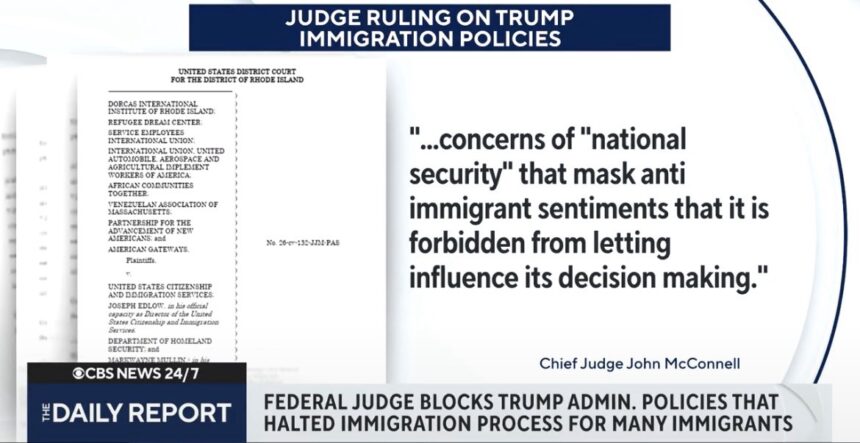
Chief Judge John J. McConnell Jr. of the U.S. District Court in Rhode Island delivered a detailed 135-page opinion. He found the policies arbitrary and capricious under the Administrative Procedure Act. The judge ruled that USCIS lacked statutory authority for the broad pauses and failed to provide reasoned explanations.
McConnell wrote that the actions “placed the lives of countless individuals on hold — solely by virtue of their countries of birth.” He criticized the use of national security claims as a pretext that masked anti-immigrant sentiments. The ruling vacates the four main policies nationwide.
More Read

The case, brought by immigrant advocacy groups including Dorcas International Institute of Rhode Island, argued the measures violated immigration laws and discriminated based on nationality.
Reactions and Next Steps
Immigration advocates welcomed the decision. They called it a restoration of lawful pathways and a rebuke to overly broad restrictions.
The Trump administration and its allies condemned the ruling as judicial overreach. They described it as political sabotage by an activist judge. Officials plan to appeal, likely to the First Circuit and potentially the Supreme Court.
More Read

Legal experts note that similar Trump-era immigration policies have faced court challenges before, with mixed outcomes. The travel ban itself remains in place; this ruling targets only domestic USCIS processing of benefits.
What Happens Now for Applicants
USCIS must resume processing affected cases. However, significant backlogs already exist, and staffing shortages could slow progress. Applicants from the listed countries should monitor official USCIS updates, as implementation will take time.
This case highlights ongoing tensions in U.S. immigration policy. It pits executive authority against judicial review in a system that processes millions of applications each year. Whether the ruling stands could shape how future administrations handle security vetting and benefit adjudications.