

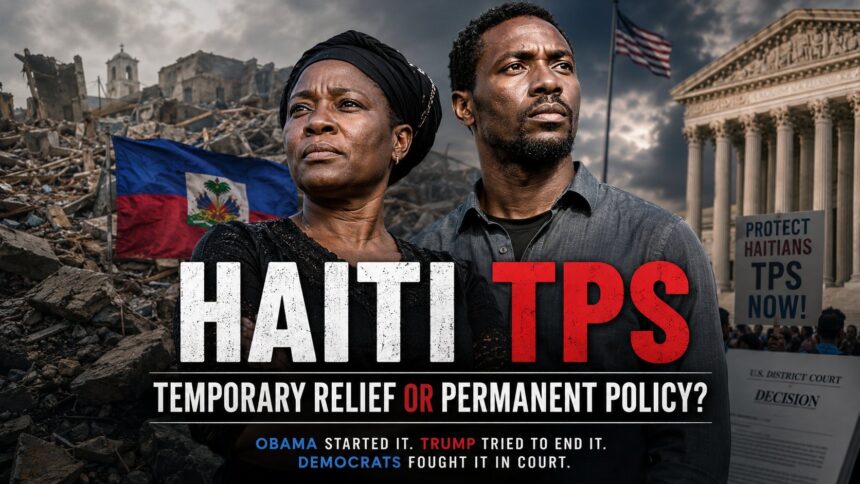
The TPS deportation ruling handed down by the US Supreme Court on June 25, 2026 has stripped hundreds of thousands of immigrants of their last legal shield against removal, in one of the most consequential immigration decisions of the past decade. In a 6-3 vote along ideological lines, the Court ruled that federal courts have no power to review or pause the government’s decision to terminate Temporary Protected Status.
The case, formally known as Mullin v. Doe, clears the way for the Trump administration to begin deporting approximately 356,000 Haitian and Syrian nationals who had been living and working legally in the United States, in some cases for years.
Here is what the ruling means, who it affects, and what options remain.
What the TPS Deportation Ruling Actually Said
The central question before the Court was whether people from Haiti and Syria, whose TPS had been terminated by the Trump administration, could go to court to pause or challenge those terminations while their cases moved through the legal system.
Justice Samuel Alito, writing for the conservative majority, held that the TPS statute “plainly bars” judicial review of the administration’s decision to terminate the status. In other words, the Secretary of Homeland Security has sole, unreviewable authority to decide whether conditions in a designated country have improved enough to end TPS protections. Courts cannot step in.
More Read

The majority also declined to engage with evidence that the terminations were racially motivated, accepting any race-neutral rationale offered by the government as legally sufficient to uphold the decision.
With that ruling, lower court orders that had temporarily paused the end of TPS for Haiti and Syria were immediately lifted. The legal obstacle that had prevented deportations was removed. The administration can now proceed with removals without further judicial interference.
What Is TPS and Who Qualifies?
Temporary Protected Status is a humanitarian program created by Congress in 1990. It allows the Secretary of Homeland Security to grant temporary protection from deportation, along with work authorization, to people already in the United States whose home countries are unsafe to return to because of war, natural disasters, or other extraordinary conditions.
More Read

TPS designations last between six and 18 months and can be renewed. Beneficiaries undergo background checks and must meet eligibility requirements to qualify. The program has historically enjoyed bipartisan support. Every president, Republican and Democrat, has used and extended TPS for various countries since 1990. Trump is the first president to actively work to end it on a large scale.
Haiti was first designated for TPS in 2010 following a devastating earthquake. Syria was designated after the civil war that erupted in 2011 and caused more than 500,000 deaths and the displacement of millions of people.
Who the TPS Deportation Ruling Immediately Affects
The most direct impact of the TPS deportation ruling falls on approximately 350,000 Haitian nationals and about 6,000 Syrian nationals who held legal status under the program before the June 25 ruling. According to legal advocates, the decision converts them from legal residents into undocumented immigrants who are now subject to deportation.
Many of these individuals have built their lives in the United States over years or decades. They hold jobs, pay taxes, raise US-born children, and are integrated into communities across the country.
“These are people who have been building their lives here for over a quarter century, and there is no precedent in modern immigration history for revoking status for a population like this,” said Todd Schulte, president of immigration advocacy organization FWD.us.
What Legal Options Remain for TPS Holders After the Ruling
The options remaining for affected TPS holders are extremely limited, and most of the traditional pathways have also been restricted by the current administration.
More Read

There is no direct TPS-to-green-card pathway under existing law. Asylum is generally only available to people who apply within one year of arriving in the United States, which rules out most long-term TPS holders. Marriage to a US citizen remains a potential option for some individuals, but the administration has also slowed or used immigration benefit applications as opportunities for arrests and deportations.
DHS had also paused processing of all immigration applications from countries on its travel ban list for more than six months. Haiti, Syria, Venezuela, and Afghanistan were all on that list. While courts have recently ordered DHS to resume reviewing those paused applications, progress has been slow.
“To the extent that there may be some other pathways, this very same administration has also banned them,” Schulte said.
DHS Secretary Markwayne Mullin said people on the TPS program can or should have applied for other forms of legal status to remain in the US, or should leave the country. Immigration attorneys have widely pushed back on this framing, noting that most TPS holders do not have a qualifying pathway to another status.
Could Other TPS Countries Be Next?
Yes, and that is one of the most significant long-term consequences of the TPS deportation ruling.
The decision does not just affect Haitians and Syrians. It establishes that no TPS termination can be challenged in court, regardless of which country is involved. That gives the Trump administration a clear legal path to terminate TPS for every remaining designated country without fear of judicial review.
As of March 2025, over 270,000 additional people from other countries still held active TPS designations. Those countries include El Salvador, whose nationals have held TPS for nearly 26 years, as well as Venezuela, Ukraine, and several others. Any of those designations can now be terminated by the DHS Secretary with no avenue for affected people to challenge the decision in court.
The authority to decide whether conditions in any designated country have improved enough to end protections now rests entirely with the Secretary of Homeland Security, subject only to the political process, not judicial oversight.
What the Dissenting Justices Said
Justices Sonia Sotomayor, Elena Kagan, and Ketanji Brown Jackson dissented from the ruling.
The dissent challenged the majority’s reading of the TPS statute and its treatment of the humanitarian intent behind the program. The dissenting justices argued that Congress created TPS precisely to provide protection for vulnerable populations and that stripping courts of all review authority contradicts both the letter and the spirit of the law.
The American Immigration Lawyers Association called the ruling “deeply alarming” and said it was troubled by the Court’s refusal to preserve protections for individuals with TPS even when the administration had failed to follow proper procedures in ending the program.
The National Immigration Forum called on Congress to act and provide permanent legal status to TPS holders, warning that the imminent termination of TPS for Haiti alone will disrupt thousands of lives, harm communities that have integrated TPS holders, and remove essential workers from sectors of the American economy that rely on their contributions.
For now, with the courts closed as an avenue of challenge, congressional action is the only remaining institutional check on further TPS terminations.
If you currently hold TPS and are concerned about your status, consult a licensed immigration attorney immediately to understand your individual options before your work authorization expires.