

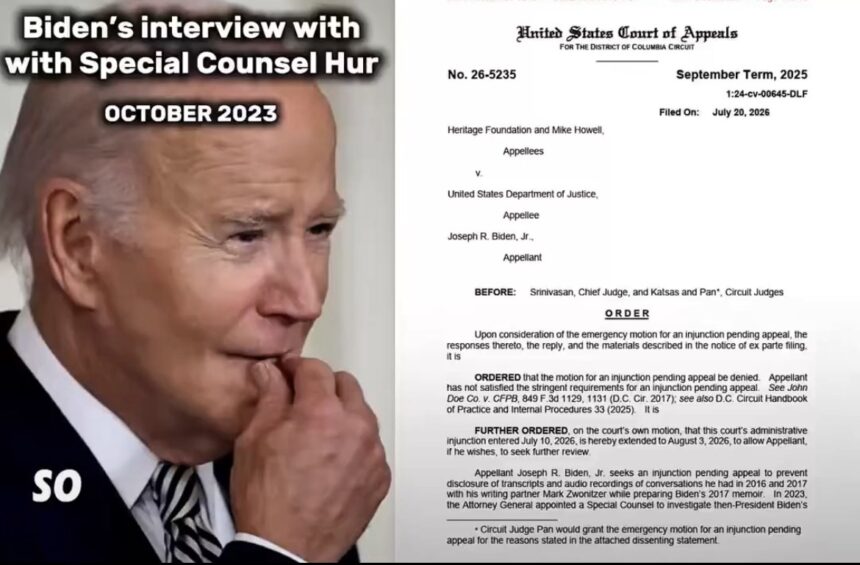
Washington, D.C. — In a significant development for government transparency, the U.S. Court of Appeals for the D.C. Circuit has advanced proceedings that could lead to the public release of extensive audio recordings featuring former President Joe Biden. The materials, central to Special Counsel Robert Hur’s classified documents investigation, have been the subject of a prolonged legal battle.
Background on the Biden Audio Recordings Dispute
The recordings in question stem from approximately 70 hours of conversations between Biden and his memoir ghostwriter Mark Zwonitzer in 2016 and 2017 while preparing Promise Me, Dad. Federal investigators recovered the files during Hur’s probe into Biden’s handling of classified materials after leaving office as vice president.
Although transcripts from Biden’s direct five-hour interviews with Special Counsel Hur were released earlier, and select audio clips surfaced in 2025, the ghostwriter tapes have remained at the center of ongoing Freedom of Information Act (FOIA) litigation. Conservatives and transparency advocates argue the full audio provides critical context into Biden’s cognitive state and interactions involving sensitive information.
Lower Court Ruling Opens Door to Disclosure
In June 2026, U.S. District Judge Dabney Friedrich (a Trump appointee) rejected Biden’s attempt to permanently block the release to the Heritage Foundation. Friedrich determined that the public interest in understanding the basis for Hur’s decisions outweighed the former president’s privacy claims.
Key points from the district court decision:
More Read

- Extensive DOJ redactions removed references to family members and sensitive personal topics.
- The materials primarily cover foreign policy discussions and Biden’s decision not to run for president in 2016.
- Public access to such records serves democratic accountability, especially regarding a high-profile special counsel investigation.
D.C. Circuit Issues Temporary Pause for Appeal Review
Biden’s legal team immediately appealed and sought an emergency injunction. On July 10, 2026, the D.C. Circuit issued an administrative stay, temporarily halting any release until 11:59 p.m. on July 20, 2026. This order allows the three-judge panel time to evaluate whether a longer injunction pending full appeal is warranted.
The panel includes judges appointed across administrations: Chief Judge Sri Srinivasan (Obama), Judge Gregory Katsas (Trump), and Judge Florence Y. Pan (Biden). The court emphasized the pause was procedural and not a decision on the underlying merits.
What This Means for Public Access and Future Implications
With the administrative pause now expired, attention turns to whether the appeals court will fully deny Biden’s request or allow the lower court’s pro-disclosure ruling to stand. If released, the redacted audio could reignite debates over executive privilege, former presidents’ privacy rights, and FOIA’s role in high-stakes political investigations.
More Read
Related Searches:
- Biden Hur interview audio release 2026
- D.C. Circuit ghostwriter tapes ruling
- Mark Zwonitzer recordings Heritage Foundation
- Special Counsel Hur classified documents probe updates
This case highlights the tension between privacy protections for public figures and the public’s right to information about official investigations. As proceedings continue, further updates from the D.C. Circuit are expected soon. Watch for developments that could make these historic recordings available in the public domain.
This article is based on court documents and reporting from multiple sources as of July 21, 2026.