

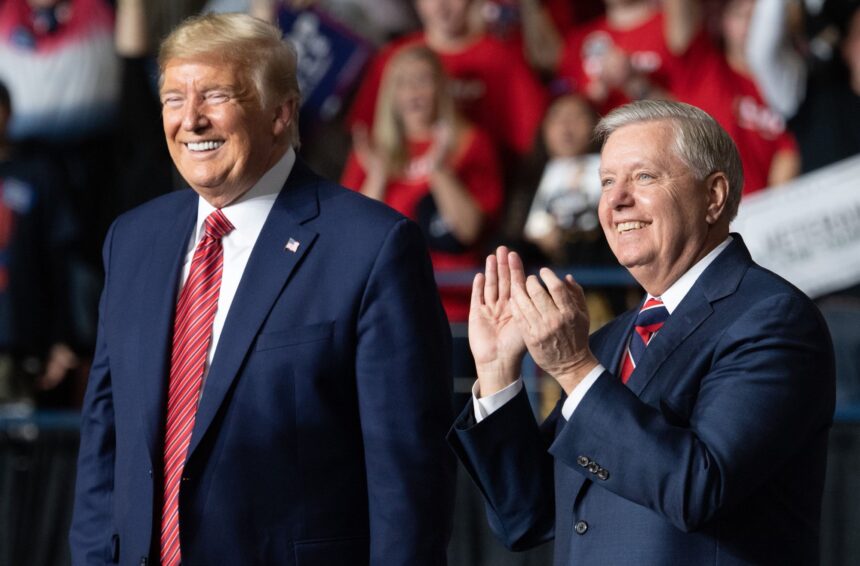
U.S. Senator Lindsey Graham (R-South Carolina) has died at the age of 71 following a brief and sudden illness. The longtime senator, known for his hawkish foreign policy views and close alliance with President Donald Trump in recent years, passed away on July 11, 2026.
President Trump led tributes with a heartfelt statement posted on Truth Social, calling Graham “one of the greatest people and Senators I have ever known” and a “true American Patriot.”
President Donald Trump’s Tribute to Lindsey Graham
In his post, Trump wrote:
“Senator Lindsey Graham, one of the greatest people and Senators I have ever known, is dead!
He was always working, and was a true American Patriot. Lindsey will be greatly missed!!!
DETAILS AND ARRANGEMENTS TO FOLLOW. So sad!”
Trump’s message quickly spread across social media, including a post by Mario Nawfal that paired the tribute with context from Graham’s final major televised interview.
Details of Lindsey Graham’s Death
Graham died after suffering a cardiac arrest at his Capitol Hill home in Washington, D.C. He had recently returned from a trip to Ukraine, where he met with President Volodymyr Zelenskyy. His office confirmed the death followed a brief and sudden illness.
More Read

Funeral arrangements and further details are expected to be announced in the coming days.
Lindsey Graham’s Political Career and Legacy
Lindsey Olin Graham represented South Carolina in the U.S. Senate since 2003. Before that, he served in the House of Representatives (1995–2003) and the South Carolina House of Representatives (1993–1995). A Republican, he was known as a strong advocate for national defense, a staunch supporter of Israel, and a key figure in foreign policy debates.
Graham maintained a high-profile role on issues ranging from military spending and veterans’ affairs to Middle East strategy. He was a close friend and colleague of the late Senator John McCain and later became one of President Trump’s most vocal allies on Capitol Hill.
More Read

Lindsey Graham’s Final Major Interview: A Roadmap for the Middle East?
Just weeks before his death, on June 21, 2026, Graham appeared on CBS News’ Face the Nation with Margaret Brennan. In what would become his last major televised interview, he outlined what he believed would happen in the Middle East if diplomacy with Iran failed.
Key excerpts from the interview include:
“If this deal fails, President Trump is going to take the Strait of Hormuz over by force. The United States will control the Strait of Hormuz. We’ll charge a fee for all those who go through to pay for the operation, and we’re going to expand the Abraham Accords in calendar year 2026. We’re going to get Saudi Arabia to join the Abraham Accords… And if Iran contests control of the Strait of Hormuz by the United States, we will obliterate them.”
Graham further elaborated on the strategy:
“We’re going to try to get Saudi Arabia to join the Abraham Accords to end the Arab-Israeli conflict in 2026, and if Iran continues to attack Israel and Lebanon, the new policy will be, we’ll hit Iran.”
He framed potential U.S. control of the critical oil chokepoint as a way to fund operations while pressuring Iran.
Strategic Importance of the Strait of Hormuz
The Strait of Hormuz is one of the world’s most vital shipping lanes, through which roughly 20% of global oil trade passes. Graham’s comments highlighted a potential hardline U.S. approach to securing energy routes and containing Iranian influence.
His predictions also emphasized expanding the Abraham Accords the historic normalization agreements between Israel and several Arab nations with Saudi Arabia as the next major player.
More Read

Reactions to Lindsey Graham’s Passing
Political figures across party lines are expected to pay tribute in the coming days. On social media, reactions ranged from condolences honoring his decades of service to partisan commentary. Many noted his tireless work ethic and consistent presence on national security issues.
Graham’s death comes at a pivotal time for U.S. foreign policy, particularly regarding Iran, Israel, and broader Middle East stability.
What Comes Next?
With Graham’s passing, the Senate loses one of its most experienced voices on defense and international affairs. His final public comments on Face the Nation now read, in hindsight, as a potential blueprint for the Trump administration’s approach should diplomatic efforts with Iran falter.
Details on memorial services and succession for his Senate seat will be closely watched in the coming weeks.
Senator Lindsey Graham’s death marks the end of a significant chapter in American politics. His influence on foreign policy debates and the roadmap he laid out in his final interview will likely continue to shape discussions about U.S. strategy in the Middle East for years to come.