

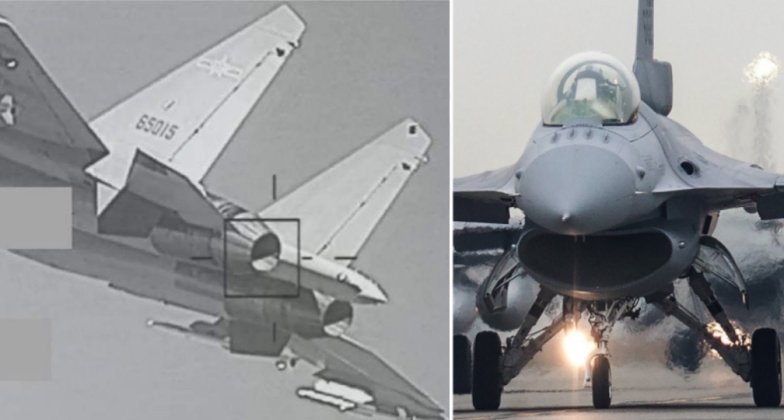
Taipei — In a calculated display of vigilance, Taiwan’s Ministry of National Defense made public some striking surveillance images this week. They showed one of the island’s upgraded F-16V fighters quietly tracking a Chinese J-16 combat jet over the Taiwan Strait using an advanced American-made targeting pod. The pictures, released on the evening of May 19, captured details so clear that the serial number on the Chinese aircraft’s tail stood out plainly.
This was not some random snapshot from a routine patrol. It came during what the People’s Liberation Army described as a “joint combat readiness patrol” involving 22 fighter jets and naval vessels pushing into Taiwan’s air defense identification zone. Taiwan’s response felt measured yet pointed. By sharing the imagery, officials sent a message without firing a shot or raising voices: we see you, and we can see you better than you might think.
The Star Technology: Taiwan’s Passive Sniper Pod
The star of the show was the AN/AAQ-33 Sniper Advanced Targeting Pod mounted under the F-16V. Unlike radar systems that broadcast their presence, the Sniper works in a passive infrared and electro-optical mode. It emits nothing. No electronic ping, no radar warning receiver alert for the other side. The Taiwanese pilot could observe, track, and potentially engage without the Chinese crew ever knowing they were in the crosshairs until it was too late.
One image zoomed in on the J-16’s twin engine nozzles, those powerful exhausts glowing in infrared. Another framed the tail section with that unmistakable serial number. Analysts who have studied the releases say the clarity suggests the Taiwanese jet maintained a solid lock from a significant distance. The Taiwan Strait narrows to about 130 kilometers at its tightest point. Some estimates put the Sniper pod’s effective air-to-air range closer to 187 kilometers under good conditions. That gives plenty of breathing room for standoff operations.
More Read

I spoke with a defense researcher in Taipei who follows these encounters closely. He asked not to be named because of the sensitivity around cross-strait military matters. “This is classic ISR work,” he told me, referring to intelligence, surveillance, and reconnaissance. “Taiwan is showing that its F-16V fleet, upgraded with the latest U.S. systems, can gather high-quality data without escalating things into a direct confrontation. The public release adds a layer of deterrence. It tells Beijing that these patrols do not go unnoticed.”
Taiwan’s Long Push to Modernize Its Air Force
Taiwan has been steadily modernizing its air force for years. The F-16V Viper upgrade program turned older Fighting Falcons into formidable machines with AESA radars, better avionics, and pods like the Sniper. The island operates around 140 of these upgraded jets now, a backbone of its defense against a much larger Chinese force. China fields hundreds of J-16s, advanced Flanker derivatives built for multirole missions with long range and heavy weapons loads. But in this particular game of cat and mouse over the strait, technology and geography gave Taiwan an opening.
More Read

Lockheed Martin developed the Sniper pod originally for the U.S. Air Force. It has proven itself in real conflicts, giving pilots the ability to designate targets precisely for laser-guided munitions or simply maintain situational awareness in contested airspace. Taiwan acquired a batch years ago as part of broader arms packages from Washington. The system excels in all-weather, day-and-night operations. In passive mode over the strait, it turns the F-16V into a stealthy observer that can feed data back to command centers or even cue weapons like the AIM-9X Sidewinder missile.
Daily Pressure and the Human Side of Tensions
For ordinary Taiwanese, these patrols feel like a constant background hum of pressure. In cafes in Taipei or markets in Kaohsiung, people talk about it with a mix of resignation and resolve. “We get used to the news,” one shopkeeper told a reporter recently, “but it wears on you.” The government has responded by boosting defense spending, extending conscription, and deepening ties with the United States and other partners. The F-16V upgrades fit squarely into that picture.
This was not the first time Taiwan has shown off Sniper pod footage. Similar releases happened during large-scale Chinese drills in late 2025. What made this one stand out was the sharpness of the images and the timing. Tensions have remained high since President Lai Ching-te took office. Beijing views his administration with deep suspicion, seeing any assertion of Taiwanese identity as a step toward formal independence. Chinese military activity around the island has become almost daily, with jets crossing the median line of the strait on a regular basis.
A Strategy of Quality Over Quantity
The Ministry of National Defense released three images in total. Besides the J-16 close-ups, there were shots of Chinese naval vessels tracked by Taiwanese ships. The accompanying statement struck a calm tone. “The National Armed Forces are committed to maintaining the status quo in the Taiwan Strait,” it said. No chest-thumping, just a quiet affirmation of readiness.
More Read

This approach reflects Taiwan’s broader strategy. It cannot match China’s sheer numbers, so it focuses on quality, asymmetry, and international support. The United States has signaled strong backing, with arms sales continuing and joint training exercises. Japan and Australia have also shown growing interest in the region’s stability. For Beijing, these episodes must feel frustrating. Massive displays of force intended to intimidate end up providing Taiwan with photo opportunities that make headlines worldwide.
Military watchers point out that the J-16 pilot likely operated as part of a larger package that included KJ-500 airborne early warning aircraft. Those planes provide a big-picture radar view for the formation. Even so, the Sniper’s passive nature means no immediate giveaway from the Taiwanese side. “It is possible the Chinese knew a Taiwanese jet was nearby through their own sensors,” one expert noted, “but the lack of emissions from the pod itself denies them precise targeting information or confirmation of hostile intent.”
Looking Back at a Pattern of Incidents
Looking back, incidents like this have become part of a familiar pattern. In October 2024, during Joint Sword drills, Taiwanese F-16Vs used Sniper pods to track J-15 fighters operating from Chinese carriers. Similar footage emerged in December 2025. Each time, the message is the same: Taiwan’s defenses are alert and capable. Yet the frequency of these patrols raises questions about where the threshold for real crisis lies. What happens if a miscalculation occurs at close range?
Defense analysts in Washington and Tokyo have followed the latest release with interest. Some see it as evidence that Taiwan’s investments are paying off. Others worry that repeated Chinese incursions could normalize the idea of gray-zone pressure until something snaps. For now, both sides seem content to probe without crossing into open conflict. The images of that J-16’s tail fin serve as a reminder that the strait remains one of the world’s most watched patches of sky and sea.
Pilots, Training, and the Human Element
Back in the operations rooms at Chiayi Air Base, where many of Taiwan’s F-16Vs are stationed, pilots train for exactly these scenarios. Reports suggest they can scramble in as little as six to fifteen minutes. The Sniper pod is a key part of their toolkit, enhancing not just air-to-air awareness but ground-attack options as well. In a hypothetical larger conflict, that kind of capability could prove decisive in the opening hours.
Of course, no one on either side wants to test that theory. Chinese state media has downplayed the Taiwanese release, calling it propaganda. Official spokespeople in Beijing continue to insist that Taiwan is an internal matter and that military activities are normal exercises of sovereignty. Taiwanese officials, meanwhile, emphasize self-defense and the need for peace through strength.
What This Means for the Future
As the week draws to a close, the images continue to circulate online and in international coverage. They have sparked discussions among aviation enthusiasts and security experts alike. For the average person following the news, they offer a rare glimpse into the high-tech shadow play unfolding daily above the waves. The F-16V and its Sniper pod may not win wars on their own, but they buy Taiwan something invaluable: time, information, and the ability to respond on its own terms.
In the end, this latest episode underscores a simple reality. The Taiwan Strait is not just a geographic feature. It is a stage where deterrence, technology, and political will intersect every single day. Taiwan’s decision to share these pictures was not about bragging. It was about quietly reminding everyone involved that it intends to stay in the game.