

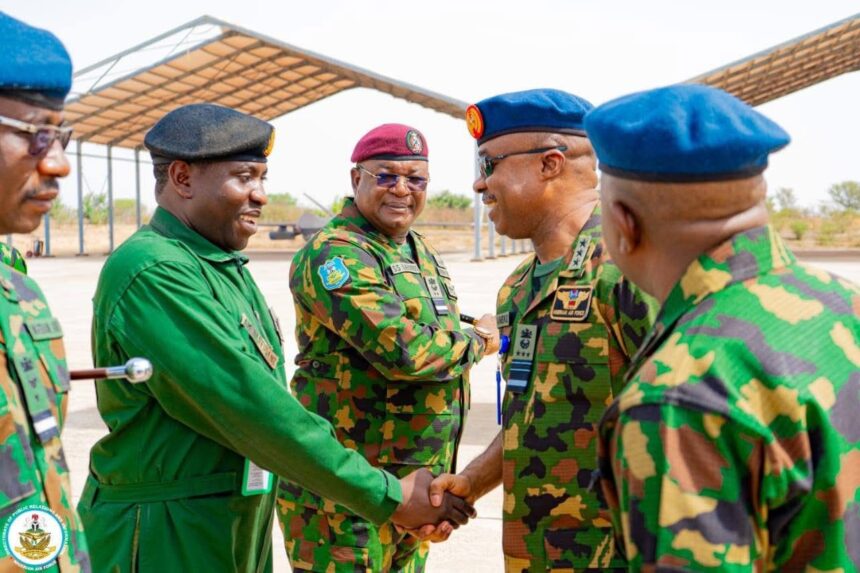
Bauchi, Nigeria — Photographic evidence has emerged confirming the presence of a U.S. Air Force MQ-9 Reaper drone at Bauchi Air Base in northeastern Nigeria as early as April 29, 2026, highlighting deepening military cooperation between the two nations in the fight against Islamist insurgents.
The image, released by the Nigerian Air Force (NAF) as part of coverage from a visit by Chief of the Air Staff Air Marshal Sunday Kelvin Aneke, shows senior Nigerian officers in discussion at the base. In the background, inside an open hangar, a distinctive MQ-9 Reaper unmanned aerial vehicle is clearly visible. The photo, first highlighted by OSINT accounts including @sentdefender on X, predates by more than two weeks the U.S. Africa Command’s (AFRICOM) public announcement of kinetic operations.
The United States began deploying MQ-9 Reapers and approximately 200 troops to Bauchi Airfield earlier in 2026, at the request of the Nigerian government. The mission initially focused on intelligence, surveillance, and reconnaissance (ISR), as well as training and advisory support for Nigerian forces combating groups such as Boko Haram, the Islamic State West Africa Province (ISWAP), and other affiliates. U.S. personnel have operated in a non-combat role, providing real-time intelligence through a joint fusion cell while Nigerian troops lead ground operations.
This deployment followed the U.S. withdrawal from Air Base 201 in Niger in 2024 and represents a strategic repositioning to maintain aerial surveillance capabilities in the Lake Chad Basin region, where militant activity has persisted despite Nigerian military offensives like Operation Hadin Kai.
On May 16–17, 2026, the partnership escalated into direct action. In coordination with Nigerian forces, AFRICOM conducted strikes that killed Abu-Bilal al-Minuki (also referred to as Abu-Mainok), described as ISIS’s global director of operations and a senior ISWAP figure, along with other high-value targets and over 150 fighters. Additional strikes followed on subsequent days. No U.S. or Nigerian personnel were reported harmed.
More Read

President Donald Trump and Nigerian President Bola Tinubu both publicly acknowledged the operation, emphasizing the value of bilateral cooperation. AFRICOM Commander Gen. Dagvin Anderson highlighted how months of intelligence sharing enabled the mission.
The MQ-9 Reaper, capable of long-endurance flights at high altitudes and equipped for both surveillance and precision strikes, has played a key supporting role. While early operations emphasized ISR, the recent kinetic phase demonstrates how the platform’s intelligence has directly contributed to targeting.
This development marks a notable expansion of U.S. engagement in Nigeria’s counter-terrorism efforts amid ongoing regional instability that has displaced millions and claimed thousands of lives. Officials have not specified an end date for the deployment, suggesting it could continue as long as mutual security interests align.