

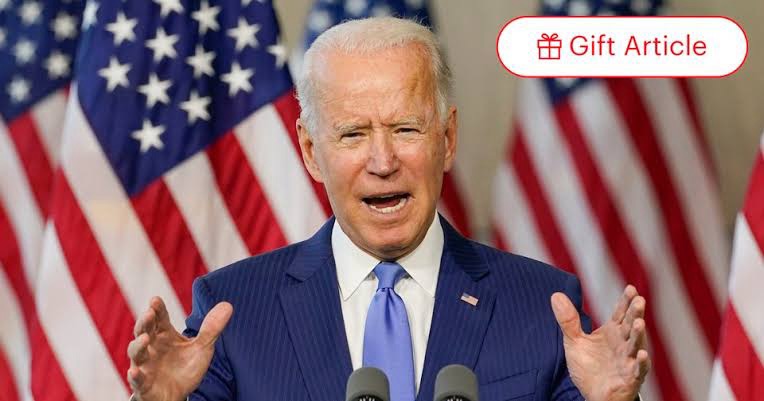
Seven years ago today, Joe Biden stood before a crowd in Nashua, New Hampshire and made a prediction that would define — and eventually haunt — his entire political brand.
“The thing that will fundamentally change with Donald Trump out of the White House — not a joke — is you will see an epiphany occur among many of my Republican friends,” Biden told voters on May 14, 2019. “With Donald Trump out of the way, you’re going to see a number of my Republican colleagues have an epiphany. Mark my words.”
He repeated the line months later at a fundraiser hosted by the law firm Sidley Austin in Washington, D.C. It became a cornerstone of his argument for why the country should elect him president. And now, exactly seven years later, that prediction is being relitigated in real time as a symbol of just how wrong the Democratic Party’s assumptions about the Republican Party turned out to be.
What Biden Was Actually Arguing
Biden’s “epiphany” framing was not a casual throwaway line. It reflected a deeply held theory of the case — one that shaped his entire approach to politics and governance.
As a longtime senator who prided himself on reaching across the aisle, Biden believed the MAGA movement was an aberration, a temporary hijacking of a GOP that was fundamentally still capable of bipartisan cooperation. He argued that Republican lawmakers were not true believers in Trumpism, just politicians too “intimidated” to break with a popular president. Once Trump was gone, Biden believed, the pressure would lift and the old rules of Washington would reassert themselves.
More Read

He won the 2020 Democratic primary on that message. He won the general election on that message.
And then reality arrived.
What Actually Happened
Trump lost in 2020. The epiphany did not come.
More Read

Instead of moving away from Trump after the 2020 defeat, the Republican Party consolidated further around him. The handful of Republicans who did break with Trump — by voting to impeach him, by certifying the 2020 election results, or by speaking critically of his conduct — found themselves primaried out of office, marginalized, or forced into retirement.
Trump then returned to the White House in 2024 with a popular-vote win, something he had never achieved before, and an Electoral College landslide. Rather than an aberration, Trumpism had proven itself to be the GOP’s durable center of gravity.
“The Republican epiphany did not happen,” Democratic pollster Anna Greenberg said flatly in a recent interview.
The reasons, she argued, were there from the start. “In the 2020 election, it’s pretty clear that a big part of the why Trump lost was because of his handling of Covid. It was not necessarily a rejection of Trump or Trumpism.”
Former Senate Democratic leadership aide Adam Jentleson, who criticized Biden’s epiphany rhetoric at the time it was made, put it more bluntly. “There was a sense that Trump was an aberration. Seeing him lose an election and fall out of favor and then reassert his control over the GOP and get re-elected completely shattered any illusion that Republicans of sound conscience were going to rise up and take back their party.”
This Was Not the First Time Democrats Made This Mistake
Biden’s prediction echoed a nearly identical miscalculation made by President Obama in 2012. After winning re-election that year, Obama suggested the Republican “fever” would finally break, and the party would move toward cooperation with his administration.
More Read

It did not. The GOP blocked his Supreme Court nominee Merrick Garland outright and spent the next four years in near-total opposition.
Political observers at the time noted the parallel. Biden’s 2019 epiphany prediction was, as one reporter put it, the Obama “fever” theory in a different coat.
Amanda Litman, co-founder of the progressive group Run for Something, said both predictions represent the same fundamental error. “It’s Trump’s party all the way down. Even when he’s gone, it’s still his ideology driving things forward.” She added that Obama and Biden’s belief in a return to bipartisan compromise is now “falling out of favor” among the Democratic base entirely. “Democratic primary voters are sick of pretending we can revert back to the status quo or that we can take the high road.”
How Democrats Have Responded
The failure of the epiphany theory has not just become a talking point — it has reshaped what Democratic voters are demanding from their candidates and representatives.
An NBC News poll from March 2025 found that 65% of self-identified Democrats wanted their representatives in Congress to stick to their positions even if it meant getting nothing done. Only 32% wanted to compromise with President Trump to reach consensus. That is a complete reversal from April 2017, when a majority of Democrats favored compromise.
Democratic strategist Rebecca Katz, who named her firm Fight Agency after the 2024 GOP sweep, was direct about the stakes. “Every elected official who believes that has either retired, lost or is about to lose.”
The shift is already visible in primary results. In New Jersey, progressive activist Analilia Mejia recently defeated the Democratic Party’s preferred candidate in a House special election, a signal that the base is actively rewarding confrontational candidates over conciliatory ones.
Senator Chris Murphy of Connecticut offered a more nuanced version of where Democrats need to go. He argued the party should fight back aggressively while also offering something to Trump’s voters. “It’s not just about punching MAGA in the mouth. It’s about understanding there’s a lot of his base that actually does believe in things like a higher minimum wage and industrial policy.”
Was the Epiphany Prediction Entirely Wrong?
Biden’s allies argue that the bipartisan strategy was not a complete failure, even if the grand theory behind it was.
During his first two years in office, Biden did secure meaningful legislative victories with Republican Senate votes, including the infrastructure bill, the CHIPS and Science Act, a postal service overhaul, and legislation codifying same-sex marriage protections. Those were real wins that required genuine Republican buy-in.
The counterargument, however, is that those victories were products of a unique and unrepeatable moment: a narrow window when a small number of retiring Republican senators were focused on their legacies rather than their base. Once the 2022 and 2024 cycles came around, that window closed. The bipartisan infrastructure for deal-making that Biden had counted on dissolved, and his legislative record in the second half of his term reflected that.
What Today’s Anniversary Means
The fact that Biden made the epiphany prediction on exactly this date seven years ago is not lost on political commentators. It has turned May 14, 2026 into an unofficial audit of one of the defining assumptions of the post-2016 Democratic Party — the belief that Trumpism was temporary, curable, and ultimately the exception rather than the rule in American conservatism.
The verdict, at least from Democratic strategists, pollsters, and a growing share of the base, is clear: the assumption was wrong, the GOP did not change, and the Democratic Party is now reorganizing itself around that reality.
For ongoing analysis of how both parties are positioning heading into the 2026 midterms, NBC News Politics and The Week have been tracking the strategic shifts in real time.
Key Takeaways
- On May 14, 2019, Biden predicted Republicans would have a political “epiphany” once Trump left office and return to bipartisan cooperation.
- Trump lost in 2020, but the epiphany never came. He returned to the White House in 2024 with a popular vote win and an Electoral College landslide.
- Democratic pollsters and strategists broadly describe the prediction as a significant miscalculation, rooted in a misreading of what Trumpism was.
- Obama made a nearly identical “fever break” prediction in 2012, which also did not materialize.
- Democratic voters have dramatically shifted away from favoring compromise. A 2025 NBC poll found 65% of Democrats want their representatives to hold firm even at the cost of legislative progress.
- The Democratic Party is now moving toward a more confrontational posture, with progressive candidates outperforming establishment picks in key primaries.