


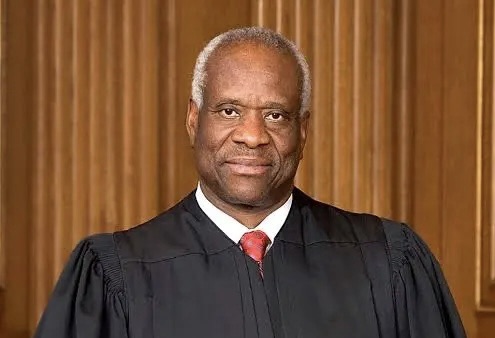
Justice Clarence Thomas walked into a legal conference outside Miami on Thursday and said something that stopped the room. The Supreme Court, he told the gathering of lawyers and judges, has become a fundamentally different place to work since he first joined it in 1991. Not because of caseload or politics, but because of physical safety.
“The security concerns now are much different from the way they were when I first became a circuit justice,” Thomas told the 11th US Circuit Court of Appeals judicial conference in Aventura, Florida. “That’s really one of the big changes since I’ve been on the court. That it’s become very, very dicey.”
He returned to the point multiple times during the interview, conducted by his former clerk Kasdin Mitchell. It was not a prepared speech. It was a candid conversation. And the picture Thomas painted of daily life as a Supreme Court justice in 2026 is one that most Americans have never considered.
What Exactly Did Clarence Thomas Say?
Thomas described a reality in which basic movement outside the courthouse has become a calculated security decision. He said he can no longer move around as freely as he once did, that security concerns now filter every public appearance he makes, and that he has to weigh not just his own risk but the risk his presence creates for everyone around him.
Earlier this year, Thomas had been scheduled to appear in person at an event at American University in Washington. He switched to a remote appearance at the last minute. The reason given was security.
More Read

At the same 11th Circuit conference two years ago, Thomas had used far sharper language, calling Washington a “hideous place.” Thursday’s remarks were milder in tone but more specific in substance. He was not venting. He was describing operational constraints on how a sitting Supreme Court justice can function in public life.
“And as I said, because of the security concerns, I’m not able to move around as much as I used to,” Thomas added during the session.
He also struck a more reflective note, saying the situation illustrated how far the country has traveled in the wrong direction. “We have come a long way in the wrong direction,” he said, describing the security setup at the conference itself as a symbol of that shift, noting he would have preferred to simply sit with the audience rather than be physically separated from them.
More Read

Why Are Supreme Court Justices Facing More Threats Now?
The threat environment around the Supreme Court changed dramatically in 2022. In June of that year, a draft opinion leaked from the court indicating that Roe v. Wade would be overturned. Within days, an armed man was arrested near the home of Justice Brett Kavanaugh. He later told investigators he had planned to kill Kavanaugh. The assassination attempt, the first of its kind targeting a sitting Supreme Court justice in modern history, accelerated every conversation about how the court protects its members.
Since then, the court has sought millions of dollars in additional security funding from Congress, covering both physical protection and a significant increase in cyber threats targeting justices, their families, and court staff. Threats against federal judges broadly have risen sharply over the past several years, a trend that judiciary officials had been warning about long before the 2022 Kavanaugh incident.
Thomas was speaking at a judicial conference organized by the 11th Circuit, a federal appeals court that covers Florida, Georgia, and Alabama. The fact that even at a legal conference, surrounded by lawyers and fellow judges, Thomas felt compelled to comment on the security arrangements around him underscores how deeply the threat environment has changed the day-to-day reality of serving on the nation’s highest court.
Who Is Clarence Thomas in 2026?
The security remarks are the immediate news hook, but Thomas’s appearance at the 11th Circuit conference is also notable for where he stands in Supreme Court history right now.
As of this month, Thomas has become the second-longest serving Supreme Court justice in American history, surpassing Justice Stephen J. Field after more than 34 years on the bench. The only justice with a longer tenure is liberal William O. Douglas. If Thomas remains on the court through 2028, he will claim the top spot outright.
He is 77 years old. There are no signs he is considering retirement.
More Read

When his interviewer Kasdin Mitchell kept bringing up the longevity milestone during Thursday’s session, Thomas deflected it with dry humor, laughing and saying “Thanks for letting me know that. You keep bringing that up.”
His influence extends well beyond his own opinions. Thomas now sits as the most senior member of a six-justice conservative supermajority, a court that has moved sharply in his direction over the past decade. As the most senior justice in any majority that does not include Chief Justice John Roberts, Thomas has the power to assign opinion-writing to whoever he chooses, a behind-the-scenes lever that shapes the ideological weight of rulings. His former clerks are also increasingly filling out the ranks of the federal judiciary, with ten of them having been appointed to federal courts by President Trump.
“The court has radically moved in his direction over the course of his time on the court,” Stanford law professor Pamela Karlan told the Washington Times.
What Is a Circuit Justice and Why Does It Matter?
Thomas specifically referenced his role as a “circuit justice” when describing how security has changed. That term is worth understanding because it is part of what makes his comments about restricted movement particularly significant.
Every Supreme Court justice is assigned as a circuit justice to one or more of the 13 federal circuit courts. The circuit justice role involves handling emergency applications from that circuit, including requests to stay lower court orders while appeals are pending. It also traditionally involved attending judicial conferences like the one Thomas spoke at on Thursday.
Before the modern threat environment, circuit justices regularly traveled to these conferences, sat with their colleagues in the lower courts, and engaged directly with the legal community in their assigned circuits. Thomas’s comment that security concerns are “much different from the way they were when I first became a circuit justice” points to a direct erosion of that tradition. Justices are now more physically isolated from the broader judicial community than at any point in modern history.
What Is the Supreme Court Asking Congress to Fund?
The court’s security funding requests to Congress have become a recurring line item in judicial budget discussions. The court is seeking increased resources to cover:
- Expanded physical security for justices at their homes and at public appearances
- Enhanced cybersecurity measures following a significant rise in digital threats targeting court personnel
- Broader protection for justices’ family members, who do not have the same baseline security coverage as the justices themselves
The funding requests have bipartisan support in principle but have moved slowly through a Congress that has been focused on other budget priorities.
Key Takeaways
- Justice Clarence Thomas told a legal conference in Florida on Thursday that the Supreme Court security environment has become “very, very dicey” since he first joined the court in 1991.
- Thomas said he can no longer move freely in public and must weigh every appearance against the security risk it creates for himself and others around him.
- He switched a planned in-person appearance at American University earlier this year to remote, citing security concerns.
- The threat environment around the court escalated sharply after the 2022 attempted assassination of Justice Brett Kavanaugh, following the leak of the Roe v. Wade draft opinion.
- Thomas is now the second-longest serving justice in Supreme Court history, with more than 34 years on the bench. He would become the longest-serving justice in 2028 if he stays on the court.
- The Supreme Court has been seeking millions of dollars in additional security funding from Congress to address rising physical and cyber threats.