

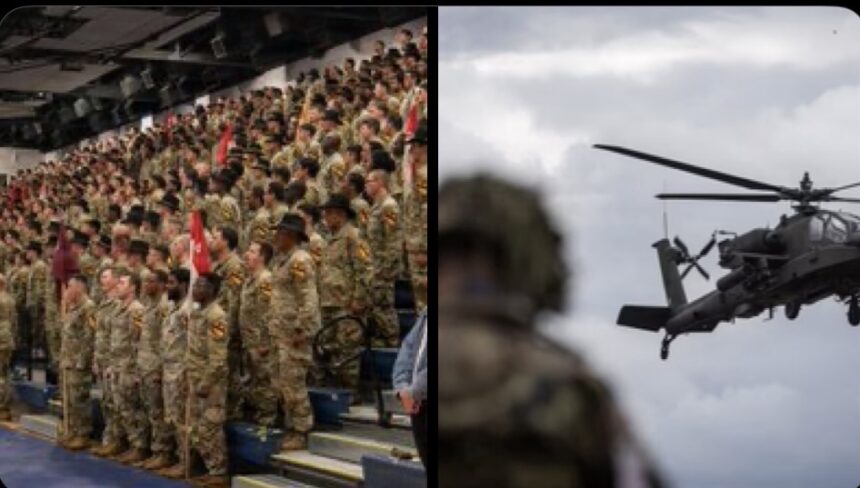
In a move that has blindsided military officials, allied governments, and members of Congress, Defense Secretary Pete Hegseth abruptly canceled the deployment of more than 4,000 US troops to Poland on Thursday. The decision came with no advance notice to key Senate committees, no public explanation from the Pentagon, and with some of the affected soldiers already on the ground in Europe.
Here is a full breakdown of what happened, why it happened, and what it actually means for the roughly 80,000 American troops currently stationed across Europe.
What Did Hegseth Cancel Exactly?
A memo signed by Hegseth halted the scheduled deployment of the 2nd Armored Brigade Combat Team, 1st Cavalry Division, a Fort Hood, Texas-based tank brigade known as the “Black Jack” brigade. The unit had already cased its colors on May 1 in preparation for a nine-month rotation through Poland, the Baltic states, and Romania. Some personnel and equipment had already arrived in Europe when the cancellation order came through.
The same memo also canceled the future deployment to Germany of a battalion specializing in firing long-range rockets and missiles, and directed that a command overseeing those capabilities be removed from the continent entirely.
Pentagon spokesperson Sean Parnell said Hegseth made the decision after reviewing “theater requirements and conditions on the ground.” No further explanation was given.
More Read

How Many US Troops Are in Poland Right Now?
As of May 2026, there are approximately 7,400 US troops permanently stationed in Poland, with additional rotational forces that have historically brought that number higher. The US Army’s V Corps has its forward headquarters in Poznan, Poland.
The canceled deployment would have added roughly 4,700 soldiers from the armored brigade combat team, plus over 500 soldiers from the long-range missile battalion. Combined, that is more than 5,000 troops that will not be arriving as planned.
Before Russia’s invasion of Ukraine in February 2022, US troop levels in Europe sat at around 80,000. The Biden administration surged that number after the invasion began. The current Hegseth-directed drawdown, across Poland and Germany, is explicitly designed to return US forces in Europe to those pre-2022 levels.
More Read

Why Did Hegseth Cancel the Poland Deployment?
The Pentagon has not given a direct public explanation, but the available evidence points to several overlapping motivations.
Trump’s anger at European allies. The broader context for all of the recent European troop moves is President Trump’s frustration with NATO partners, particularly Germany. When German Chancellor Friedrich Merz said publicly that Iran had “humiliated” the US in negotiations, Trump responded furiously and immediately. Defense Department talking points reviewed by CNN tied the troop level changes directly to that frustration, stating that European nations “have not stepped up when America needed them” and that “recent Germany rhetoric has been inappropriate and unhelpful.”
The Germany withdrawal needed to go somewhere. Two weeks before the Poland cancellation, the Pentagon announced it was withdrawing 5,000 troops from Germany. Poland had been widely expected to absorb some of those forces, making it a logical receiving location. Canceling the Poland deployment on top of the Germany withdrawal suggests the troops are not being repositioned within Europe but are instead being pulled back to the United States entirely.
A pattern of unilateral Pentagon decisions. The Poland cancellation is the latest in a series of abrupt military moves Hegseth has made without consulting congressional leadership or NATO allies in advance. Army Secretary Daniel Driscoll and acting Army chief of staff Gen. Christopher LaNeve did not mention the Poland cancellation during their Senate Armed Services Committee testimony just two days earlier, on May 12.
Who Was Surprised by This Decision?
Almost everyone outside the Pentagon’s inner circle.
Democratic Senator Jeanne Shaheen, who sits on the Senate Armed Services Committee, told reporters the cancellation “came as a surprise.” She added: “As far as I know, we weren’t notified about it. It is, I think, very short sighted. It sends the wrong message — wrong message to Vladimir Putin, wrong message to China, wrong message to Iran.”
More Read

Poland’s own defense minister, Wladyslaw Kosiniak-Kamysz, tried to downplay the news publicly, posting on social media that the issue “does not concern Poland — it relates to the previously announced change in the presence of some US Armed Forces in Europe.” That framing was widely read as damage control from a government trying to avoid the appearance of a public rift with Washington.
Army officials who spoke to reporters, on condition of anonymity, described the decision as baffling and said the manner in which the cancellation was handled — with troops and equipment already in place — had angered people within the military chain of command.
What Does This Mean for NATO?
A NATO official acknowledged Thursday that the United States was adjusting its troop presence in Europe, but said the cancellation of the American brigade would not affect the alliance’s deterrence and defense plans, noting that Canada and Germany had already increased forces on NATO’s eastern flank to compensate.
That reassurance has not fully landed with European security analysts, who have been watching the cumulative effect of US troop reductions in Europe with growing alarm.
Gen. Alex Grynkewich, commander of US European Command and the NATO Supreme Allied Commander Europe, told lawmakers in March that Russia “is an enduring regional challenger, capable of threatening the US homeland.” The concern from NATO allies is that pulling back US forces at this moment, while Russia’s war in Ukraine continues, sends a political signal that undermines deterrence even if the military impact is manageable in the short term.
The 2026 Pentagon funding bill adds a legal wrinkle: it states that the US military cannot have fewer than 76,000 troops permanently stationed or deployed to Europe for more than 45 days without providing a series of notifications and certifications to Congress about strategy. The legal threshold and timeline are now being watched closely by Senate Armed Services Committee members.
What Happens to the 4,000 Troops Who Were Headed to Poland?
It remains unclear. Pentagon officials said Thursday that internal planning was “in flux.” One Defense Department official, speaking anonymously, said current thinking assumed a net reduction of 5,000 troops across Poland, Germany, and possibly other European countries, but added that the numbers were not yet final.
What is confirmed is that soldiers from the brigade who were already in Europe now face the logistical chaos of redeploying back to the United States. Their equipment, some of which had already shipped overseas, also needs to be returned. Army officials described the situation as operationally disruptive and said the confusion over the canceled mission had created real problems for soldiers and unit planning.
Trump has separately told reporters that troop cuts in Europe would go “even deeper” than what has been announced so far.
Key Takeaways
- Defense Secretary Pete Hegseth signed a memo canceling the deployment of the 2nd Armored Brigade Combat Team to Poland, affecting roughly 4,700 soldiers, with some personnel already on the ground in Europe when the order came.
- The cancellation also scrapped a long-range missile battalion deployment to Germany and ordered the removal of the command overseeing those capabilities from Europe.
- The Pentagon gave no detailed public explanation. The decision was not disclosed to Senate Armed Services Committee members during testimony two days earlier.
- Current US troop levels in Poland stand at approximately 7,400, with the V Corps forward headquarters based in Poznan.
- The drawdown is designed to return US forces in Europe to pre-2022 levels, reversing the buildup that followed Russia’s invasion of Ukraine.
- NATO says deterrence plans remain intact, with Canada and Germany filling some of the gap, but allied governments and Democratic senators have publicly described the decision as alarming and poorly communicated.