

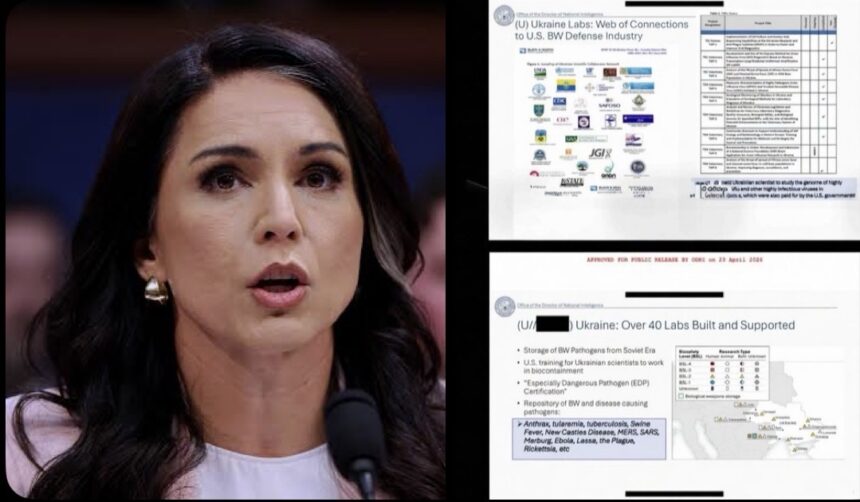
Outgoing Director of National Intelligence Tulsi Gabbard released a set of declassified slides on June 12, 2026, that outline U.S. taxpayer support for more than 120 biological laboratories across more than 30 foreign countries. Roughly one third of those facilities sit in Ukraine, where they handled high-risk pathogens amid an active war zone. The documents come from the Office of the Director of National Intelligence and were approved for public release in April 2026 as part of a broader review ordered under the current administration.
View the full declassified slides here
The release highlights long-standing U.S. involvement through the Department of Defense’s Biological Threat Reduction Program, formerly known as the Cooperative Threat Reduction program. Officials describe the original goal as securing remnants of the Soviet biological weapons program after the Cold War and helping partner countries monitor and contain natural disease outbreaks. Critics now question how far those efforts strayed from basic biosecurity into areas with limited oversight.
Background on U.S. Biolab Programs
The United States began funding upgrades to laboratories in former Soviet states in the 1990s. The aim was to prevent dangerous materials from falling into the wrong hands and to convert old military facilities into civilian health infrastructure. In Ukraine, agreements signed in 2005 expanded this work. U.S. contractors and Ukrainian partners modernized existing sites and built new diagnostic centers.
By the mid-2010s, the program had supported dozens of facilities across the country. Funding covered design, construction, equipment, and training for local scientists. Specific projects included upgrades at sites in Odesa, Kherson, Lviv, and Kyiv. One Kyiv laboratory received roughly $3.5 million in U.S. support. Four labs alone accounted for more than $9 million in documented taxpayer costs.
More Read

The work involved collaboration with U.S. agencies such as the Centers for Disease Control and Prevention, the Department of Agriculture, and international bodies including the World Health Organization. Ukrainian subcontractors handled much of the on-the-ground construction and equipment installation under the lead of American firm Black & Veatch.
Pathogens Documented in the Facilities
The declassified slides list a range of serious biological agents studied or stored at the supported laboratories. These include anthrax, tularemia, tuberculosis, African swine fever, Newcastle disease, MERS, SARS, Marburg virus, Ebola, Lassa fever, plague, and Rickettsia species. Some facilities held especially dangerous pathogen collections dating back to the Soviet era.
U.S. personnel trained Ukrainian scientists in biocontainment procedures and paid for genomic studies of highly pathogenic avian influenza and other viruses inside the upgraded labs. The documents note permits issued by Ukrainian health authorities for work with these agents at various dates between 2010 and 2012, with some approvals listed as still in process on embassy websites at the time.
More Read

Intelligence assessments cited in the release warned that certain Ukrainian labs housed dangerous pathogens and remained vulnerable to seizure, damage, or compromise during conflict. Russian forces advanced near several sites early in the 2022 invasion, prompting U.S. officials at the time to express concern about securing the materials.
Ukraine-Specific Risks and Scale
More than 40 U.S.-supported laboratories operated in Ukraine according to the declassified material. These sites formed a network that included central reference laboratories, veterinary institutes, anti-plague research centers, and regional diagnostic facilities. The total U.S. investment in the Ukrainian portion of the program exceeded $200 million since 2005.
The ongoing war created unique security challenges. Facilities holding live pathogens sat in regions subject to artillery fire, occupation threats, and supply disruptions. The documents acknowledge that Russian accusations of biological weapons activity at some sites referenced basement-level work, though U.S. records frame the projects as defensive threat reduction rather than offensive development.
Gabbard stated that previous administration officials had “lied to the American people about the existence of U.S.-funded and supported biolabs” and had threatened individuals who tried to highlight the programs. She tied the disclosure to President Trump’s executive order directing an end to federal funding for risky gain-of-function research conducted abroad without proper safeguards.
Questions of Oversight and Transparency
The slides describe cases where research on dangerous pathogens proceeded with “virtually no control or supervision.” While the core mission focused on disease surveillance and material security, the scale of the network and the nature of the agents involved have renewed debate over accountability.
Proponents of the programs argue they strengthened global health defenses and reduced the chance of accidental releases from unsecured Soviet-era stocks. They point to the destruction of weaponized anthrax stockpiles and the conversion of former military sites into civilian labs. Opponents and transparency advocates counter that the lack of public visibility created opportunities for mission creep and left taxpayers funding sensitive work without clear metrics for success or risk assessment.
More Read
The release does not present evidence that the laboratories engaged in offensive biological weapons development. Instead, it underscores gaps in documentation and external review, particularly for projects conducted in partner countries during periods of political instability.
A Separate but Related Case in Las Vegas
Around the same period, federal authorities dropped charges against Ori Solomon, a 55-year-old Israeli citizen arrested in connection with an unlicensed biological laboratory operating out of a short-term rental property in Las Vegas. The site contained materials linked to HIV, malaria, and tuberculosis. Solomon faced federal accusations that were later dismissed without prejudice after prosecutors reviewed additional evidence. He continues to face a state-level charge in Clark County related to improper disposal of hazardous waste and remains free to return to Israel.
The Las Vegas incident, though unrelated in scale or official sponsorship to the overseas programs, illustrates broader challenges in regulating private or semi-private work with high-risk biological agents inside the United States. It adds to the conversation about consistent standards for biosafety across both government-funded international efforts and domestic activities.
Implications for Future Policy
Gabbard’s disclosure arrives as the administration reviews all U.S. involvement in foreign biological research. The stated goal includes identifying every location, cataloging contained pathogens, and halting any experiments that could enhance transmissibility or virulence without rigorous controls.
Supporters view the move as long-overdue accountability that restores public confidence in government handling of sensitive science. Skeptics, including some biological weapons experts, argue the documents largely restate information already known to intelligence agencies and risk reviving old disinformation narratives without adding new proof of wrongdoing.
The full list of laboratories and detailed pathogen inventories continues to draw attention. As more details surface, lawmakers and health security specialists will likely press for clearer rules on funding thresholds, independent audits, and real-time reporting of any security incidents at supported sites.
The episode underscores a central tension in modern biosecurity: the need to study dangerous pathogens to prepare for natural outbreaks sits alongside the imperative to prevent those same agents from causing harm through accident, theft, or misuse. How the United States balances those priorities in the years ahead will shape both domestic policy and international partnerships.