

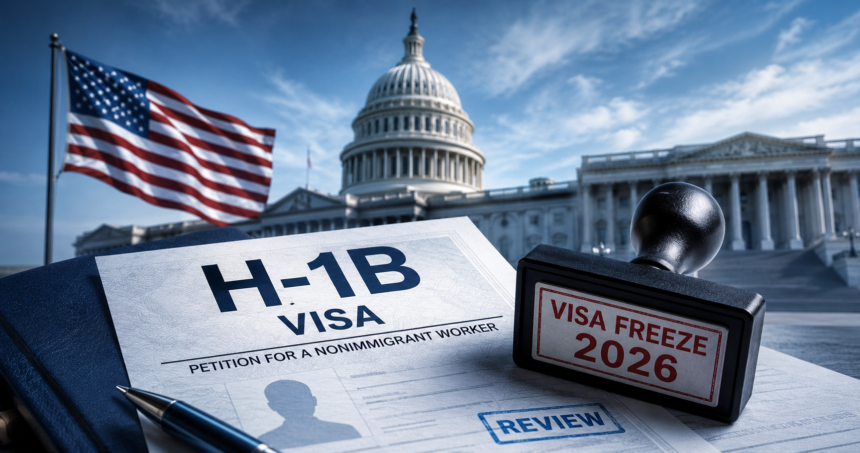
A new bill in Congress wants to pause America’s most-used work visa for three years. Here’s everything you need to know.
A group of Republican lawmakers has introduced one of the most aggressive immigration bills in decades, targeting the H-1B visa program that hundreds of thousands of foreign workers rely on to live and work in the United States. If passed, the End H-1B Visa Abuse Act of 2026 would completely freeze new H-1B visa approvals for three years and reshape the program from the ground up.
For the latest updates on U.S. immigration policy changes, visit our Immigration News section at BrieflyUSA.
Here’s a full breakdown of what the bill proposes, who it affects, and whether it can actually become law.
What Is the End H-1B Visa Abuse Act of 2026?
Representative Eli Crane (R-AZ) introduced the End H-1B Visa Abuse Act of 2026, which would pause the issuance of H-1B visas for three years and implement significant reforms when the program resumes.
A bloc of eight Republican representatives led by Crane introduced the 71-page bill on April 27. It is being described by supporters as the most sweeping attempt to overhaul America’s main skilled-worker visa program in over two decades. You can read the full bill text on the official Congress.gov legislation portal.
More Read

What Does the Bill Actually Propose?
The bill goes far beyond a simple pause. The End H-1B Visa Abuse Act of 2026 would freeze H-1B issuance for three years, slash the annual cap, raise the minimum wage requirement to $200,000, and end the Optional Practical Training (OPT) program, among other sweeping changes affecting workers, students, and employers.
Here is a breakdown of the key provisions:
A 3-Year Complete Halt
The bill would pause issuance of new H-1B visas for three years, cut the annual cap from 65,000 to 25,000, and replace the lottery with a wage-based selection favoring higher-paid roles. The current lottery system has long been criticized for being exploited by outsourcing firms. Learn more about how the USCIS H-1B lottery process works.
More Read

A $200,000 Minimum Salary Floor
Employers seeking H-1B workers would need to certify that no qualified American worker is available and that the company has not conducted recent layoffs. The $200,000 wage floor is designed to prevent companies from using the visa to hire cheaper foreign labor over American workers.
No More H-4 Family Visas
The bill would remove derivative spouse and minor-child eligibility, effectively ending the H-4 dependent visa for spouses and children of H-1B workers. Only the principal worker would be admitted under the H category. This would force thousands of families currently living in the U.S. under H-4 status to explore other visa options.
End of the OPT Pipeline
Optional Practical Training currently allows F-1 students to work in the U.S. for up to 12 months after graduation, with an additional 24-month STEM extension. The bill would prohibit employment authorization for F and M students, as well as certain J exchange visitors, making it harder for employers to recruit U.S.-educated international graduates before pursuing H-1B sponsorship.
No Path to a Green Card
The H-1B-to-green-card pathway would close under the proposed legislation. Workers who have spent years building toward permanent residency through employment-based categories would lose that route entirely. Check the latest USCIS Visa Bulletin to understand where priority dates currently stand.
Federal Agencies Included
The bill also forbids federal agencies from hiring any non-immigrant workers, an unprecedented restriction that would hit research labs and defense contractors.
Who Would Be Most Affected?
The impact would be felt hardest in tech, healthcare, and engineering.
More Read

Business groups immediately warned of talent shortages, especially in technology, healthcare, and engineering, where 70 percent of recent H-1B approvals went to Indian nationals.
Indian professionals, who form one of the largest groups of H-1B visa holders across the technology and healthcare sectors, stand to be significantly affected if the bill advances. The ban on dependent visas would also affect thousands of families who relocated with spouses and children on H-4 visas.
For international students, university career centers worry that eliminating OPT would make U.S. graduate programs less attractive, shrinking an international student cohort that contributes an estimated $40 billion to the economy each year.
This bill is part of a wider crackdown on immigration under the Trump administration. We have covered several related policy shifts in our BrieflyUSA Immigration section, including the travel ban expansions and the suspension of immigrant visa processing for citizens of 75 countries.
What Are Supporters Saying?
Supporters frame the bill as a defense of American workers.
“The federal government should work for hardworking citizens, not the profit margins of massive corporations. We owe it to the American people to prevent the broken H-1B system from boxing them out of jobs they are qualified to perform,” said Rep. Crane.
Supporters argue the current system has been used to replace American workers with lower-cost foreign labor. The Economic Policy Institute has published extensive research on how the H-1B program affects American wages, which is frequently cited in these debates.
What Are Critics Saying?
Opposition to the bill is equally strong.
Critics warn the changes could limit access to global talent, slow innovation, and exacerbate labor shortages, particularly in industries already struggling to recruit domestically.
The tech industry in particular has pushed back hard. Organizations like the National Foundation for American Policy have argued that H-1B workers are critical to U.S. competitiveness and that restrictions of this scale would push companies to hire overseas instead of in America.
Can This Bill Actually Pass?
Probably not in its current form, but it still matters.
As of late April 2026, neither chamber of Congress has voted on the bill. Immigration attorney Ana Gabriela Urizar notes: “While it’s important to understand the scope of this bill, it’s equally important to remember that it is not currently in effect. Many proposed bills change significantly, stall, or fail to advance during the lawmaking process.”
The proposal faces long odds in a split Congress, but it marks a sharp rightward shift in the policy debate and will shape negotiations on a forthcoming omnibus immigration package.
Follow our BrieflyUSA Immigration coverage to stay updated as this bill moves through Congress.
What Should H-1B Workers and Employers Do Right Now?
Workers, students, and employers do not need to take immediate action based on the bill alone. Anyone considering an H-1B filing, an OPT-based career plan, or an adjustment of status application should monitor the bill’s progress and plan with current law in mind, while staying flexible in case any provisions advance.
Employers that rely on the H-1B cap season should accelerate contingency planning, including internal reskilling pipelines and exploring alternative U.S. visa options such as O-1 or L-1 visas.
For official processing times and application status, check USCIS.gov directly. For legal advice specific to your situation, consult a licensed immigration attorney through the American Immigration Lawyers Association directory.
Bottom Line
The End H-1B Visa Abuse Act of 2026 is the most aggressive immigration bill targeting skilled foreign workers that Congress has seen in years. Even if it never passes in full, it signals exactly where U.S. immigration policy is heading under the current administration and is already creating real anxiety among workers, employers, and students who depend on the H-1B system.
Stay informed on this and every other major U.S. immigration development at BrieflyUSA.